Authority Malpractice, Broadway Division [Corrected]

Looking back over the nearly 17,000 posts here, I realize that the ethical issue of authority abuse has come up often, apparently because it drives me crazy. Experts and authorities, alleged, self-proclaimed or otherwise, are supposed to make everyone else better informed and smarter, not more ignorant and stupid. The “experts” that Ethics Alarms has fingered most frequently are pundits, politicians, historians (notably partisan Presidential historians like Jon Meacham, Michael Beschloss, and the late Arthur M. Schlesinger Jr. ) elected officials and baseball writers (with a special place reserved in Baseball Writer Hell for Tom Boswell).

One of the requirements for this sub-category on Ethics Alarms is that I personally know enough about the topic the expert is mangling to detect the authority abuse. Musical theater happens to be one of those topics on which I am qualified to speak and write with some credibility, so I was annoyed yesterday to hear Sirius/XM’s Broadway channel host Seth Rudetsky emit an inexcusable whopper.

Rudetsky is what is called an “industry star,” meaning that the Broadway community knows and appreciates his work though he is largely unknown to anyone outside that community except certifiable American musical nuts. He does have a little empire on Sirius, though, hosting and commenting upon about 50% of the content on the Broadway channel while apparently going out of his way to sound as screamingly gay as possible. (I believe this indulgence damages the popularity, cultural status and prospects of musical theater, but that’s a topic for another day).

Rudetsky styles himself as an “expert on Broadway history and trivia” (as it is phrased on his Wikipedia page), so I was gobsmacked when I heard him say, in his introduction to the “Annie Get Your Gun” duet “Old Fashioned Wedding,” that “there was this thing that Irving Berlin did” in his musicals where two characters would sing different songs and then Irving put the songs together, and they “fit.” Rudetsky recalled the “You’re Just in Love” duet in Berlin’s “Call Me Madam” (above) as an example, and said that “Old Fashioned Wedding” from the revival of “Annie Get Your Gun”was another instance of Berlin’s “thing.”

Continue reading

Stephen Sondheim (1930-2021): Integrity Was Everything

Sondheim2

There’s not too much I can add to the many tributes and essays about Stephen Sondheim, who died yesterday at the age of 91, but I feel I owe him a special salute for his ethics. Ethics is not a common trait in theater, or in show business generally. Sondheim, one could argue (and I will) built his career on ethical values.

The Times has three excellent pieces: a front page obituary, a report on a final interview, and an appreciation by critic Jesse Green. I don’t disagree with any of them, nor do I dispute Sondheim’s importance to musical theater and the culture, which justifies his superstar send-off. None of them come right out and say what I believe to be obvious, if inconvenient: for all his influence, Sondheim represented a fascinating, elitist, dead-end for musical theater, which he was determined to elevate whether it was healthy for the genre or not.

Musical theater arose from humble, populist origins like the British music hall, and it was generally accepted to be a way for ordinary people to have a good time without having to think too much. That model served the genre, and the industry, well until Sondheim’s mentor, Oscar Hammerstein II took off from where only scattered experiments like “Lady in the Dark” and “Pal Joey” had previously ventured to bring serious topics and dilemmas into song while still sending the crowd home humming. Sondheim, once he had freed himself from writing words to established composers’ tunes in “West Side Story” and “Gypsy,” deliberately sought darker, more complex stories to musicalize than even Oscar would dare attempt.

Continue reading

“Porgy And Bess” Ethics

“Porgy and Bess,” the now  iconic opera that premiered in the United States in 1935, tells the tragic and heroic  story of a Southern African-American ghettoemploying  some of the most memorable music in  the musical theater canon. Composer George Gershwin denied licensing rights to  companies that wanted to use white performers in the opera (requiring black make-up)  and his estate still stipulates that the work  be performed by an all-black cast, or rights will be denied.

It will not shock anyone who has read much here to learn that I oppose Gershwin’s all-black edict, just as I oppose objections to actors of any race being prohibited from playing characters of different races. The only question should be whether the production and artistic version is fair to the work and to the audience. Prior restraint of any vision is antithetical to the spirit of the performing arts. I happen to think that a white version of “A Raisin in the Sun” would be ill-advised, but how do I know for sure? I’ve been proven wrong before, and more to the point, I’ve proven others wrong with my own productions.

The inevitable result of Gershwin’s grandstanding, for I believe that’s what it was, is that most people never have a chance to see a full production of “Porgy and Bess.” Yet there is no reason why the cast would have to be all black. Let’s even put aside the inflammatory  issue of “black-face.” Some characters in the show, like the snake-like hustler Sporting Life, could be portrayed as white without distorting the show one bit. Non-traditional casting principles would argue that the whole cast could consist of whites, Asians and others playing the black characters. It would be fun—yes, I think of this kind of principled fight as fun—to cast the show with light skinned African-Americans and mixed race performers who identify as black. What would the Gershwin estate do about that, I wonder? Continue reading

The Admirable Mr. Sondheim

And an ethical hat it is, too!

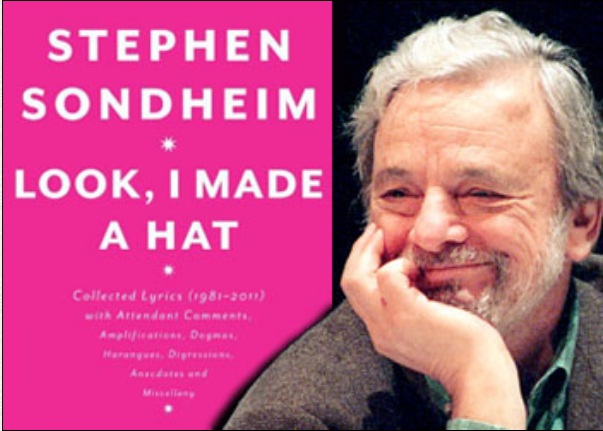
Readers who are not interested in the art of lyric writing and the mechanics of constructing a Broadway musical should probably avoid the second and final installment of Stephen Sondheim’s chronicle of his creative life, “Look, I Made a Hat.”  They will be missing something important nonetheless: a rare example of truly ethical memoirs.

As in his first volume, “Finishing the Hat,” America’s pre-eminent composer-lyricist for the stage reveals himself as a gentleman, an adult, and a thoroughly ethical human being, and does so not by proclaiming his virtues, but by demonstrating them in his writing. He is not uncritical, but always fair and kind. He accepts personal responsibility for projects that failed, and is generous with giving credit for projects that were successful. There is no false modesty in Sondheim about his own skills and achievements, but neither does he seem to overvalue them or seek his reader’s admiration by blowing his own horn.

The line Sondheim walks in both books is fine, and he walks it finely. For example, I initially thought his decision to only criticize the techniques of other lyricists who are dead was a cowardly one, but upon reading both books it is clear that the decision was motivated by kindness. Sondheim takes the craft of lyric-writing very seriously, and his integrity would not allow him to censor a critical observation regarding a colleague’s work when he believed the criticism was illuminating and had merit. Realizing how hurtful a critique from someone of his reputation and accomplishments could be, Sondheim restricted his frank and (mostly)  fair assessments to writers beyond wounding. If Jerry Herman isn’t grateful, he should be. Continue reading