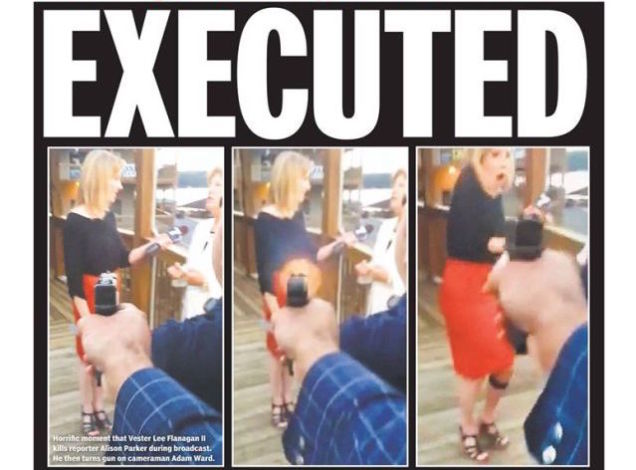
Ethics Verdict: The New York Daily News WDBJ Shooting Front Page Isn’t “Tasteless” or Unethical; It’s Journalism

Virginia shooting

Honestly, I don’t get it. The horrible photos of the exact moment deranged racist Vester Lee Flanagan opened fire on Alison Parker convey what happened in specificity and clarity that no mere verbal description could. If your issue is gun violence, this shows it. If you want to see and understand what tragedy is “up close and personal” and even if you don’t want to understand it, this is how we learn. The furious criticism being focused on the Daily News is traditional Daily News hate, as far as I can determine. That paper has been criticized for having the guts to show raw images for a century now: one of its first outrages was a surreptitious photo of murderess Ruth Snyder being electrocuted:
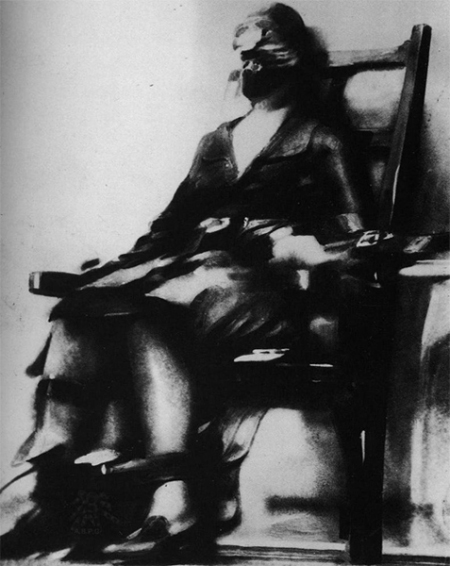
Snyder_chair

Now that photo is history. Today’s front page will be history too.

At the journalism ethics site of the Poynter Institute, Kelly McBride, Poynter’s vice president for academic programs and a media ethicist, argues against using the unedited pictures, saying that “the problem with it is that it a deeply intimate image. It is a moment of someone’s death.”

You mean like….. this?
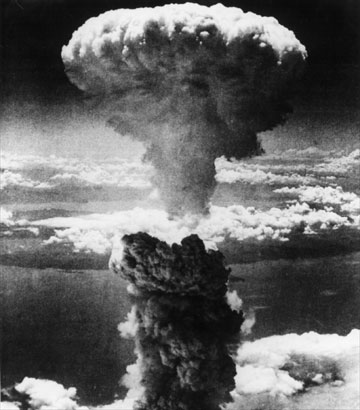
Nagasaki

That’s just thousands of people being incinerated in Nagasaki, but from a distance, so it’s tasteful, is that the idea? Well, what about this award winner… Continue reading

Hiroshima Ethics And The Washington Post’s Misleading “Five Myths” Feature

Atom bomb cloud

The Washington Post’s Sunday “Five Myths About…” feature is a weekly irritation, as it begins with a misleading definition, and proceeds to a series of dubious and sometimes dishonest conclusions. In spirit it is like the fact-checking columns,  (though, ironically, the Post’s less than most) in that it claims to “disprove” opinions. This week’s installment, however, was too much.

Gregg Herken was this week’s guest bloviator, and the Post gave the emeritus professor of U.S. diplomatic history at the University of California a chance to plug his books on the atomic bomb, so I don’t blame him for taking it. I do blame him for allowing the column’s format and the editors to turn what could have been informative and edifying into lazy scholarship, sophistry, and nit-picking. Now I don’t want to read his books.

His entry was called “Five myths about the atomic bomb.” As is typically the case, no myths were debunked. Myths, in the parlance the Post is evoking, are a “traditional stories of ostensibly historical events that serve to unfold part of the world view of a people or explain a practice, belief, or natural phenomenon.” They are, by definition, false. Herken, however, neither identifies nor disproves any true myths. What he does is offer contrary opinions to those of others that are as provable as true as the opinions he claims to be debunking, which is to say, not provable at all. That means that the headline/title states an unprovable assertion as fact: “These statements are untrue.” Herken cannot ethically say that, but he does anyway.

Bad historian. Bad.

Herken starts off well:

“On Aug. 6, 1945, the United States dropped an atomic bomb on the Japanese city of Hiroshima. Another bomb fell Aug. 9 on Nagasaki. Decades later, controversy and misinformation still surround the decision to use nuclear weapons during World War II. The 70th anniversary of the event presents an opportunity to set the record straight on five widely held myths about the bomb.”

His first myth is that “The (Hiroshima) bomb ended the war.” Continue reading

Unethical Post of the Month: Jonah Goldberg

In his latest post on the National Review website, conservative blogger Jonah Goldberg wonders why the CIA hasn’t had the sense to assassinate WikiLeaks founder and current renegade leaker Julian Assange. That’s right: Goldberg believes that in the national interest (for Assange has gathered and leaked massive amounts of classified information relating to U.S. military operations), the U.S. government should murder an Australian citizen without due process, a trial, or anything approaching regard for law, ethics, and human rights.

I make it a rule, in the interest of civility and respect, to control the urge to sink to pure name-calling, but really: what an idiot. And a dangerous one. Continue reading

The Ethics Of The Ground Zero Mosque

The proposed Ground Zero mosque should be a straightforward ethics issue, but it is not. Now it is bound up in a thoroughly confusing  debate that confounds and blurs law, ethical values, history, rights, and human nature.  Everyone is right, and everyone is wrong.

Yes, it’s an Ethics Train Wreck, all right. This one is so bad I hesitated to write about it—ethics train wrecks trap commentators too—in the vain hope that it would somehow resolve itself with minimal harm. That is obviously not in the cards, however; not when the Anti-Defamation League weighs in on the side of religious intolerance, thus forfeiting its integrity and warping its mission. The wreck is still claiming victims, and there is no end in sight. Continue reading