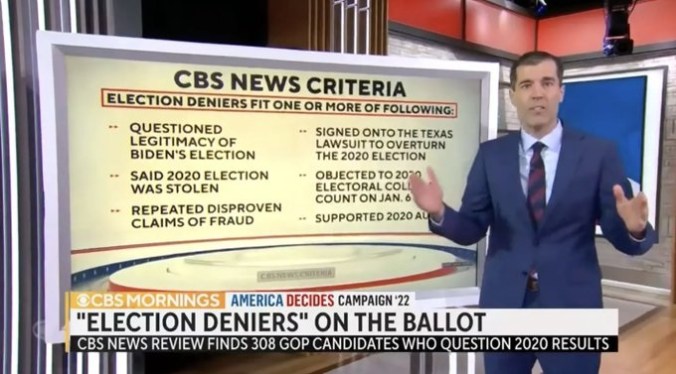
Now that the anti-Trump, Democrat propaganda-promoting, biased and incompetent mainstream media has been forced to cover the unfolding Fani Willis ethics debacle that threatens to swallow her partisan “Get Trump!” prosecution, it is giving us blazing examples of just how untrustworthy its coverage can be. The headline above looms over CBS’s “news” story that is really a lame and transparent effort to try to spin the Fulton County DA out of the mess of her own making.
The focus of the report is that poor Fani just about had to hire her lover as one of the prosecutors in the high profile case against Donald Trump, because she was “unable to find someone in the DA’s office with the stature and credentials needed for the case,” and “turned to at least two other legal heavy hitters in Atlanta who turned the job down.” Then the article, while conceding that Nathan Wade had little relevant experience, tells us that Wade was Willis’s “friend and mentor” <cough!> and that she told colleagues he “had the toughness to handle the scorched-earth legal tactics that Trump’s lawyers and their co-counsel were likely to employ in the legal battle.” You know, because Trump is such an evil bastard.
Ooooh, I would fire Brennan for this if I were in charge of CBS news.
Brennan tried to cross-examine Speaker of the House Mike Johnson on last weekend’s “Face the Nation” about his stance on the 2020 election. “Back in 2021, you were the lawmaker who circulated the legal brief known as the “Texas Amicus Brief [actually Texas v. Pennsylvania] challenging the 2020 election outcome in a number of states,” Brennan stated, “which by CBS editorial standards makes you an election denier.”
“That’s nonsense,”Johnson replied, and when Brennan said: “Can I get you on the record on that?,” he continued, “I’ve always been consistent on the record. Did you read the brief? Did you get a chance to read what we filed with the Supreme Court?”
Her shocking answer, a veritable huminhuminhumina if ever there was one:”Well- I have read extensively some criticisms of that…”
Oh! She read some criticisms of the brief by her biased, propagandist colleagues, so that was sufficient preparation, she believed, to call someone who supported the brief’s arguments an “election denier.” That’s like using a book review to write a book report on a book you never read.
The Media Research Center, a conservative “media watchdog” roughly the Right’s equivalent of Media Matters but with a much bigger job, analyzed six of the daily late night comedy shows: Comedy Central’s “The Daily Show,” ABC’s “Jimmy Kimmel Live!”, NBC’s “The Tonight Show Starring Jimmy Fallon” and “Late Night with Seth Meyers,” CBS’s “The Late Show with Stephen Colbert” and “The Late Late Show with James Corden”until its April exit, from January 3, 2023 through December 22, 2023. The results are here. The researchers counted 9,518 jokes they judged political in nature, and broke them down into categories. 1,601 targeted progressive, Democrats and figures on the left of the political spectrum. 186 aimed at people, groups, or institutions not associated with either side. 7,729 or 81% of the jokes were considered barbs atwere directed at individual, organization or positions considered to be conservative. 493 targets were the objects of a single joke, with 285 of these on the right, 167 on the left, and the remaining 41 on non-partisan topics.
The unbalanced percentages are only a surprise in that they are less lopsided than I would have guessed, but still obviously showan absurdly unfair partisan bias. If, as was once the norm in all political comedy, all sides and parties were mocked relatively equally with the President in the White House taking most of the fire, political humor can be fairly categorized as entertainment with the primary objective being to make as many people laugh as possible. Distorted to this extent, however, late night comedy becomes a self-evident propaganda weapon that plays a significant part in the mainstream media mission to sway elections and manipulate public opinion.
[ JM here:I want to let Curmie’s Conjectures stand on their own, so I apologize at the outset by intruding with a brief introduction. Lest anyone be dissuaded from reading the whole post because the author’s scholarly tone and apparent focus at the start suggests that this will be a narrow discourse on topics rather more relished by Curmie and me than by the majority of EA readers—theater and the performing arts—fear not. The tags on the article will be “Canada, censorship, the Hamas-Israel War Ethics Train Wreck, and political theater.” The post also involves some of the same considerations as one of mine two days ago. ]
There is a theory, one to which I subscribe, which suggests that the Dionysian Festival of classical Athens began not really as a religious observance in honor of a demi-god but rather as a means of consolidating the political power of the tyrant Peisistratus. Whether or not this is true, there is no doubt that by 458 BCE Aeschylus’ Oresteia, widely acclaimed as “the world’s first dramatic masterpiece,” offers commentary on the reforms of the Areopagus enacted by the strategos Ephialtes some three years earlier.
There is no question that since that time the theatre has often—not always, but often—been political. The 20th century offered more than a few examples of playwrights and production companies who, often at personal risk, critiqued the power structures around them: Jean-Paul Sartre took on the Nazis; Lorraine Hansberry, racism in the US; Athol Fugard, apartheid; Václav Havel, communism in Eastern Europe.
Not all such efforts were for causes most of us would endorse, of course. Socialist Realism was a Stalinist policy under which all art had to support The Revolution: not just avoid criticism of the regime, but actively and explicitly endorse it. More recently, the Freedom Theatre of Jenin (on the occupied West Bank) has been in the news. A few weeks ago, one of the student organizations at my university posted an encomium to the company, which they described as “an example of creating liberating theatre and serving communities through theatrical pedagogy and profound performance.” I remembered having written about that theatre a dozen or so years ago. If I might quote myself for a moment: “Turns out that the Freedom Theatre was pretty damned proud of having turned out alumni who engaged in armed insurrection, and at least one of whom, a suicide bomber, richly merited description as a terrorist.”
So no, propagandistic theatre isn’t always a good thing… but engaging with the world is. Even subtle messages matter. Under normal circumstances, Aunt Eller’s wish that “the farmer and the cowman can be friends” doesn’t amount to much. But Oklahoma! hit Broadway after the declaration of war against the Axis powers and before D-Day. “Territory folks” need to put aside their petty grievances when there’s a guy with a funny mustache who’s far worse than any of your neighbors will ever be.
That is the headline to this news report by Metro and carried by MSN on the death of Gaston Glock, the Austrian engineer who formed the Glock firearms company in 1963.
It’s as flagrant an example of biased journalists editorializing in news story headlines as you are ever likely to see. This represents a reporter, editor and publication distorting and manipulating the news to make a political statement. The anti-gun movement is especially fond of the appeal to emotion over facts that it represents.
Glock, as far as we know, never profited at all from anyone’s death or killing. He would have made the same profits if no one had ever fired one of his company’s guns. The headline is a lie, and yet MSN felt it was appropriate to circulate it on the web. The analogies to this kind of warped logic write themselves, and you can come up with them as easily as I can.
There was a time not so long ago when only underground newspapers, and supermarket tabloids would indulge in this level of garbage journalism.
The title for this two-part edition of Curmie’s Conjectures refers to a song by the Irish punk band the Boomtown Rats, “Don’t Believe What You Read,” which includes not only the title admonition but also lines like “I know most what I read will be a lot of lies / But you learn really fast to read between the lines.”Part I of this exercise attempted to suggest something of the parameters of the problem. As Jack suggested in his introduction to that piece, it’s not an exhaustive list of the various forms of journalistic chicanery, but I hope it served as a representative sample.
Here in Part II, I’ll attempt the daunting task of examining strategies to “read between the lines” and come at least a little closer to the truth of what happened in a given situation. So, what to do? How do we determine if that less-than-objective source we’re reading actually has this one story right, especially if it’s the only source about a particular story? Boy, do I wish there was an easy answer to this one. That said…
The most effective means of ascertaining the truth, of course, is to get different perspectives on the issue. I think I’ve mentioned both here and on my own blog that when I was in England doing my MA (at the time “Don’t Believe What You Read” was released, as it happens), I’d alternate between reading the Telegraph, which leaned right, and the Guardian, which leaned left. If the former said “X but Y,” thereby suggesting that Y was the more important point, the latter would likely say “Y but X.” But whichever paper you read, you’d know that X and Y, though perhaps seemingly in opposition, were both true, and both worth knowing about.
Of course, both the Telegraph and the Guardian were, whatever their political perspectives, both reputable news sources. That’s a statement that would be difficult to make about many of the most prominent news media in this country in the 2020s. Equally importantly, as suggested in Part I, the problem is often that we hear only from one perspective.
There are three possibilities for why this should occur. One, which is (alas!) probably the least likely, is that both X and Y editors make an honest decision that a story is or is not newsworthy. Or X media outlet knowingly runs with a story that is either grossly distorted or fabricated altogether. Or outlet Y, knowing the story casts their team in an unfavorable light, ignores it, hoping it will just go away. At some point it becomes untenable to try to ferret out the true motives; the truth of the story may be a little easier to discern, although there are no guarantees.
[I am particularly grateful for this installment of Curmie’s Conjectures because it assuages my guilt a bit. As longtime readers here know, I occasionally promise posts that never show up, or do, but so long after the promise that it’s embarrassing. Years ago, I promised a post defining and examining all journalistic tricks that I classify as “fake news,” and I use the term broadly to include misleading headlines, burying the lede, omitting key information thatundermines the writer’s agenda, poisoning the well and other techniques. I started the thing, got frustrated and overwhelmed, and never finished it. Here Curmie doesn’t exactly present what I intended, but he touches on much of it, and as an extra bonus, he wrote it more elegantly than I would have (as usual). JM.]
I doubt that this blog has ever before turned to punk rock for ethics advice, but Boomtown Rats composer/frontman (and Live Aid impresario) Bob Geldof had it right in a song that’s probably more relevant today than it was 40+ years ago: “Don’t Believe What You Read.” Well, not uncritically, at least. At our host’s suggestion, I’m about to enter the fraught territory of trying to decide if a story published by an obviously biased media outlet might, this time, just be accurate.
It’s difficult of late to find a news source that only leans in one direction or the other, rather than proselytizing for the cause. The news networks and major newspapers have carved out their market shares based on feeding their viewers and readers what they want to be fed. Whether the advent of Fox News was a trigger or a reaction is up to individual interpretation, but there’s absolutely no doubt that we’re now in an era in which news as reported is determined largely by editorial positioning, rather than the other way around.
It’s inevitable that, to steal a line from another of my favorite musicians, Paul Simon, “a man hears what he wants to hear, and disregards the rest.” Fighting our own biases is not made easier by the knowledge that learning from experience and confirmation bias are opposite sides of the same coin. If a story appears only on Fox News and the Drudge Report, or only on AlterNet and MSNBC, there’s an excellent chance that the indignation is feigned and the actual events are something of a nothing-burger.
But “usually” is not “always.” As a society, we’re well aware of the tale of the boy who cried wolf and the miraculous last-second basket from well past half-court. We nod and smile at the suggestion that stopped clocks are right twice a day.
There are a few variations on the theme of biased journalism. The first, editorializing in a news story, is generally the easiest to spot and the easiest to counteract. If there are words like “communist,” “Nazi,” or “un-American” to describe a US politician, or phrases like “unborn children” or “reproductive freedom,” you’re reading an editorial, whether the article identifies itself as such or not. There’s nothing wrong with editorializing; it’s what I do here and on my own blog, after all. But I also try to not to suggest that what I write is completely objective.
Another variation on the theme, and a personal pet peeve, is what I call a Schrödinger sentence, because it is simultaneously true and not true. For example, I’ve seen a whole lot of conservative commentary on this blog that “progressives want X.” (“X” in this context, of course, has nothing to do with what Elon Musk renamed Twitter.) True, there are enough progressives who advocate for X to make the noun plural, but I’m a progressive, and I’m a big fan of not-X. The implication—or, rather, one possible implication—of the sentence is that in order to be a progressive, one must want X. That is no more true than suggesting that all conservatives believe in Jewish space lasers. And I really resent being told what I believe.
For decades now, I had held on to the hopeful fiction that at least one factchecking organization, the Annenberg Public Policy Center’s FactCheck.Org, at least could be relied upon to make a good faith effort to do its job objectively. Oh, it has always had a left-leaning bias, make no mistake about that. Many years ago I was at a conference where the keynote speaker was the head of FactCheck.Org. She proudly proclaimed the organization’s “absolute objectivity and non-partisanship.” When it came to time for audience questions, I couldn’t restrain myself: bypure coincidence, I happened to have in my briefcase a recent “factcheck” by the group that outright misstated a fact to minimize negative characterizations of Bill Clinton. I read the relevant passage to the speaker, and asked, “How can you honestly describe that passage as anything other than partisan and biased?” Her response was, as I recall, “Huminahuminahumina...”
But still, I am a sap. I so wanted to believe that there was an exception to my conviction that factcheckers are all Democrat propagandists. And now FactCheck has engaged in an instance of flagrant (and inept) propaganda under the guise of factchecking…
Now fast-forward to the post-Hamas massacre progressive crisis. FactCheck.Org posted a factcheck titles, “Cruz Distorts Facts on Biden Support for Israel.” Writer Eugene Kiely concluded that there is“little support” for Senator Ted Cruz’s claim in a Fox News interview that “literally from within minutes of when this horrific attack began on Oct. 7, the Biden White House has been telling Israel, do not retaliate, cease-fire, stop, do not kill the terrorists.”
Heck, anyone who reads Ethics Alarms could have debunked the debunker. I wrote here,
CNN’s not-so-subtle partisan innuendo is displayed in the title: “He’s second in line to the presidency. Financially, he’s just getting by.” Obviously, Speaker Mike Johnson must be incompetent or profligate, or have a drug or gambling problem, or something. After all, as CNN vaguely tells us, his Democratic predecessor as Speaker, Nancy Pelosi, has “done very well.” I’ll say: her wealth is estimated at about 180 million dollars. CNN doesn’t try to explain how she has done so well, but it is widely believed that it involves insider trading.
Since becoming Speaker, Mike Johnson has been attacked by Democrats for his vile habit of believing in the Bible and its teachings. Add to that the fact that he apparently isn’t smart enough to turn what is supposed to be selfless public service into a personal fortune like his colleagues have, and it’s easy to see why the Axis of Unethical Conduct is telling the pubic that he can’t be trusted.
I have a clarification for them: a member of Congress who isn’t getting rich from the job is more trustworthy, not less.
What an infuriating, despicable headline, though the story is equally bad. If abortion supporters—yes, it’s the Democratic Party exploiting the issue—weren’t “squeamish” about what they so indignantly and self-righteously support they wouldn’t have spent the past 70 years trying to figure out ways to avoid directly admitting what they are advocating. “Baby? What baby?”
The argument for abortion, that is, terminating a developing unique human life distinct from that of its mother before it can grow to be born and go on to experience life, liberty and the pursuit of happiness, has been, and still is, deliberately clouded by misleadng rhetoric about “choice” and “reproductive care,” the current dodge. Wait, how is that other human life in the equation assisted with his or her “reproduction”? Is it “care” to have that life’s own chances of reproducing taken away from it?
And what choice does the victim of an abortion have?
If Democrats weren’t “squeamish” about having to deal with those questions, they wouldn’t be trying (and, tragically, thanks to the abysmal level of attention, critical thought and ethical competence of the average American, largely succeeding) to avoid them.






 Ethics Alarms