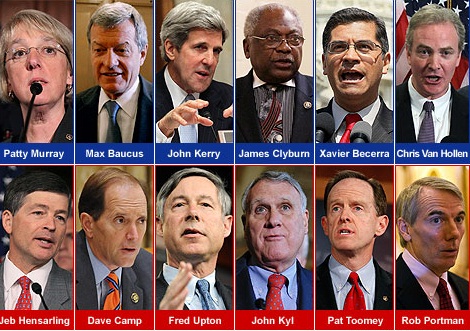
Ethics Dunces: The Senate and House Leadership

The names are in.

As part of the pathetic, cynical and inadequate budget deal to raise the nation’s debt ceiling, Republicans and Democrats were called upon to assemble a bi-partisan “super committee” of twelve House members and Senators, chosen by the respective leaders from both parties, to come up with a way to close the deficit. Now that the S&P ratings downgrade has embarrassed the nation, destabilized foreign markets and sent an unambiguous message that the United States has to get serious about balancing the books and fast, have our political leaders responded to the challenge by choosing elected representatives of states and districts who have track records of collaboration, political courage, truthtelling and placing the best interests of the nation over narrow electoral fundraising and ideological objectives?

Naaa.

What, are you surprised? The leaders of the House and Senate have met our lowest expectations, and have chosen a hyper-partisan group to make up the super committee, guaranteeing that it will be super-contentious and super-ineffective. The degree to which this represents an abdication of their duties of leadership and responsible government is impossible to exaggerate. Continue reading →

Ethics Hero: Sen.Tom Coburn

Sen. Tom Coburn (R-OK) has become the main villain in the battle over the  9/11 First Responders Bill, which will grant over 7 billion dollars in health care assistance to those who have become ill as a result of their heroic work in the aftermath of the World Trade Center bombings. He is leading Republican opposition to the bill, on the grounds that it still needs to be paid for despite its worthy purpose and its undeniably deserving beneficiaries.

Coburn is one of the most dedicated deficit hawks in the Senate, which means that he realizes that the federal deficit will never be brought under control if feckless House members and Senators can always be shamed and bullied into spending money the government doesn’t have, or into rejecting necessary cuts, through the use of one or more predictable refrains: Continue reading →

Unethical Quote of the Week: Charles Blow

“Such has been the narrative of his presidency: being treated like the janitor in chief — mopping up messes made by others and being chastised for leaving streaks.”

—New York Times columnist Charles M. Blow, discussing the public’s impatience with President Obama’s response to the Gulf oil spill.

Blow’s revolting comment, buried toward the end of an article calling for President Obama to display more emotion [Translation: “Act!”] over the Gulf catastrophe, is nothing short of despicable, but perhaps we should be grateful for it nonetheless.  Now we know the drill: no matter what the issue, no matter what the provocation, biased, race-baiting commentators like Blow will judge any criticism of President Obama to be motivated by bigotry, and refuse to accord his critics the respect they expect to be given themselves. Continue reading →

Ethics Heroes Odd Couple: Sen. Jim Bunning and the Washingon Post

“The point Mr. Bunning was trying to make was a reasonable one: At some point, Congress has to stop borrowing and spending, even for worthy purposes.”

This wasn’t Rush Limbaugh talking, or some Fox News talking head. This was the Washington Post, in an editorial, validating the Kentucky senator’s lonely stand in which he single-handedly placed a five-day “hold” on a $10 billion bill to pay for extended unemployment benefits and other popular programs.

Bunning’s symbolic protest was vilified by the Democrats and disowned by most Republicans. As the Post editorial pointed out, it was “spectacularly bad politics,” giving the Democrats a perfect foil to symbolize the heartlessness of “the Party of No.” Courage and principle are often, and perhaps, sadly, always bad politics. Continue reading →