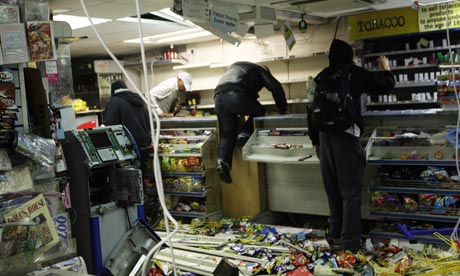
Another Harvey Ethics Quiz On Looting….

The comments on the Ethics Quiz on shooting looters was edifying. Now let’s examine the question of “legal looting,” according to a Yale Law School professor.

In a post for Bloomberg, Stephen L. Carter argues that “Peacefully taking what you need from a supermarket isn’t the same as looting.” he writes in part,

Should we conclude that people taking food from an empty store during an emergency are not committing a crime? That’s exactly what we should conclude — they are not lawbreakers — but it’s important that we understand exactly why.

Let’s start by considering our own instincts. If I were trapped and my family was starving, I would grab the food; I suspect most readers would too. Already our instincts tell us, then, that the moral situation in which we find ourselves is different when a disaster has struck. I believe, very deeply, in the importance of strong property rules. In an emergency, however, we should interpret the rules differently…. A well-known example in the Model Penal Code posits a hiker who, trapped by a blizzard, breaks into a cabin and eats the food to survive. The hiker has taken both food and shelter without the permission of the owner. By choosing to violate a property rule rather than starve to death or die of exposure, the hiker has selected the lesser of two evils. This is one form of the defense known as “necessity,” and is generally considered to mean that there is no crime.

(You need to read the whole post to fairly consider Carter’s argument.)

Your Ethics Alarms Hurricane Harvey Ethics Quiz of the Day is…

Is looting an abandoned supermarket for food still a crime?

Continue reading

The Internet Censorship Bill and Escalating Abuse of Government Power: Why Do We Continue to Trust These People?

Yesterday, the Senate Judiciary Committee unanimously approved a bill giving the U.S. Attorney General the power to shut down any website with a court order, if  he determines that copyright infringement is  “central to the activity” of the site.  It doesn’t matter if the website has actually committed a crime, and there is no trial, which means that the law is a slam dunk violation of the U.S. Constitution.  The Combating Online Infringement and Counterfeits Act (COICA) is a little goody bought by the lobbyists and PACs of Hollywood, the recording industry and the big media companies, to block the rampant internet file sharing that has cost them a lot of money in lost sales and profits over the past decade.

I am adamantly opposed to filesharing and the ethically dishonest arguments used to defend it, most of which begin with “Everybody does it.” I sympathize with the artists whose work is being stolen, and the companies who have complained to Congress. But all the strong condemnation of filesharing by lawmakers and corporate executives doesn’t change a central fact: the Constitution says you can’t do what COICA allows. It says this in at least two places: the First Amendment, which prohibits government interference with free speech, and the Fifth Amendment, which decrees that property can not be taken from citizens without Due Process of Law. A law that lets a government official just turn off a website without a hearing or showing of proof? Outrageous. and unconstitutional. Continue reading