Evening Ethics Cool-Down, 9/16/2021: On Idiots, The Donner Party, Statistical Reparations And The Evil NFL

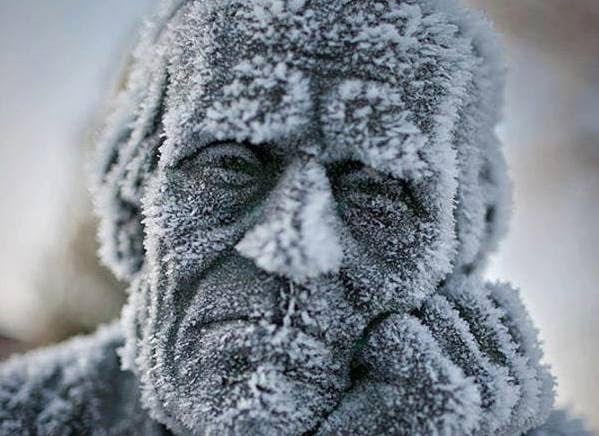
Frozen Statue

I had to get out of bed to write this; I’ve been exhausted all day. I better not be getting old. That will really tick me off…

***

I’m working on a post called “Cannibal Ethics,” and this obviously led me to the Donner Party, the group of doomed pioneers who had to eat each other to survive when they were caught in a storm in the Sierra Nevadas in 1846. If I knew that they had come to their fate because of a negligent author, I had forgotten it: a fake expert named Lansford Hastings had written “The Emigrant’s Guide to Oregon and California” recommending a short-cut (which actually increased the trip’s mileage) to the Promised Land (this was before the two areas were ruined by reality-free politics)He had never actually traveled the new trail when he published the book. He did finally do it shortly before the Donner party set out, and helped sealed its fate by leaving paper notes along the way that further misled them. One told the already desperate wagon train they could cross Utah’s Great Salt Lake desert in a faction of the time it actually took. The group ran out of water in the middle of the salt plain about half-way across.

If I compiled a list of U.S. Ethics Villains throughout history—I’ve considered it—Hastings would be on it. After he left the U.S. for Brazil following the Civil War, he wrote a sequel of sorts to the book that killed so many of the Donner Party: “The Emigrant’s Guide to Brazil.” (1867).

1. Tales of The Great Stupid, Headline Division. From the Boston Globe: “How did Boston miss its moment to elect a Black leader?” The reporter, Stephanie Ebert just can’t imagine why he three Black candidates in the mayoral primary were eliminated in favor of Michelle Wu, the daughter of Taiwanese immigrants and Annissa Essaibi George, whose father was a Tunisian Arab Muslim. But, Ebert complains, there won’t be “any candidate who knows the weight of being Black in a city with deep racial scars.”

Maybe the three black candidates were not seen as skilled, experienced, or qualified as the primary’s winners. Or is Ebert saying that being black should be enough to qualify someone to be mayor?

Continue reading

Waning Thursday Ethics Wrap-up, 12/17/2020: Baseball, Football, And The Ripper

Traffic has been sluggish this week. I wonder if the blog is depressing people….I know it’s been depressing me.

1. A confirmation bias classic. I decided to watch the new Netflix documentary about the hunt for “the Yorkshire Ripper,” Peter Sutcliffe, only because Grace and I had been on a Jack the Ripper binge of late, including the well-done (but completely fictional) Johnny Depp film, “From Hell.” I did not expect “The Ripper” to tell one of most instructive tales of how bias makes you stupid as well illustrating as the perils of confirmation bias, but that’s what it does.

Sutcliffe, a Yorkshire truck driver, murdered 13 women and attacked nine others, but police missed him for five years because they convinced themselves that he only killed prostitutes. This, in turn, led the newspapers to name him after Jack the Ripper, the mysterious serial killer in Victorian London who killed and mutilated five prostitutes in 1888. The name, in turn, reinforced the bias that a Jack copycat was whom they were seeking. As a result, women who were not prostitutes and had been attacked by Sutcliffe were ignored when they went to the police.

With their investigation foundering, police officials decided that letters from someone claiming to be the Ripper were genuine—Jack the Ripper also wrote letters to the police, you see—and a tape recording referring to the letters must have had the real killer’s voice on it. So they had a speech expert identify the accent of the speaker, which placed him in a very small area in Yorkshire. Any suspect who didn’t have that accent was eliminated….including Sutcliffe, who was interviewed nine times. By the end of his rampage, Sutcliffe wasn’t killing prostitutes any more.

Sutcliffe was eventually captured by accident. Says one of those interviewed for the project: “No wonder the police couldn’t catch him. They were chasing a mythic Victorian maniac instead of a real man.”

Continue reading

Ethics Hero: Dr. Jeremy Krock

All over America, there are people who are doing wonderful, generous, kind and important things, not for recognition or personal profit, but because something needs to be done to set things right, and nobody else will do it. The only way most of us learn about these ethics heroes is if some enterprising reporter discovers their stories, and brings them to the public’s attention. For every one we hear about, there are probably dozens that remain in obscurity.

One of those Ethics Heroes I have just learned about is Dr. Jeremy Krock, an anesthesiologist by trade, who began the Negro Leagues Grave Marker Project seven years ago. His self-appointed mission is to find the neglected burial places of players from the old Negro baseball leagues, and give them each a grave marker that identifies them and their place in baseball history. Continue reading