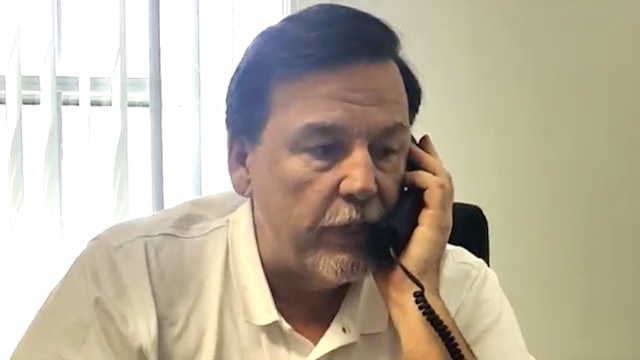
Now THAT’S Defamation…

I don’t know what is so hard to grasp about the concept of defamation. The idea is that one must not assert as fact something about a person that is demonstrably false and that holds that person up to public ridicule or hostility, harming their reputation. It is easily distinguishable from opinion: it must be published “with fault,” meaning as a result of negligence (asserting a “fact” without checking that it is true) or malice (with the intent of harming someone’s reputation). Why is that difficult? I don’t know. This guy, however, really doesn’t understand defamation, and he was a radio talk show host. That’s like not understanding snakes and becoming a snake charmer. Yes, the ethics value being missed here is competence.

New Hampshire radio talk show host Michael Gill (above)  used billboards, his website and his radio show called “State of Corruption Radio” to call local businessmen, among other things, heroin dealers. A typical broadcasts included quotes like this:

“Now I told you, and I’ve been telling you, the heroin dealers are in this state are Anagnost and Crews. Now who are these people? Well a couple of the wealthiest men in our state. That’s how they got wealthy, okay? They have a warehouse. I brought this up. We had witnesses, distributing and unloading drugs and machine guns from trucks.”

Wait, what? Didn’t this guy have a lawyer? Didn’t the station have a lawyer? Any lawyer within hearing distance of a broadcast like that had a duty to rush to the station, break into the studio, and stuff a wadded up sock in Gill’s mouth. Continue reading

Morning Ethics Warm-Up, 9/8/17: Hybrid Topics! CNN, Hillary, DACA And More…

Good morning, all.

1 The Public Interest Legal Foundation, a conservative non-profit public interest group that focuses particularly on voting issues, claims to have data suggesting that Hillary Clinton’s narrow win in New Hampshire in the 2016 election—about 2,700 votes gave her the state—may have been achieved by fraud. A study showed that more than 6,000 voters in New Hampshire had used the state’s same-day voter registration procedures to register and vote.  The current New Hampshire speaker of the House, Shawn Jasper, sought and obtained data about what happened to these 6,000 “new” New Hampshire voters who showed up on Election Day. Most of them are no longer in the Granite State. Only 1,014 have ever obtained New Hampshire driver’s licenses. Of the 5,526 voters who have not, just 3% have registered a vehicle in New Hampshire.  70% of the same-day registrants used out-of-state photo ID to vote in the 2016 presidential election in New Hampshire and to utilize same-day registration.

All of which suggests that it would be prudent if a group other than a right-wing advocacy organization did an unbiased and objective study.  Since Democrats won several top races last year along thin margins, notably Maggie Hassan defeating Kelly Ayotte in the U.S. Senate race by 1,017 votes, some Republicans are claiming that out-of-state voters illegitimately tilted the election. Of course, for all anyone knows, the same-day voters may have voted Republican. The episode does compel three conclusions:

  • Same day registration is a recipe for chicanery. I am suspicious of any elected official or activist who supports it.
  • The Democratic/ mainstream media cant that there is no voter fraud is incredible on its face, and manifestly dishonest.
  • The nation’s lack of eager, objective investigators without partisan agendas is crippling. I don’t believe what conservative sources and pundits conclude about the New Hampshire vote, and I find the lack of interest the liberal national mainstream news media seems to have in the story— on Google, I see New Hampshire sources and conservative sources like Breitbart, BizPac, Fox and the Washington Times—gives the story more credibility, not less.

2. For those who are still having trouble accepting that the DACA was an illegal measure as executed by President Obama, I highly recommend the article by Constitutional law expert Jonathan Turley, who explains why he regarded it as “a flagrantly legislative act by President Barack Obama.”  So did I, but he’s a legal scholar and I’m just a lawyer. From an ethics perspective, my area of expertise, I’m still disturbed at the attitude of the supporters of this Obama’s end-around the Constitution (and others). which can be summarized as, “Let’s see if we can get away with it, because we like the results.” It translates into “the ends justifies the means,” and epitomizes the drift of the Left toward totalitarian methods and philosophy. Continue reading

Morning Ethics Round-Up: 7/5/17

Good morning!

1. I’ve always had ethical problems with parole hearings, and thanks to a link sent by Ethics Scout Fred, I really have ethics problems with parole hearings. This story, from New Hampshire public radio, portrays an unprofessional and chaotic process in which parole boards, made up of officials without training or guidelines, insult, bully and deride prisoners to get the answers they want. A sample:

“While they may review cases beforehand, the parole board has only about 15 minutes to speak with people convicted of charges including sex offenses, drug crimes, and domestic violence before deciding if they can live safely outside prison walls. Members receive no training and appointment requires no prerequisite experience. Most of the time, inmates who meet minimum requirements are granted parole.”

Great.

2. Crime naturally makes me think of Chicago, where, it is reported, the wise city managers, led by Mayor Rahm Emanuel (D) are installing a system that requires public high school students to show that they have plans for the future before obtaining their diploma. In order to graduate, students will  have to demonstrate that they’ve secured a job or received a letter of acceptance to college, a trade apprenticeship, a gap year program or the military The Washington Post reports. Emanuel’s plan, approved by the Board of Education in late May, makes Chicago’s the first big-city system to make post-graduation plans a requirement.

“We are going to help kids have a plan, because they’re going to need it to succeed,” Emanuel told the Post. “You cannot have kids think that 12th grade is done.”

Oh, why don’t we just enlist the kids in the Social Justice Youth Corps, give them uniforms and some good progressive indoctrination, and be done with it? This is such an egregious abuse of power and autonomy, as well as parental authority, that the fact that it got a single vote indicates that the culture’s values are coming apart. I’m going to list five things that are unethical about this plan, and invite readers to some up with the doubtlessly large number of others that I missed because its early and the shock of this story fried half of mu brain:

It’s dishonest grandstanding. How are they going to enforce the “plan”? Will Chicago’s Plan Police keep tabs on graduates? Will students who don’t follow the plan be captured and thrown back into high school?

  • It is unfair, coercive. unconscionably narrow. What if a student’s plan is to continue her education by taking a year off and touring the world? What if the student plans on training for the Olympics, or a bodybuilding championship?

What if she wants to go to New York City and audition for shows?

  • The measure demonstrates myopic disregard for the original, the eccentric, the creative, the  bold, the dreamer, the non-conformist and the individualist

But then individualists make poor sheep, right?

  • It is totalitarian. It is none of the government’s business what a student chooses to do after graduation, or when that student decides to it. Here was my plan, fully backed by my parents: spend as much time figuring out what I want to do with my life as it took.

I’m still figuring.

  • It is arrogant. It is disrespectful. It is presumptuous. It is an invasion of parental authority. It is probably unconstitutional. It is wrong.

ARRRRRRRGHHHHHHH!!! Continue reading

Observations On The New Hampshire Democratic Candidates Debate

NH debate

I’m sure that there are loyalists who just love watching Clinton or Sanders no matter what they are doing and saying, just as I will watch even a lousy Danny Kaye movie just to see Danny Kaye. But wow, I’d really like to see the results of a post-mortem on the brain of anyone who said last night’s debacle was anything but excruciating and depressing. If I were a Democrat, I’d be on a three-day drunk after last night. I’m not, and I’m still considering it. This was easily the worst presidential candidates debate I’ve ever seen, read about or analyzed.

Why? Well, how many other debates had two candidates, their faces contorted in anger, shouting at each other (Bernie is always shouting, really) when they hardly disagree about anything of substance? How often is it so obvious that one candidate isn’t trying to win, and avoids every opening and opportunity to take down his opponent? As I have said before, if I had contributed to Sanders, I’d demand my money back. I thought losing the pathetic Martin O’Malley would be a plus, but it wasn’t. Focusing only on the irredeemably absurd Sanders and the unquestionably corrupt Clinton just made the question more vivid: after two and a half centuries as a major party, how could the Democratic Party have so little respect for the American public and so little devotion to its role in selection of the Presidency to leave us with this?

Now that I’ve gotten that off my chest, here are specific observations. The transcript is here.

1 More than any debate in 2016, this was performed as if  only hard-left loyalists were watching, and the moderators behaved that way as well. Agenda items like the minimum wage and “equal pay for jobs” were tossed off as shorthand and givens, without any fear that anyone would say, “Hey, wait a minute..” Yesterday, for example, data was revealed showing that in six major cities that enacted large minimum wage hikes last year, employment has suffered—as predicted by anyone without “progressive” blinders on. That would have been a good question to raise, but nobody was there to raise it. Rachel Maddow? Right.

2. The debate was deja vu, and little else. How many times do we need to hear Sanders’ generalized rap about the economy being rigged, Wall Street being a den of thieves, and single-payer health care being obviously the way to go because “everybody does it”? How many times do we have to hear that Hillary is going to “improve [Obamacare]… build on it, get the costs down, get prescription drug costs down” without being given a clue how, and without anyone even asking the question? How is she going to do all this without having the country “plunge back into a contentious national debate that has very little chance of succeeding.” What does that mean, Hillary? Funny, I thought debate was how policies get made in a democracy. Please explain: what is your substitute for democracy? Don’t “progressives'” have a totalitarian ethics alarm any more?

3. Clinton’s responses to the Sanders accusation that she’s not progressive enough—the Democratic doppleganger of the annoying and equally silly Republican accusation that a candidate isn’t a “true conservative,” were something to behold:

  • “I am a progressive who gets things done.” A bumper sticker slogan, and by the way, what things? Honestly, I can’t name any at all: she was a Senator, didn’t create any major legislation, and wasn’t a successful Secretary of State. What things does she get done? Again, Bernie won’t ask a real question….but then, he hasn’t accomplished anything either. Later, to prove her credentials in getting things done, Hillary talked, as she always does, about “fighting” for this or that, even going back to her days with the Children’s Defense fund and the DOA Hillarycare bill that crashed and burned in her husband’s first term. A 69-year-old candidate for President who  actually “gets things done” wouldn’t have to dig this deep—and a candidate trying to defeat her wouldn’t hesitate to say so.
  • She actually compared Sanders’ criticism of her progressive bona fides with not regarding a liberal Democratic Senator as progressive enough when that Senator, Paul Wellstone, has been dead since 2002, and Sanders has never mentioned him during the campaign at all! This was a straw man for the ages.

4. Having finished that pointless “debate,” they moved on to whether Hillary was the “establishment.” This sounded like a an acid-flashback from 1968, but never mind: here was Hillary’s rebuttal:

“Senator Sanders is the only person who I think would characterize me, a woman running to be the first woman president, as exemplifying the establishment.”

Sexist, insulting, tribal and dumb. Merely having two X chromosomes means that you are by definition not part of the existing power structure even when you have been part of that power structure for decades? This is just a dog-whistle to vagina-voters, who themselves are a disgrace to democracy, fairness and civic responsibility. What is it about Hillary Clinton’s career since hooking up with Bill that has shown her to be a power-seeker and broker distinguishable in conduct and motives from a man? Oh, that’s right: when her husband serially abused women as well as betraying their marriage, she sided with..him, against them.

5. Ethics alarm: “The reality is that we have one of lowest voter turnouts of any major country on earth because so many people have given up on the political process,” says Sanders. Sanders really does believe that when the United States is different from all those other less successful countries, it must be wrong. This “reality” just cynical poison that Sanders likes to say, even though it contradicts his own rhetoric. If Obama is such a great President, wasn’t he elected over Romney and McCain? Doesn’t Bernie think that makes a difference, and that the difference was votes? The GOP Congress he and Hillary are complaining about was elected when Democrats stayed home and Republicans came out in force, was it not?  If the impression that their participation makes no difference is wrong, as it is, why does Sanders keep citing it as if he agrees? What does “so many people have given up on the political process”  mean? Is he really attacking democracy itself Continue reading

Transgender Ethics: Epic Trailblazer Malpractice In New Hampshire

Ex-N.H. state legislator, Stacy Laughton, a.k.a Barry Laughton.

Ex-N.H. state legislator Stacie Laughton, a.k.a  felon Barry Laughton.

Trailblazers have an ethical obligation when they presume to break a social or occupational barrier to a marginalized group’s participation and equal treatment. Simply put, their duty is to make the bias that has created the barrier and necessitated the “trail” look ignorant, cruel, foolish and unfair. A trailblazer does not have to be a shining star, though it helps, but must be capable of at least doing a solid, average, generally acceptable job., even in the grudging judgment of bigots.

This is because a trailblazer who does a poor job or displays character traits that are objectively inadequate for a role model, which a trailblazer inevitably becomes, risks adding to the barrier he or she just breached for those who follow behind them. The ethical requirement for trailblazers is the same as the traditional edict for doctors “First do no harm.” Being a trailblazer, however, is not easy, and since failure is catastrophic for the group a trailblazer represents, there is a duty not to attempt such a high-risk, high-profile cultural role unless the trailblazer is first, reasonably convinced that he or she the resources of talent, ability, fortitude, character and courage to succeed, and second, willing to accept and overcome the added stress of relentless attention and criticism.

There have been excellent trailblazers, cultural heroes all. Jackie Robinson, the first black Major League baseball player to break the color barrier is the template, but there are many other successes: Justice Thurgood Marshall, John F. Kennedy, the first Catholic President of the U.S., Amelia Earhart, Diane Crump, the first female jockey, the late Ed Brooke, the first black U.S. Senator since reconstruction, and too many more to mention. There have also been some miserable failures. The worst trailblazer was probably Shannon Faulkner, who fought in the courts for two years to force The Citadel to accept female cadets, then, after she was victorious, showed up fat and unprepared, and washed out in just one week as millions of dubious vets said, “See? What did we tell you?” Then there was Carol Moseley Braun, the charismatic, promising African-American Democrat whon Illinois voters elected as the nation’s first black female Senator, only to turn out to be thoroughly corrupt.

More recently, we have seen other trailblazers fall short, like Michael Sam, the first openly gay player drafted by the NFL.  Is there a celebrity gay marriage that has not ended in a quick divorce? Most have been failures, reinforcing the belief that gays are promiscuous and unsuited for a real marriage. Most vividly of all in the realm of trailblazer malpractice, we are reminded of the disheartening and tragic examples of Barack Obama, and Eric Holder every day.

Still, in the annals of epic trailblazer fiascoes, it would be hard to top the story of Stacie Laughton, New Hampshire’s first openly transgender state legislator, who was elected in 2012 as one of three House members for Ward 4 in Nashua. Continue reading

Ethics Quiz: Is It Time For A “Let’s Tweet Insults About Chip McGee Day”?

Meet Chip McGee!

Meet Chip McGee!

At Bedford (New Hampshire) High School, several students were not pleased with Superintendent Chip McGee’s announcement via his Twitter feed that classes would resume the day following the school’s cancellation for snow. They responded with tweets of their own, some that were not especially pleasant. McGee, as one would expect a mature adult to be, especially one overseeing the education of children, was philosophical. saying, “Kids said some very funny, clever things. And some kids stood up and said, ‘Hey, watch your manners.’ That was great. And some kids — a few — said some really inappropriate things.”

Yes, kids will be kids. McGee then suspended those latter students for up to four days.

“It’s been a really good exercise in issues of students’ right to speech, on the one hand, and students’ and teachers’ rights to an educational environment that’s conducive to learning,” McGee explained to the Constitutionally ignorant. “Kids have the right to say whatever they want about me [and] The First Amendment right means you can say what you want, (but) it doesn’t mean that you are free of repercussion. It can’t disrupt what we’re doing in school … If something disrupts school, and it (occurs) outside school, we not only can take action, we have to.”

McGee  hopes that the punished students will learn from this incident about “the line” of decent and appropriate commentary. “You only learn that by checking where it is, and having something happen when you cross it,” he said.

Good ol’, wise ol’ Chip McGee. He has no idea what the hell he’s talking about.

The students are absolutely guaranteed of speech without “repercussion,” if the speech is off school grounds and the repercussion is from a school official who takes offense. The school has no authority to punish students for what they post on Twitter, from their homes, none at all, unless it relates directly to action at school itself, such as organizing a school disruption. A student opinion of the superintendent or his decisions? That’s 100% protected speech. I can find that right to free speech Chip mentions right there in the Constitution, but search as I might, I can’t locate in the Bill of Rights the provision describing the “students’ and teachers’ rights to an educational environment that’s conducive to learning” that extends to what a student says and writes outside of school. Where is that “right,” Chip?

Chip speaks in the measured tones of a caring educator, but he acts like a petty tyrant who is eager to abuse his position and power to punish anyone who dares to displease him in what they say or think.

No merely insulting or uncivil tweet is going to disrupt school, and if that’s Chip’s claim, he has a rather tough burden of proof to demonstrate it. Nor does a public school—that’s the state, you know— have the right to effectively censor speech by punishing content. If the speech isn’t libelous or a credible threat, Chip McGee’s reasonable remedy consists of asking to speak with the Tweeter and express his hurt and disappointment, or perhaps consulting with the student’s parents, who do have a right to limit online speech when their children are the speakers.  As an educator, he might explain to the student that insulting authority figures who you must relate to by flaming them on mass social media is neither wise, civil, nor a good habit. He might even  suggest that an apology is in order. He may not, however, abuse his power and position to constrain the free speech of those students and others by inflicting punishment. Chip McGee, who has the young minds of children within his power to lead or mislead, needs to learn this basic civics lesson, as do other tin god educators, and I’m sure there are many, who similarly itch to punish students for exercising their speech rights in the privacy of their homes.

Thus this somewhat atypical Ethics Alarms Ethics Quiz question to ponders:

Should we declare a “Let’s Tweet Insults About Chip McGee Day”?

Continue reading

Jaffrey, N.H. Motto: “Live Free, or, Well, We Don’t Really Want To Die, Exactly, Maybe Just Play It Safe And Try Not To Make Crazy People Too Angry At Us So They’ll Leave Us Alone”

The Mayor of Jaffrey, New Hampshire.

Every year, Jaffrey, New Hampshire holds a Festival of Fireworks in August that attracts thousands of people to the town and is one of the special pleasures of living there. The festival was scheduled for today, but city officials cancelled it after they received a letter threatening to set off a bomb at the event.

As one non-threatening letter writer commented in a local paper, “So much for “Live Free or Die.” Continue reading

The Ethical Duty To Correct Stupidity

The Martin Luther King Memorial was unveiled without the commission responsible for it bothering to fix what has been almost unanimously condemned as an embarrassing mistake, a rephrased, out-of-context quote on the sculpture base (“I was a drum major for justice, peace, and righteousness”) that misrepresents Dr. King’s career and was also something he never said. This is inexcusable, but at least the boob who unilaterally made the decision spelled “righteousness” correctly. The sign above is emblematic of a different ethical problem, the widespread abdication of the shared obligation to speak up when one sees someone else making a really stupid mistake. Continue reading

Ethics Hero: Rep. Ron Paul

One of the benefits of absolutist ethical systems is that they can force you to maintain your integrity when unethical positions are convenient or temporarily beneficial. So it was that libertarian Rep. Ron Paul (R-Tx) emerged from Monday’s New Hampshire debate among GOP Presidential hopefuls as the only candidate who rejected limiting the participation of gays in the military and the infamous “Don’t Ask Don’t Tell” policy. While Herman Cain, Michele Bachmann, Mitt Romney, Rick Santorum (naturally), Newt Gingrich and Tim Pawlenty all said, in various and convoluted ways, that they supported DADT, Paul cut precisely to what is ethically offensive about the policy.

“We have to remember, rights don’t come in groups,” Paul said. “We shouldn’t have gay rights. Rights come as individuals….it would be behavior that would count, not the person who belongs to which group.”

I am far, far from being a Ron Paul fan, for his libertarian principles lead him to as many irresponsible positions as ethical ones. And he is certainly emboldened to risk the displeasure of the Republican base as a candidate with about as much chance of getting the Republican nomination as I do (though more of a chance than Newt Gingrich).  But on a night when six of his rivals pandered to homophobia and embraced a policy that both violates core American values and endorses lying, Ron Paul alone had the courage and principle to correctly place “Don’t Ask” where it belongs, in conflict with the Declaration of Independence and the Constitution.

Comment of the day: “It Has Come To This”

JC comments in response to “It Has Come to This,” the recent  post about a school suspending a student for the non-bullying, non-threatening, non-defamatory content she wrote to friends on her personal Facebook page in the privacy of her own home. JC apologetically calls it a rant; I don’t think it is. He is providing useful context for the school’s abuse of its power, and illuminates how we got to this unfortunate place, where parents abdicate to the schools, and the schools open the door for government intrusion into our homes and families.

“…Do schools have a legitimate concern? After Columbine, Red Lake, etc. I can understand why schools would be concerned about online postings discussing murder. Often the shooting is mentioned before hand in an online post. How to prevent this school shootings? School officials think that paying attention to students online activities (whether at school or at home) is the answer. There is a world of difference between the student saying I wish teacher X was dead and saying I am going to bring three guns to school and here is the plan on how I am going to carry out my attack. School officials seem to view that difference as a fine line that they would rather be on the safe side of.

“Rant warning. Just so you know.” Continue reading