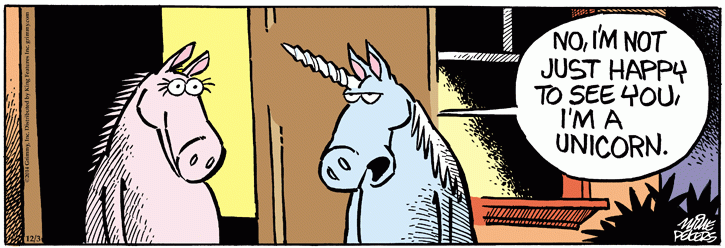
Daily Comics Ethics: When Did Erection Gags Become Appropriate For The Funny Pages?

Grimm cartoon

When did I miss the evolution of the newspaper comics, always regarded as the young tyke’s entry into the newspaper perusal habit, into one more entertainment medium requiring ratings and advance parental review? The comic above appeared in today’s Washington Post and elsewhere. I think it’s funny—for a Playboy cartoon. Maybe it’s not too racy for the New Yorker. But the funny pages? Seriously? This is an erection joke! In a strip with Mother Goose in the title! (The strip is “Mother Goose and Grimm” by Mike  Peters, who is also an award-winning political cartoonist.) It refers to the classic naughty line that had censors screaming when Mae West said it (after writing it.) My Dad read the daily comics to me before I could read, then explained the jokes that I couldn’t understand. Is this the kind of joke toddlers will be having explained to them now? Continue reading

Print The Legend Ethics: The “War of the Worlds” Panic

OrsonWellesDailyNews

One of the worst results of an untrustworthy news media is that it becomes difficult, as time passes, to determine with any certainty what the truth is.

A classic example is on display today, in Slate, which celebrates the 75th anniversary of young, svelte, Orson Welles’ famous Halloween Eve broadcast of his radio adaptation of H.G. Wells’ “War of the Worlds,” with no Tom Cruise or Dakota Fanning but a nice conceit that involved telling the story through fake news flashes and eye-witness interviews. (One reporter is fried on the air by the Martian invasion vehicles.) An new NPR program and a PBS documentary both tell the familiar story of how the realistic-sounding radio play caused widespread panic among radio listeners who missed the opening credits, leading them to think that Earth was really under attack. Newspapers of the day headlined mass panic, and gave accounts of citizens running for cover, huddling in the basement, and cringing in terror.  The episode made Orson Welles a national celebrity, and launched him on his meteoric, long and strange career.

According to Slate authors Jefferson Pooley and Michael Socolow, it never happened. Declaring the story of the “War of the Worlds” panic a myth, the authors state without equivocation that the newspaper accounts, headlines, commentary and interviews, were fabricated:

“Radio had siphoned off advertising revenue from print during the Depression, badly damaging the newspaper industry. So the papers seized the opportunity presented by Welles’ program to discredit radio as a source of news. The newspaper industry sensationalized the panic to prove to advertisers, and regulators, that radio management was irresponsible and not to be trusted. In an editorial titled “Terror by Radio,” the New York Times reproached “radio officials” for approving the interweaving of “blood-curdling fiction” with news flashes “offered in exactly the manner that real news would have been given.” Warned Editor and Publisher, the newspaper industry’s trade journal, “The nation as a whole continues to face the danger of incomplete, misunderstood news over a medium which has yet to prove … that it is competent to perform the news job.” Continue reading

Dubious Ethics Studies, Part I.

Thanks to Malcolm Gladwell (Blink) and the one-word titled books he has inspired, we are being exposed to more social science research than ever before, much of it with relevance to ethics. I’ll admit to using some of these when they support my point of view, and that is the problem: what such studies supposedly signify often tell us more about the biases of the analysts than the behavior of the subjects. Two recent studies illustrate the point. Continue reading

Ethics Hero: Peter Shellem (1960-2009)

Newspapers are on the ropes these days, and sometimes I am not sorry. Even the best of them are too often sloppy, superficial, biased and incompetent. If they go down for the count, however, we will dearly miss the likes of Peter Shellem, an old-fashioned gum-shoe reporter who used his professional skills not only to find the truth, but to save lives in the process.

If you were not a regular reader of  the Harrisburg, PA Patriot-News, the odds are that you never heard of Shellem. I  hadn’t, until I read his New York Times’ obituary this morning.  His passion was investigating the cases and prosecutions of convicted prisoners when something about their guilt didn’t seem quite right to him.  The Times notes that Defense attorney Barry Scheck called Shellem ” a one man journalism innocence project.”  Shellem’s investigations freed five wrongly convicted Americans, one of them who had been in jail 28 years, since he was fourteen.

A colleague at the Patriot-Ledger, in a remembrance, writes that Shellem did what he did because he was genuinely offended that our justice system could be so unjust. In this he was ahead of his time, for only recently, in the wake of the Duke lacrosse scandal, has the  extent and impact of prosecutorial excesses begun to inspire the media and law enforcement to scrutinize past convictions and current prosecutions with due skepticism.  There are more innocent people behind bars than we once believed, as well as many guilty prisoners who did not receive the rights guaranteed them as citizens. Peter Shellem didn’t help all of them directly, but his work did.

It appears that Peter Shellem committed suicide. Though he was apparently dissatisfied with his life, we should not be. His work was meaningful; his impact on the lives of others was profound, and his work set  high ethical standards for us all. His credo: If you see a wrong, fix it. If you recognize injustice, expose it. If you detect corruption, stop it.

We should all aspire to follow his example.