The Legal Profession Appears To Have A Serious Character Standards Problem…

I refer you, for context, to the recent post about Shon Hopwood, Georgetown Law Center’s former bank-robber, former federal prisoner professor, who was welcomed into membership in the D.C. bar…like me.

Now comes word that Tarra Simmons, a third-year law student, convicted felon and former drug addict, who in December won a Skadden Fellowship to help people recently released from prison, was told by the Washington State Bar Association that she did not possess the character to make her a trustworthy lawyer.

Tarra was a magna cum laude law school graduate, and co-chairs Washington’s Statewide Re-Entry Council.  She recently received a gubernatorial appointment to the state’s Public Defense Advisory Committee, and was selected by the dean of Seattle University School of Law to receive the school’s dean’s medal this year.

Nevertheless, the character and fitness board’s vote against Simmons was not even close, at 6-3.

A registered nurse for 11 years, Simmons became addicted to prescription drugs and methamphetamine after her father died, as she self-medicated for depression. In 2011, she was charged with felony theft, drug possession and gun possession, pleaded guilty, served 20 months in state prison. She says she  wants to assist former justice-involved individuals, as  a lawyer who has lived their experience, so they “can overcome barriers and rejoin society.”

But Tarra cannot cannot take the Washington Bar examination without getting a positive  character and fitness recommendation, and that looks unlikely. She’s appealing to the Washington Supreme Court, but traditionally that forum is tougher in assessing the  character and fitness of  potential admittees.

I think her course now is obvious: move to the District of Columbia. The bar there will surely see no reason to doubt her character.

After all, it’s not like she robbed a bank.

__________________________

Pointer: ABA Journal

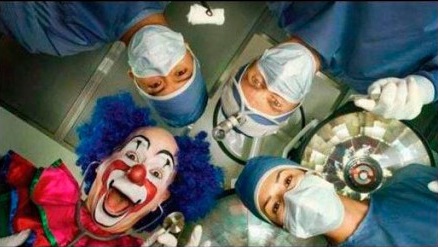
Disrespect And Assault In The Operating Room: Our Nightmares Are Real

clown-in-the-operating-room

“A few moments later, the anesthesiologist walks in the room and asks, ‘What do you got?’ Dr. Canby says, ‘Vaginal delivery. Uterine atony. External massage failed. Give her some ketamine.’”…I look at Mrs. Lopez—her eyes are half-closed and vacant. Dr. Canby instructs me to hold her knee. A fellow medical student holds her other knee….Canby then performs an internal bimanual uterine massage. He places his left hand inside her vagina, makes a fist, and presses it against her uterus. I look down and see only his wrist; his entire hand is inside her. Canby puts his right hand on her abdomen and then massages her uterus between his hands. After a few minutes, he feels the uterus contract and harden. He says something like, ‘Atta girl. That’s what I like. A nice, tight uterus.’ And the bleeding stops. The guy saved her life…But then something happened that I’ll never forget. Dr. Canby raises his right hand into the air. He starts to sing ‘La Cucaracha.’ He sings, ‘La Cucaracha, la cucaracha, dada, dada, dada-daaa.’ It looks like he is dancing with her. He stomps his feet, twists his body, and waves his right arm above his head. All the while, he holds her, his whole hand still inside her vagina. He starts laughing. He keeps dancing. And then he looks at me. I begin to sway to his beat. My feet shuffle. I hum and laugh along with him. Moments later, the anesthesiologist yells, ‘Knock it off, assholes!’ And we stop.”

This is an operating room anecdote related in an anonymously authored article published this week in the Annals of Internal Medicine, a respected medical journal. The publication says that the piece is intended to shine light in a dark corner of the medical profession. Oh-oh. The essay is anonymous, I assume, because the author is afraid that there would be professional repercussions from his revealing this—what? Bad habit? Dirty secret? Crime? Reason for us to go stark, raving mad? Continue reading

Ethics Dunce: Alexandra Robbins, The Mocking Nurse

Mockery

If you set out to defend ethically indefensible conduct in print, you better be able to do a better a job of it than this.

Alexandra Robbins, in an op-ed causing quite a bit of controversy in the Washington, D.C. area, attempted to not only justify the despicable conduct of medical professionals deriding and ridiculing their unconscious patients, but to sanctify it, arguing, lamely, that doctors and nurses are mocking the unwitting and vulnerable human beings who have placed their lives in their hands in order to “rejuvenate [the medical personnel] and bond them to their teams, while helping to produce high-quality work. In other words, the benefits to the staff — and to the patients they heal — outweigh occasional wounded feelings.”

Right.

Robbins’ protests of virtue amount to a desperate raid on the Ethics Alarms Rationalization List, which, as always, operates as virtual Rotting Ethics Detector, or RED. If you find yourself thinking these corrupting self-delusions, you’re on the verge of unethical conduct; if you find yourself saying them, you’ve applied for membership in the Dark Side, and if you are so rationalization-polluted that you proclaim them in print, like Robbins, you shouldn’t be trusted to mail the water bill, much less to cavort in the operating room.

Rationalizations aren’t the only ethical problem with her loathsome essay. The entire thing is a Jumbo, denying the blatantly undeniable. “Oh, no!” readers are told. “We aren’t being disrespectful to patients when we mock their weight, sex organs, or the maladies that placed them in pain, peril and in our care!” Robbins expects us to believe that insults constitute “non-destructive coping measures” that help nurses and doctors “provide the best possible care, even if those methods might seem unprofessional outside of the health-care setting.”

They seem unprofessional because they are unprofessional. Continue reading

Ebola in Dallas: No Excuses For the CDC

doctor_stooges_2

The statement by the nurses union in Dallas describing the Three Stooges level breaches in safety protocols surrounding the treatment of Thomas Duncan, the nation’s first Ebola fatality is shocking, but it should be no surprise, ironically. By now, Americans should be used to being told that our benevolent overseers in the government have matters well in hand, our best interests at heart, and the expertise and resources to do the job governments are supposed to do.  They are also used to discovering, especially lately, that the expensive systems and professionals we have been instructed to trust are in truth lazily administered, incompetently run, staffed with too many sluggards just waiting for a paid retirement, and most of all, well aware that failure carries little or no accountability.  In the recent past it has been the Secret Service, the Veterans Administration, the State Department, Homeland Security, the IRS, HHS and our military that have shown deficits in management, oversight, planning, professionalism and common sense undermining our trust. Now it is the Center for Disease Control. Continue reading

Gallup’s 2010 Ethics Poll: Little Trust Where We Need It Most

As it does periodically, Gallup has released the results of its surveys to determine what professions Americans regard as ethical, and which ones they don’t. Gallup notes that there has been very little change over the last two years; on its site, it compares the results to those of polls taken from 2004 to the present.

The professions that have positive ratings from the public are nurses, the military, pharmacists, grade school teachers, doctors, police, clergy, judges, and day care providers.

The rest are in the red, trust-wise, with TV and newspaper reporters coming in below auto mechanics and bankers, lawyers below them, business executives even below lawyers, and well below them, Congress, which comes in barely above car salesmen—and more people actually have a low opinion of Congress members than of car salesmen. Congress inches ahead because a larger number also think that members of Congress are ethical.

Probably federal workers… Continue reading