Ethics Dunce: Sen. Rand Paul (R-Ky)

dunce-capSenators should not intentionally set out to make the American public stupid, or to validate invalid ethical constructs. Thus this explanation of his current proposal from Sen. Rand Paul needs to be derided, and should also cause concern for anyone who thinks it’s important for the Republican party to find some leaders who are trustworthy. Paul, in the course of pushing his stillborn, grandstanding plan to use a constitutional amendment to require government bigwigs to live with the same health care laws they impose on the rest of us, said this to The Daily Caller:

“My amendment says basically that everybody including Justice Roberts — who seems to be such a fan of Obamacare — gets it too. See, right now, Justice Roberts is still continuing to have federal employee health insurance subsidized by the taxpayer. And if he likes Obamacare so much, I’m going to give him an amendment that gives Obamacare to Justice Roberts.”

See, the fact that U.S. Supreme Court Chief Justice John Roberts refused to declare the Affordable Care Act unconstitutional using a highly-controversial legal distinction in no way suggests that he personally “likes” it, and anyone who thinks that is what judicial opinions, especially Supreme Court Opinions, mean is shockingly ignorant of the judicial system, the legal system, the law, the role of judges in society, the Constitution, and by extension, pretty much most of the principles that give government, management and leadership any integrity or competence. The fact that such an anyone has risen to the level of U.S. Senator goes beyond shocking to terrifying. Continue reading
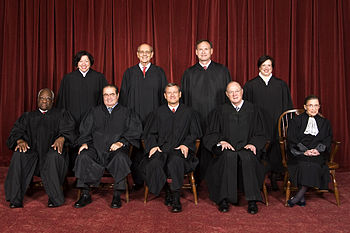

The Supreme Court Upholds The Individual Mandate and Obamacare: The Ethics Opinion

This morning the Supreme Court announced its decision upholding the key provision in the Affordable Care Act, a.k.a Obamacare. It is apparently a huge and complex decision, and is now available in text form online here.

The political and legal analysis will be coming soon from others far more qualified than I [UPDATE: The legal dissections have begun, and you can’t do better than to start here] , and while I am deeply interested in them, that’s not my job. I won’t be able to read the opinions and the various concurring opinions and dissents, not to mention digest them, for quite a while, but some ethical verdicts are already evident from what I do know: Continue reading

The Worst Ombudsman Ever Strikes Again!

"Wait! Wait! It wasn't that good a story! Why did you have to pay so much attention to it? Now Our friends are all mad and everything!"

Patrick B. Pexton, whom Ethics Alarms dubbed The Worst Ombudsman Ever last Fall, has cemented his title with yet another example of bias and incompetence. By rights, he should be in a spirited battle for WOE with New York Times “public editor” (a.k.a ombudsman ) Clark Hoyt, who, among other derelictions of duty, has refused to criticize Times columnist Charles M. Blow for blatant anti-Morman bigotry. At least Hoyt writes about journalistic ethics, which is his (and Pexton’s) job to do, though not always well. The ombudsman’s proper role in any organization is to serve the public interest by answering and resolving complaints against the organization, calling foul when the organization does wrong, and making standards clear when it does not. In a new organization, the ombudsman is the guardian of journalistic ethics, and all that implies, from fairness to objectivity to competence. Pexton seems to see his function as an advocate for the Post when it is under attack, and for the Obama Administration when the opportunity presents itself. That does not serve the public interest.

Thus it is that Pexton has written a bizarre and gratuitous  defense of a Post story that went viral on the internet, arguing that it wasn’t the Post’s fault that so many people paid attention to it, that the story was no big deal, really, and that “only our reactive, partisan, hyperventilating media culture” made it one. Isn’t that strange? A newspaper’s story gets quoted and circulated, and its ombudsman feels that he has to apologize for it? What was the matter with the story? Was it wrong? That would justify Pexton’s professional <Cough!> attentions. Well, no, it wasn’t wrong. Was it unfair? Er, not really, no. What then? Continue reading

Ethics Hero: The American Bar Association

Well, I'll be hornswoggled! INTEGRITY!

The mainstream media and left-of-center pundits managed to leave criticism of President Obama’s bizarre—for a lawyer and supposed authority on Constitutional law, and yes, for a President too—assertion that there was something “unprecedented” about the Supreme Court declaring an act of Congress unconstitutional, and something inappropriate for this to be done by “unelected” judges, to conservative sources, an increasingly common and deplorable technique that allows the Left to thereafter discredit legitimate and non-ideological observations as “partisan.” Thus it was a relief, and a credit to the organization, when the reliably liberal American Bar Association weighed in with the same critique of the President’s comments, with similar intensity. Continue reading

Ethics Quote of the Week: Prof. Paul Horwitz

“I can think of a number of posts about the ACA from legal scholars last week that were clearly and openly offered as advocacy and did a fine job of it. And I can think of others that were clearly not offered as advocacy at all, and said useful and interesting things about the oral arguments…But I do believe that some posts last week traded on the authority of their authors, made overconfident or disingenuous claims about the state of current law and the strength or weakness of opposing arguments, and did so for strategic reasons. I see those reasons as more inculpatory than exculpatory. I don’t see the minimal requirements for scholarly integrity that I offered as changing because of the medium, or because of the importance and currency of the case.”

Hey, Professor! We assume you're smarter than we are: don't play games with our trust!

—-University of Alabama Law Professor Paul Horwitz, writing about the confounding number of liberal law professors and scholars who wrote internet posts professing that the constitutionality of Obamacare’s individual mandate was obvious and undeniable, and that the provision’s Supreme Court approval was assured. As Ethics Alarms did regarding other commentators, Prof. Horwitz suggests that some of the commentary was designed as spin, or to use his term, to “shape the narrative.” He argues that in cases where the scholar was deliberately over-stating the case for constitutionality, this constituted a breach of integrity and honesty. Hie professor-speak for this is “inculpatory.” He means that it was unethical.

Which, of course, it was. Continue reading

Unethical Quote of the Week: President Obama (Sigh!)

“Ultimately I’m confident that the Supreme Court will not take what would be an unprecedented, extraordinary step of overturning a law that was passed by a strong majority of a democratically elected Congress.”

President Obama speaking in the White House Rose Garden about the Supreme Court’s deliberations on the constitutionality of Obamacare.

Obama made John Marshall roll over in his grave. We Marshalls just hate that,,,

This is the kind of presidential dishonesty that drives me bonkers, I must confess. It manages to deceive and misinform. It is dependent on the ignorance of  the public, so it is also condescending, disrespectful, and cynical, in addition to being an intentional  lie.

Not a lie, you say? Perhaps a mistake? Sorry, no dice: Obama was advertised as a former constitutional law expert and a Harvard Law School whiz. He can’t claim now that he’s really a babe in the woods when it comes to the Law of the Land and judicial history.

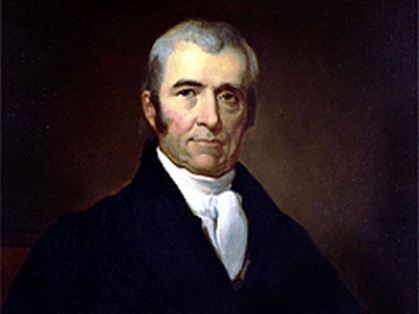
Unprecedented? The power of the Court to overturn unconstitutional acts of Congress was established by precedent, when Chief Justice John Marshall—love that name—led the court to invalidate the Judiciary Act of 1789. Is Obama playing games with “democratically-elected Congress,” since the Senate wasn’t elected directly until 1912, with the passage of the 17th Amendment. I suppose so…if challenged, he can say that he is still right, because all of Congress wasn’t elected “democratically” in 1789. Of course, few Americans know that, so the statement qualifies as deceit. Continue reading

Ethics Quote of the Day: The Editorial Board of the Washington Post

“Sadly, even before the sessions on health-care reform had ended, some liberals were preemptively trying to delegitimize a potential defeat at the court. If the justices strike down the individual mandate to purchase health insurance, they said, they will prove themselves partisan, activist and, essentially, intellectually corrupt. We share in the disappointment that the justices on both sides of their ideological divide are, for the most part, so predictable. That’s not, in the ideal world, how judging is supposed to work. But we also think there’s a kind of cynicism, or at least intellectual laziness, in asserting that this is an easy or obvious call — that no justice could possibly strike down the mandate out of honest, reasoned conviction.”

The Editors of the Washington Post in this morning’s superb, balanced and fair editorial entitled “Civics Lesson From

the Supreme Court.”  The Post leaves no question that it supports the individual mandate as necessary—at least now, after the fact of

"Biased political hacks!! The ones who disagree with us, that is..."

Obamacare’s passage into law—because “no American should go without health care, and that society as a whole should be willing to pitch in toward that end.”  But the editors also properly chastise the cynical and cowardly political calculations by the bill’s supporters that placed the constitutionally-dubious mandate in the position to jeopardize the whole law, as well as criticize the unethical phenomenon that Ethics Alarms discussed here-–the preemptive effort by Democrats and their pundit allies to blame the rejection of Obamacare, if it occurs, on “judicial activism” and political bias by the conservative justices. Continue reading

Incompetent Elected Officials Of the Month: Oh, Brother!

My mood after I wrote this...

As more and more observers predict that the individual mandate, a cornerstone of Obamacare, will be declared unconstitutional by the Supreme Court, I found my mind returning to the topics that have bothered me from the beginning. Why didn’t Congress make certain that it was on sound constitutional ground when it passed the law? Did they really understand what they were passing? Is it possible that our elected officials could spend so much time and occupy so much of the nation’s attention on an issue they didn’t understand? Surely our highest elected officials entrusted with devising the laws of this great nation must understand the powers and limits that relate to their duties in the Constitution. Don’t they? Isn’t that a minimum qualification for office?

George Mason Law Professor David Bernstein has provided clues to the answers to those question, and you’re not going to like them. He writes: Continue reading

Obamacare Defenders, Spinning

Are you hypnotized yet?

It would be nice, it really would, if partisans on both sides of a legitimate, close issue of national importance would admit that there are valid arguments on each side, show some mutual respect, and not frame their arguments as if anyone who thinks differently is deluded, stupid or evil.

Thus it has been elevating, if, I suppose, misleading, to read over a year’s worth of debate on the topic now under consideration by the Supreme Court, Obamacare’s so-called individual mandate, over on the scholar and lawyer- glutted blog, the Volokh Conspiracy. Written by distinguished and articulate academics, it is a right-leaning and libertarian site for sure, yet manages to cover all sides of most of the issues it considers thoroughly and fairly. Nobody could read the detailed, case and precedent-filled essays about the individual mandate and think for a moment that its constitutionality is an open and shut case. It’s obviously a very close question, and one that involves far wider implications than merely one health care law. This is one of the periodic landmark constitutional cases in which the Supreme Court is being asked to approve another key adjustment in the meaning of our remarkably flexible but hard to amend national by-laws, or, in the alternative, put up a red flag and a brick wall that reminds our government that there are some things is cannot do, even if it would dearly like to.

If you care about the case being argued in the Supreme Court as I write this, go read some—it would take you a month to read it all—of the discussions on this topic over at Volokh. If you can understand the sometimes technical and overly-dense writing, you will recognize how difficult a legal issue this is. If you can’t understand it, then stop rendering opinions about the case, the mandate, and the inevitability of its approval or rejection. Journalists and pundits should follow the same advice. Continue reading

A Question For President Obama and His Campaign: Why Lie?

I have an iron-clad rule for all Presidents, regardless of party, ideology and political philosophy: Don’t use deception as a tool of governance. I have a related rule for Presidents who get elected by pledging honesty and transparency in government: Especially you!

The President’s health care law, a.k.a. “Obamacare,” whatever its merits, was probably the most dishonestly sold, packaged and passed major law in U.S. history (if someone has another candidate, please submit it.) Not all of the dishonesty was due to President Obama’s personal efforts–he didn’t tell its House and Senate not to bother to read the various versions of the bill, for example, or submit to the CBO patently manipulated assumptions to ensure its projection of a net budget surplus from the law immediately prior to its passage, assumptions that were substantially revised later. He is the one who pledged over and over again that if you liked your current coverage, nothing the law did would stop you from keeping it, a promise that seemed dubious at the time and that has in fact proven to be either mistaken or deliberately misleading.

Still…the law was passed. Utilitarian justifications and rationalizations for various tactics and maneuvers to get it passed are unnecessary now. So why does the President and his campaign team feel that they have to skirt the truth in their public relations and re-election efforts?

The Tom Hanks-narrated Obama campaign film “The Road We’ve Traveled” has already been charged with truth fouls by objective analysts on many points, including Obamacare. In the assessment of FactCheck.org, the best and most objective of the various political fact-checking websites, the film dissembles regarding, among other things... Continue reading