Good Morning (and I hope you all feel better than I do).
1 Tide Pod Update: If you want more libertarians, here’s how to get them. At the Fortune site, Harold I. Ziegler writes,
Recently, videos have circulated on social media showing teens deliberately eating Tide Pods laundry detergent packs. All of this is part of what some call the “Tide Pod Challenge.” These pods contain highly concentrated laundry detergent under pressure and explode when bitten into, releasing their toxic contents and causing rapid ingestion and inhalation of dangerous chemicals. In my capacity as a toxic chemical researcher and consultant, I have investigated and seen several instances of the horrendous consequences that result from laundry pack ingestion: permanent burning of the mouth, throat, digestive tract, and lung tissue, and in some cases even death.Procter & Gamble (P&G), the manufacturer of Tide Pods, as well as other companies selling laundry detergent packs, have acted in the past to stem the misuse of their products. But these safety measures have failed.
It’s clear that laundry pods as they currently exist are too dangerous to be sold to the public. If P&G and other manufacturers can’t figure out a way to reduce the more than 10,000 injuries they cause each year, laundry packs need to be taken off the market.
If there is a better example of the thought processes that create nanny states and push society to eliminate personal responsibility, accountability and autonomy from its values, I can’t think of it. If people persist in the “Hit Yourself In The Head With a Hammer Challenge,” ban hammers. How do intelligent, educated people end up thinking like this? More amazing still is that a consultant can put out an addled argument like this one for public consumption—Wait! Harold’s opinions make people stupid, and we can’t seem to stop people from reading them! Using Harold’s logic, we better ban freedom of expression! Or Harold!—and still be able to persuade clients to pay for his advice.
2. But if it’s more white nationalism you want, here’s how you get THAT…San Francisco Acting Mayor London Breed, an African-American, was voted out at by her colleagues Board of Supervisors in favor of Mark Farrell, who is white. The Horror. will replace her as interim mayor until voters select a new mayor in June. As soon as it became apparent that the first African-American woman to lead San Francisco, albeit only because the elected mayor died suddenly, was being replaced by a white male, black citizens in the room erupted with rage, with many leaving in protest, and others shouting, “Shame, shame, shame.” “This is war!” some shouted as the meeting ended.
Nice.
In related news, the Congressional Black Caucus announced that it will boycott the State of the Union speech. Continue reading →
1. Say please..…. A group of “Dreamers” blocked an entrance to Disneyland yesterday, as part of a protest demanding a Congressional OK for DACA. I am willing to accept the will of Congress and the President if somehow the illegal immigrants who were brought here as children and never took the initiative to become compliant with the law get a break via DACA. However, they are supplicants. The US has no obligation to accommodate their predicament. I don’t want any demands from them, and the more they demand, the less I am inclined to be sympathetic to their plight.
Ask nicely. Say please. Their sense of entitlement is redolent of the attitudes of the advocates of the usual, everyday, garden variety illegal immigrants. How dare the country we entered illegally enforce the law? If the “Dreamers” want to ask for a compassionate exception, I’ll listen, just as I’ll consider the pleas of panhandlers and homeless veterans. But don’t you dare tell me I have to give you a handout. And as non-citizens, “the “Dreamers” have no basis to protest anything.
2. Is it news yet? If you had no inkling that the FBI somehow “lost” thousands of text messages sent between those lovebirds, FBI counterintelligence expert Peter Strzok and FBI lawyer Lisa Page, at the exact point where their conversations and expressed desire to “stop” President Trump may have been especially interesting, you are not alone. There is an internal Justice Department investigation about the communications that went on during the extramarital affair, in part because both were involved in the Mueller investigation into whether there is some way that Democrats can find a legitimate reason to impeach President Trump. Strzok also helped lead the FBI’s probe of Hillary Clinton’s private email server—also now under renewed scrutiny, since more evidence suggests that it might have been rigged; did you know that?— and was initially involved in Special Counsel Mueller’s inquiry into Russia’s 2016 election meddling. Strzok was kicked off the task force after Mueller learned that there was smoking text message evidence that he detested the President, and Strzok and Page had texted about the need for an “insurance policy” against Trump being elected, creating a prima facie case that the investigation included supposed objective seekers of truth who had a political agenda. Page, Strzok’s secret squeeze, was also on Mueller’s team before returning to the FBI. That makes two potential anti-Trump moles. Continue reading →
To be clear, the KABOOM! in this case, which is the announcement that something has made my head explode, is not because of the ridiculous theory itself, but because I was wrong to believe that theories coming out of the Trump Deranged Who Were Once Smarter Than This couldn’t get worse. I thought the theory that it was obstruction of justice for President Trump to fire an employee and subordinate, James Comey, whom not only he clearly had the authority to fire, but that just about everyone in the country in both parties had declared inept, biased, or criminal at one time or another over the past 12 months, and who had clearly committed firing offenses under Trump.
How could anyone of any authority or expertise whatsoever come up with a more idiotic theory than that? I was certain the answer was, “They can’t.” I bet my head on it.
Ah, but the hate of “the resistance” and the professionalism-corroding power of the Anti-Trump Brain Eating Virus is stronger than even I thought. Get this, and hold on to your heads:
In a USA Today story President Trump’s counsel John Dowd—he’s the one who doesn’t use obscenities or look like an axe-murderer—acknowledged that he had engaged in communications with the Special Counsel on behalf of his client, conveying how much the President “appreciates what Bob Mueller is doing.” Dowd said that the President asked him to convey his “appreciation and greetings.”
Ah-HA! Notre Dame professor Jimmy Gurulé, a former U.S. assistant attorney general under President George H.W. Bush, told LawNewz.comthat the message from Dowd could be construed as intimidation or an effort to influence the investigation. “‘I’m watching you.’ How else could it be interpreted?” Gurulé said. ‘ Thank you for conducting an investigation into my campaign. Thank you for conducting an investigation into my son and my son-in-law.’”
How else? Gee, I don’t know. I’d interpret it as, “I appreciate what a difficult task you have, and understand that we all have to do our jobs”…
Law professor/blogger Jonathan Turley’s latest essay, “Roper’s Resolve: Critics Seek Dangerous Extensions Of Treason and Other Crimes To Prosecute The Trumps” had me at “Roper,” Turley’s direct reference to the most often posted movie clip on Ethics Alarms,* the scene above from “A Man For All Seasons.” Turley applies the scene correctly, too, to the depressingly large mob of previously respectable and responsible lawyers, elected officials, scholars, academics, journalists and pundits who have betrayed their professions’ values and ethics to falsely tell a gullible public that the President and members of his family, campaign and administration have committed treason, espionage, conspiracy, election fraud and obstruction of justice when such accusations are not supported by law or precedent, evidence, facts or common sense. These accusations are, rather, the product of unreasoning fury and bias sparked by Donald Trump’s election as President.
Some of the individuals Turley names, like Senator Tim Kaine, Hillary’s running mate, may be just spewing political bile out of a lack of integrity. Kaine is a former prosecutor and should know better. Some, like Cornell Law School Vice Dean Jens David Ohlin, may be examples of bias making smart people stupid. MSNBC legal analyst Paul Butler, who claimed Trump was “conspiring with the U.S.’ sworn enemy to take over and subvert our democracy,” and who declared it is now “clear” that “what Donald Trump Jr. is alleged to have done is a federal crime” are, sadly, typical of how the unethical and dishonest the news media now behaves much of the time. As for my fellow legal ethicist Richard Painter, also fingered by Turley, I’m convinced from his increasingly extreme and hysterical anti-Trump analyses that he has been driven to the edge of madness by Trump’s election. He’s not the only one.
Turley also points to former Watergate assistant special prosecutor Nick Akerman, who is just plain wrong. One cannot claim, as Ackerman does, that there is “a clear case that Donald Trump Jr. has met all the elements” of a violation of the election laws when, as Turley points out, no court has ever reached such a conclusion. That is prima facie evidence that there is no clear case.
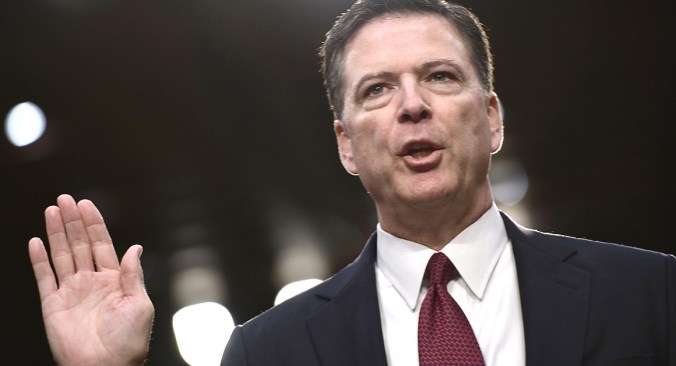
1. “Even though I was appointed to a ten-year term, which congress created in order to underscore the importance of the FBI being outside of politics and independent, I understood that I could be fired by a president for any reason or for no reason at all. And on May 9th, when I learned I had been fired for that reason, I immediately came home as a private citizen. But then the explanations, the shifting explanations, confused me and increasingly concerned me. They confused me because the president that I had had multiple conversations about my job, both before and after he took office, and he had repeatedly told me I was doing a great job and he hoped I would stay. And I had repeatedly assured him that I did intend to stay and serve out the remaining six years of my term. He told me repeatedly that he had talked to lots of people about me. Including our current attorney general. And had learned I was doing a great job. And that I was extremely well-liked by the FBI work force. So it confused me when I saw on television the president saying that he actually fired me because of the Russia investigation. And learned, again, from the media that he was telling privately other parties that my firing had relieved great pressure on the Russian investigation. I was also confused by the initial explanation that was offered publicly, that I was fired because of the decisions I had made during the election year. That didn’t make sense to me for a whole bunch of reasons, including the time and all the water that had gone under the bridge since those hard decisions had to be made. That didn’t make any sense to me. And although the law required no reason at all to fire an FBI director, the administration then chose to defame me and more importantly the FBI by saying that the organization was in disarray. That it was poorly led. That the workforce had lost confidence In its leader. Those were lies, plain and simple. And I am so sorry that the FBI workforce had to hear them and I’m so sorry the American people were told them. I worked every day at the FBI to help make that great organization better. As a help, because I did nothing alone at the FBI. There are no indispensable people at the FBI. The organization’s great strength is that its value and abilities run deep and wide. The FBI will be fine without me. The FBI’s mission will be relentlessly pursued by its people and that mission is to protect the American people and uphold the constitution of the United States. I will deeply miss being part of that mission, but this organization and its mission will go on long beyond me and long beyond any particular administration. I have a message before I close for the — for my former colleagues of the FBI. First I want the American people to know this truth. The FBI is honest. The FBI is strong. And the FBI is and always will be independent. And now to my former colleagues, If I may, I am so sorry I didn’t get the chance to say good bye to you properly. It was the honor of my life to serve beside you, to be part of the FBI family and I will miss it for the rest of my life. Thank you for standing watch, thank you for doing so much good for this country. Do that good as long as ever you can. And senators, I look forward to your questions.”
Observations: This entire statement is unworthy of the emphasis that has been placed on it by the wildly spinning news media, The key piece of information to frame the entire episode is “I understood that I could be fired by a president for any reason or for no reason at all.” Comey also presumably understood that a sub-fact within that understanding is that he could be told some of the reasons he was fired, no reasons, or the reasons the President felt like talking about. He was told he was doing a great job and then fired? Welcome to the work force. Telling an employee that he is doing a great job when he isn’t may be good management, usually isn’t, but is still well within the range of management discretion, and certainly not illegal.
Comey said that he also concerned that the President was saying that firing “had relieved great pressure on the Russian investigation.” As we learn later, the President was not being targeted in that investigation, and we know that he regards it as a politically motivated effort to distract and derail his administration and its agenda. There was nothing sinister about the President’s desire that the investigation go away as quickly as possible. I would argue that he has an obligation to do whatever he can to speed it along. If he didn’t trust Comey’s judgment—and who would?—seeing his exit as a plus is reasonable. Naturally, Comey wouldn’t see it that way.
It is amazing to me that a fired employee saying that his superior’s assessment that his organization was in disarray, that he was a poor leader and that his staff had “lost confidence In its leader” is given any weight at all. What fired employee doesn’t think his firing is unjust and the criticism of him is unfair? Comey calls it a lie: how does he know what Trump had been told or heard? How does Comey know what his agents say behind his back?
Your opinion that someone’s negative opinion about you is wrong and based on erroneous information does not make that opinion a lie. As a lawyer, Comey should know that, and should not have thrown the word “lie” around to be misunderstood by people who don’t know what a lie is—that is, most of the public. Continue reading →
1. Mainstream media bias has been such a frequent topic on Ethics Alarms that I hesitate to focus on it even when, against all odds, what passes for American journalism has another rotting chunk fall off. The reaction of most of the media to the Comey testimony was a huge chunk, once again shocking me when I didn’t think my regard for this unprofessional profession could sink lower. Some commentators yesterday (they were conservative, but there is no reason a fair and objective liberal wouldn’t and shouldn’t come to the same conclusion) said that we are witnessing the birth of a mainstream media-progressive fusion political party. This is not a hysterical analysis. The New York Times coverage of the Comey hearing, for example, was so misleading and dishonest as to eliminate that paper from ever being regarded as a reliable political analyst again, at least until it cleans house and issues an abject apology to the nation. Ethics Alarms reader Greg did an excellent job detailing the Times’ disgraceful anti-Trump/pro-resistance spin in the thread on the Comey testimony post, as did journalist commenter Tippy Scales.
The Times knows its first take was untenable; you can tell by its editorial today, in which it already is changing the subject. If Comey had laid a glove on Trump (and he didn’t) regarding impeachable conduct and a route to removing him—which was the Left’s fervent hope and the resistance’s confirmation bias-driven fantasy—the Times would have been shaking its fist and demanding action in it Sunday pronouncement. Instead, it offered an extended whine about how Paul Ryan excused Trump’s clumsy handling of his communications with Comey by citing Trump’s inexperience, but that he had condemned President Obama for his inexperience, as if the two positions are inconsistent. First, they are not: Ryan did not support Trump’s nomination, though political inexperience was the least of his disqualifications. Second, the President’s cluelessness is directly relevant to the weaker than weak argument that he was obstructing justice by having the kinds of conversations with a subordinate that is commonplace in a business setting. The Times, as it has been doing a lot lately, simply assumes away an insuperable obstruction to its “resistance” position, , saying that “The president obviously knows that it’s wrong to interfere in an investigation.”
Like Hillary Clinton, apparent cyber-dolt, “obviously” knew that using a private server for State Department business violated classified communications law?
The same logic that Comey himself used to give Clinton a Stay Out Of Jail pass applies to Trump’s statements to Comey, but far more reasonably. Not only was he not, as Ryan said, “steeped in the long-running protocols that establish the relationships between D.O.J., F.B.I. and White Houses,” the President wasn’t interfering in the Flynn investigation by telling Comey he hoped it would end, and he couldn’t interfere in the Russian investigation by firing the FBI director. The Times editorial reveals the real impetus behind the paper’s determination to bring down the President who dared to be elected by “deplorables” who don’t march to the Times’ ideological lock-step: Trump “[struts] about at the head of the party, insulting everyone and everything in sight: staff members, allies, laws, diplomatic decorum and common sense.”
Yes, for once the Times is reporting accurately, but that’s not grounds for removing an elected President, and it does not justify misrepresenting facts to create a public groundswell based on bias, hate, fear and ignorance.
2. And when it is clear that the news media and the Democrats are coordinating in an “Anti-Trump” party, what is a responsible stance for the Trump Administration regarding news organizations who wave the anti-Trump banner at the expense of fair reporting? Continue reading →
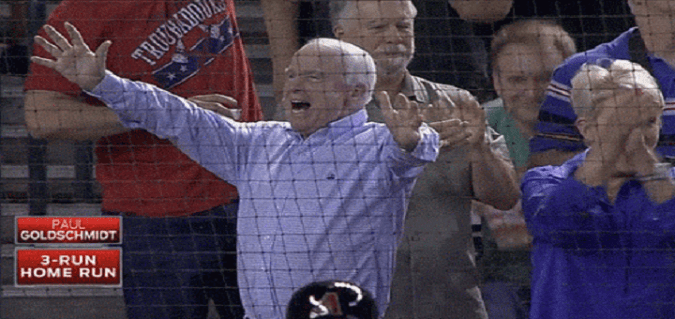
A sub-plot of yesterday’s fizzled firecracker of a “bombshell testimony” by James Comey was Senator John McCain’s bizarre questioning. When I saw how many of my “resistance” member Facebook friends were talking about it, I knew how disappointed they were that Comey produced no smoking guns or even a soggy water pistol. Poor John picked the wrong day to stop taking Ginkgo Biloba. Still, Democrats and Republicans alike were bothered by a senior senator and former Presidential candidate sounding confused and semi-coherent.
I have finally read the transcript, which you should do as well. By now I have also seen a lot of video clips. (James Comey really says, “Lordy!” Wow.)
First, some general observations, with more detailed comments to come in a subsequent post.
1. My earlier expressed opinion of James Comey when I defended him against conservative accusations that he was giving Hillary Clinton an undeserved break by not indicting her were revealed as too generous yesterday. I still believe he is honest and non-partisan. More than ever, I believe that he is untrustworthy. He was obviously in a difficult position—many, in fact—that he was not able to successfully manage, if anyone could have. However, his oft-repeated insistence that he (and his FBI) did not play politics was exposed as false, if not dishonest (a gracious interpretation of the sort that Comey denied the President in his bitter testimony.)
2. The fake Russia collusion narrative pushed by Hillary, Democrats and the news media to simultaneously excuse her loss and undermine the Trump Presidency was killed yesterday, but will wander around like a zombie for months if not years because Trump-haters will not have the integrity to admit they were wrong. Chris Matthews, a once astute and courageous liberal Democrat reporter who morphed into a partisan, knee-jerk progressive shill and anti-Republican scold as soon as he started getting paid by MSNBC, had a sudden flashback to his days of integrity when he pronounced yesterday,
“But the big story has always beenthe assumption of the critics of the president, of his pursuers, you might say, is that somewhere along the line in the last year, the president had something to do with colluding with the Russians. Something to do, a helping hand, encouraging them,feeding their desire, to affect the election in some way, some role they played, some conversation he had with Michael Flynn, or Paul Manafort, or somewhere. And yet what came apart this morning, was that theory, because in two regards the president said according to the written testimony of Mr. Comey, ‘go ahead and get anybody satellite to my operation and nail them, I’m with you on that,’ so that would mean Manafort, Carter Page, someone like that. And then he also came across today what was fascinating, Comey said that basically Flynn wasn’t central to the Russian investigation, that he was touching on it. That there was, of course, Flynn had an honest, we assume, wasn’t honest in his answer on the official forms that he had to fill out to become a national security head.”
But it only touched on that, it wasn’t really related to that. But he could be flipped for that, but in other words, they could flip him because they had him caught on something he dishonestly answered but he wasn’t central to the Russian thing, and I always assumed that Trump was afraid of was that he had said something to Flynn, and Flynn could be flipped on that. And Flynn would testify against the president that he had had some conversation with Flynn in terms of dealing with the Russians affirmatively. And if that’s the case, where’s the there there?”
There is no there there, and never has been. Thus the anti-Trump hysterics are left with what they have always believed was proof enough: Hillary lost, leaked hacks of e-mails that led the public to realize how sleazy the Democrats were should have never been seen by voters, Trump was the beneficiary of the leaks, he had said nice things about Putin, he’s an unethical creep, and a lot of his associates had business contacts with Russia, and besides, they just know Trump is guilty.
That’s not enough; in fact, it’s nothing at all. Matthews as both a lifetime Democrat and a romantic regarding the Presidency and democracy detests Trump to his Irish-American Boston liberal core, but he knows when to get off a bandwagon that will embarrass him if he stays on board, or make it impossible for Chris to look in the mirror.
3. For a lawyer, Comey’s loose use of the term “liar” and his stated belief that he assumed that Trump was a liar early on in their relationship shows a troubling inattentiveness to his own biases, as well as a classic misunderstanding of what it means to lie. Comey said Trump lied about why Comey was fired, for example. Comey has no way of knowing which of the many legitimate reasons for firing him played the biggest role in his firing. He does not know what Trump was thinking, so he cannot assert that Trump lied. He can say that he believes Trump lied, but that is only his opinion: it does not make Trump a liar, and it is not evidence. Last ditch bitter-enders among the Impeach Trump Lynch Mob will be arguing that Comey’s various opinions and reactions prove misconduct by Trump. But lying and obstruction of justice are not like sexual harassment, where a second party, by his or her reactions, determines whether misconduct has taken place. Comey stated that he took Trump’s words that he “hoped” that the FBI would drop the Flynn investigation as a “direction.” He also could have taken it as a marmoset, but that wouldn’t mean that the President meant it as one.
Any time a supervisor says “I hope you do this,” it is a statement of what will make that supervisor happy. (Did Obama ever say to his Treasury Secretary, “I hope the IRS is tough on those tea party groups: they are about as non-partisan as I am!”?) Nevertheless, it leaves the decision in the hands of the subordinate.
4. Comey came off like a classic disgruntled former employee, and I’ve interviewed many of them, angry that he was fired and determined to do as much damage to his former supervisor as possible on the way out the door.
With so much loose talk about impeachment going around (and by “loose” I mean “inexcusably ignorant”), texagg04’s review of the Constitutional standard for the removal of a President is a gift to readers of Ethics Alarms, and one of the most interesting and informative comments ever to appear here.
He was reacting to a New York Times op-ed, cited by another commenter, by political scientist Greg Weiner (no relation) titled, “Impeachment’s Political Heart,” in which the author concluded,
“The question is by what standards they should conduct this work, and that question provides an opportunity to correct the mistaken assumption according to which presidents can forfeit the public trust only by committing what the law recognizes as a crime. That is a poor bar for a mature republic to set. It is not the one a newborn republic established. And that is why the idea that the conversation about impeachment is simply a political persecution of a man who is technically innocent of a literal crime not only jumps the investigatory gun. It misses the constitutional point.”
Having studied the issue myself, I immediately rejected Weiner’s analysis (which still is worth reading in its entirety) on the ground that a constantly evolving standard of what is a “high crime and misdemeanor” simply means that Presidents can be impeached for behaving, or governing, in ways that enough members of Congress, the news media and the public don’t like. That is what is being advocated now, and that approach would undermine our democracy, the power of elections, and the office of the President.
My gut response, however, is wan and insubstantial compared to tex’s masterful historical review and astute analysis, which (whew!) reaches a similar conclusion.
[Weiner] is making an argument from the same source material I mentioned, chiefly the Federalist papers. I still haven’t found Madison’s own specific arguments regarding it, but I think the source is irrelevant as the body of work published by the Founders (“Federalist” and “Antifederalist” alike) should be read as a single work documenting an internal dialogue, to be used as clarification when and where the final adopted documents possibly contain ambiguity. This could very well be one of those cases. That being said, the body of work by the Founders which may aid in revealing their intent or at least how they believed their philosophy of our political system out to be enshrined in the constitution, isn’t the only body of work used to interpret their intent. There is precedence and tradition, which the author of this article disregards when he says “Our tendency to read the impeachment power in an overly legalistic way, which is ratified by 230 years of excessive timidity about its use, obscures the political rather than juridical nature of the device.”
He’s right in nothing but that many of the earliest drafts and proposed language of the impeachment standards were very vague, such as (not an exhaustive list):
“If it was a polite request saying, ‘Oh, you know, he’s a good guy, Flynn, I wish you’d back off this thing,’ that’s not an obstruction of justice. If it was a command, it would raise stronger problems.”
—Retired Harvard law professor , Constitutional scholar, lawyer, liberal and CNN commentatorAlan Dershowitz, trying to explain to MSNBC what “obstruction of justice” means.
I’ve never been a Dershowitz fan, but when the List of Shame is complied after the Post 2016 Election Ethics Train Wreck has finally ground to a halt, he’ll be on another list: the one containing those who maintained their integrity.
He needn’t have bothered: the news media/Democratic Party/ “resistance'” collective has already labelled James Comey’s so far only rumored “memo” recounting that the President asked the then-FBI Director, in a private meeting in February, to close the FBI investigation of Trump’s former national security adviser, Michael Flynn, proof of criminal motives and acts.
The New York Times learned of the memo from two people who claim they had read it. One of them read part of the memo to a Times journalist. According to these unnamed sources’ description of the memo, Trump told Comey, “I hope you can let this go” in a meeting that took place the day after Flynn was forced to resign.
“I hope you can let this go” would be consistent with what Dershowitz, no Trump supporter but apparently yet to be infected with the integrity- and logic-destoying anti-Trump virus, accurately described as “not an obstruction of justice.”
The Times, however, a card-carrying member of the “overturn the election” cabal—we know this because it stated last August that defeating Trump justified tossing journalism ethics into the trash, and because since the election, its pages have from the book reviews to the op-ed pages have been filled anti-Trump propaganda—called Trump’s reported request “the clearest evidence that the president has tried to directly influence the Justice Department and FBI investigation” into links between Trump associates and Russia. This must mean that there is no evidence, at all, since saying “I hope you can let this go” is barely influence at all.
The news of the alleged memo was breathlessly hailed by the “Can we impeach him now?” fanatics, including some readers of this blog who should know better and once did, as a “bombshell.” As Alan Dershowitz dispassionately points out, and as I have in the comment threads, it’s no bombshell. This is not remarkable observation; a New York Times contributor was even allowed to agree with Dershowitz. (The Times can’t completely commit to the lynch mob, for then its efforts to aid and abet would be less valuable. It’s quite a tightrope these people are walking….). Constitutional law prof Elizabeth Price Foley wrote,Continue reading →




 Ethics Alarms
With so much loose talk about impeachment going around (and by “loose” I mean “inexcusably ignorant”), texagg04’s review of the Constitutional standard for the removal of a President is a gift to readers of Ethics Alarms, and one of the most interesting and informative comments ever to appear here.
He was reacting to a New York Times op-ed, cited by another commenter, by political scientist Greg Weiner (no relation) titled, “Impeachment’s Political Heart,” in which the author concluded,
Having studied the issue myself, I immediately rejected Weiner’s analysis (which still is worth reading in its entirety) on the ground that a constantly evolving standard of what is a “high crime and misdemeanor” simply means that Presidents can be impeached for behaving, or governing, in ways that enough members of Congress, the news media and the public don’t like. That is what is being advocated now, and that approach would undermine our democracy, the power of elections, and the office of the President.
My gut response, however, is wan and insubstantial compared to tex’s masterful historical review and astute analysis, which (whew!) reaches a similar conclusion.
Here is texagg04’s fascinating Comment of the Day on the post, “Reluctant Additional Ethics Notes On A Manufactured “Crisis”: The Comey Firing Freakout”…I’ll have one brief comment afterwards: