This is going to start out as a history-heavy day at Ethics Alarms, and Zoe Brain’s terrific Comment of the Day regarding Wernher von Braun, the abuse of science, and the moral compromises of war gets it off to a smashing start.
Quick: how much do you know about Japanese Unit 731? Here’s a sample (and here’s some more background) :
Unit 731 was set up in 1938 in Japanese-occupied China with the aim of developing biological weapons. It also operated a secret research and experimental school in Shinjuku, central Tokyo. Its head was Lieutenant Shiro Ishii.The unit was supported by Japanese universities and medical schools which supplied doctors and research staff. The picture now emerging about its activities is horrifying.According to reports never officially admitted by the Japanese authorities, the unit used thousands of Chinese and other Asian civilians and wartime prisoners as human guinea pigs to breed and develop killer diseases.
Many of the prisoners, who were murdered in the name of research, were used in hideous vivisection and other medical experiments, including barbaric trials to determine the effect of frostbite on the human body.
To ease the conscience of those involved, the prisoners were referred to not as people or patients but as “Maruta”, or wooden logs. Before Japan’s surrender, the site of the experiments was completely destroyed, so that no evidence is left.
Then, the remaining 400 prisoners were shot and employees of the unit had to swear secrecy.
Special thanks is due to Zoe Brain for raising the topic of these horrific Japanese war crimes, which have received so little publicity compared to their Nazi equivalents.
Here is her COTD on the post, “Three Strikes And You’re Incompetent” : The Wernher Von Braun Fiasco, And What It Tells Us About Journalism”:
I am a sometime Rocket Scientist. I am also a sometime senior engineer on military projects – in this context, “Defence Industry” is an unhelpful euphemism to sanitise a regretably necessary evil.
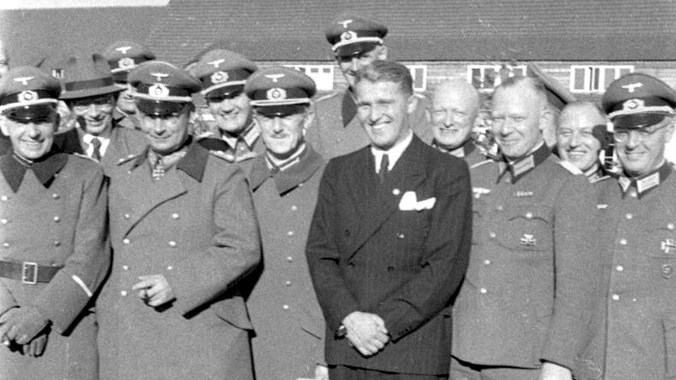
Von Braun is an object lesson. Although a member of the Nazi party, he joined to further his passion of developing rocketry. His later membership of the SS was coerced, though any man of principle would have resisted rather harder than he did.
His boss, Dornberger, who arguably had more influence on the US space program than Von Braun, was a nasty piece of work. He wasn’t just an amoral mercenary with overly flexible ethics, he was quite approving of working slave labourers to death.
I am in no danger of becoming a Dornberger. A Von Braun? Well, apart from the lack of talent on my part, yes, I could see myself becoming like him if I was careless. Just by getting too wrapped up in a technically sweet solution to an intractable problem, by telling myself I was advancing Science for all Humanity, and a hundred other justifications and excuses for selling my soul, one compromise at a time.
Maybe I already have done. Some work I did 25 years ago is now in the hands of a regime I do not trust. Had they been in power then, I would not have worked on that project, just as I refused to work on some others. Continue reading
 Ethics Alarms