Tim LeVier elaborates on the ethical awkwardness of President Obama’s stated rationale for not releasing Osama’s death photos, the topic of the post, Death Photo Ethics: Continue reading
Osama Bin Laden
Death Photo Ethics
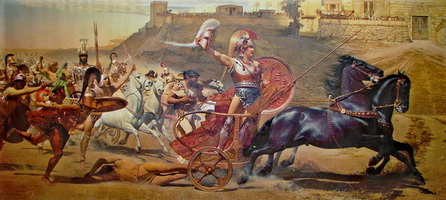
Even before Achilles dragged the corpse of Hector behind his chariot through the dust around the walled city of Troy, the tradition of demoralizing the enemy by degrading and displaying the bodies of its dead heroes was well-established. The United States was horrified when this was done to our fallen servicemen in Somalia, and it is one of the most barbaric and unnecessary practices of war. While the Geneva Convention doesn’t mention the displaying of enemy corpses, a 2005 publication by the Red Cross called Customary International Humanitarian Law does. It was written to address issues that international treaties omitted, and its Rule 113 reads:
“Each party to the conflict must take all possible measures to prevent the dead from being despoiled. Mutilation of dead bodies is prohibited. Continue reading
Geronimo Ethics

"GERONI-"--no, I'm sorry. Let's see...uh..."
Somewhere, I sometimes suspect, there is a mega-computer that scans all news, media, films, TV, video games and pop music offerings, alerting various minority groups to fresh new opportunities to manufacture complaints based on victim-posturing and absurd political correctness. The thought has passed through my brain once again, as I see reports such as the one that appeared in the Washington Post this morning, describing how Native American advocates are offended that the codename for the military operation that killed Osama bin Laden was “Geronimo,” named after the iconic Apache warrior.
A codename, as the term implies, is a word or name intended to stand for something other than its actual meaning and historical significance. Ergo, the Manhattan Project was not a plan to drop New York City on Japan. Many codenames have had absolutely no relationship to their military meanings; what is important is that they not be too hard to remember or too easy for enemies to figure out. The mission to get bin Laden could have been named “Meat Loaf,” “Lindsay” or “Charlie Sheen,” all of whom would have been honored and amused, presumably. The military picked “Geronimo.” Continue reading
No, It Still Doesn’t Justify Torture
No.
The news of how Osama bin Laden was finally tracked down and killed has caused a predictable outbreak of consequentialism. It appears that Khalid Sheikh Mohammed provided some of the key intelligence that led to the successful operation in Pakistan while he was undergoing “enhanced interrogation” in CIA prisons in Rumania and Poland. “See?” Dick Cheney’s fans are saying today. “Rendition and torture work. We wouldn’t have killed Bin Laden without them. So what do you think of those tactics now?” The opponents of torture who foolishly argued against it based on pragmatic considerations—“Torture doesn’t work!”—rather than ethical ones–-“It is absolutely wrong!“—set themselves up for this. Now what should they say? Continue reading
Oh, Shut Up, Rush.
 I tuned in to Rush Limbaugh this afternoon expecting what I got, but hoping otherwise. Sure enough, Limbaugh spent the first half-hour of his broadcast mocking President Obama for taking “single-handed” credit for Osama bin Laden’s death, counting the number of times the President uttered the words “me,” “I,” “my,” and “mine,” and minimizing any credit due to the Chief Executive and Commander-in-Chief when the nation he leads finally accomplishes something it has been trying to do for a decade.
The President of the United States gets the blame and is held accountable for gas prices he cannot control, international upheavals, incompetent local disaster management after hurricanes, economic meltdowns caused by lazy regulators, irresponsible investors, unqualified homeowners and greedy business executives, the botched clean-up of unprecedented oil spills, the abuse of prisoners by hillbilly soldiers thousands of miles away, and every other social, societal and economic ill imaginable. That’s his job, and he wanted it: fair or not, he has to take it. Continue reading
Halloween Ethics! Facebook Ethics! Political Ethics! Blackface Ethics! It’s Tennessee’s Aunt Jemima Affair, the Ethics Controversy That Has Everything!
It’s just after Halloween, and followers of the ethics wars know what that means: somewhere, somebody is in trouble for their choice of costume.
Actually, in this case it’s someone in trouble for her choice of someone in costume to pose with: Tennessee Republican state Rep. Terri Lynn Weaver posted a picture on the Internet of her standing with her pastor, who had dressed up as Aunt Jemima—of syrup fame and black stereotype infamy— for some Halloween festivities. Her caption to the photo:
“Aunt Jemima, you is so sweet.”
Weaver has apologized, swearing that when she posed for the picture with her pastor, she did not know the photo would upset anybody. “It was fun, done in innocence. My friend is dressed up as syrup. He wife was going to be a pancake,” said Weaver. “I never intended to offend anyone. I took the picture off my Facebook. I apologize if it ever meant to offend anyone.” Weaver,who apparently has lived in a cave since 1957, also said she was not aware that Aunt Jemima represented black stereotypes to many people, and was unaware that wearing blackface was also considered offensive to the vast majority of Americans. Yes, she really did. (Note: I know Aunt Jemima as a brand of pancake mix; I did not think the logo gracee any syrup containers. I assumed Weaver confused confused the good Aunt with her white rival. Mrs. Butterworth, who is a syrup brand. Aunt Jemima obviously hangs out with pancakes, so the pastor’s wife was on firm ground, no matter what. But thanks to a syrup-minded reader, I have been set straight: there is Aunt Jemima syrup, too)
State Sen. Thelma Harper, an African-American, said she and members of the Black Caucus want to put Harper before the House Ethics Committee.“This is what we have had to live with, making a mockery of being black and copying the language that Aunt Jemima used,” said Harper.
This controversy has everything! Halloween ethics! Blackface ethics! Facebook ethics! Political ethics! Syrup ethics!
Let’s go through them, shall we? Continue reading
 Ethics Alarms