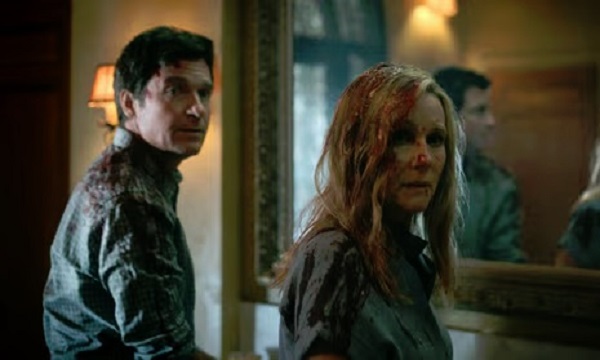
Return to “Ozark”

In 2018, I included a brief note about the Netflix streaming series “Ozark” in a morning “warm-up.” I wrote,

“Call me an old ethics fogey, but I don’t think these kinds of TV series are culturally healthy. I’ve been watching the Netflix series “Ozark,” and hating myself for it. The show is well acted and even has its ethics dilemmas, but like “Breaking Bad,” which was obviously its inspiration, there are no admirable characters, and the “heroes” are criminals. In the Golden Age of TV, there were unwritten (and sometimes written) rules that shows could not rationalize, trivialize or romanticize illegal, immoral or unethical behavior, and needed to reaffirm positive values. In “Ozark,” “Breaking Bad” and “Better Call Saul,” the latter’s spin-off, as well as “House of Cards,” and “Shameless,” among others, there are virtually no admirable characters at all. I have been watching “Ozark” in part because I like the actors, in part because there’s nothing I want to watch anywhere else except baseball, and, yes, in part because of voyeurism. Still, it makes me want to take a shower, and I felt that the increasing tendency of Hollywood to portray everything and everyone as corrupt makes a “the ends justify the means” rationalization seem like a matter of survival.”

Well, that was a shallow and unfair analysis, I am now compelled to say. Living alone with non-work time being a constant challenge between baseball seasons and disappointed by so many other series, I have returned to some old ones that I recalled as at least consistently excellent in scripting and performances, including consensus classics like “The Sopranos,” “Six Feet Under,” “Ray Donovan” and the best of them all, “Lonesome Dove.”

My reaction to “Ozark” the second time through has been completely different from the first time. For one thing, there is so much of it I don’t remember that I have to believe that I didn’t give the show my complete attention on the first viewing. Secondly, I realize now that “Ozark” is an ethics series as much as “The Walking Dead” is an ethics series, and for a similar reason. A normal family is thrust by a confluence of events beyond its control into a set of extreme circumstances beyond their experience and comprehension. They find themselves in a true Bizarro World ethical environment where what is considered ethical in a normal culture will not work, requiring the acceptance of new values and the mastering of new skills, with the alternative being death.
Continue reading

Lazy Sunday Afternoon Ethics Picnic, 5/1/2022: A Very Merry Un-Birthday Edition

There’s vintage Disney—back before it decided it had a stake in having young children instructed in sexual matters by teachers, and when innocence was considered worth protecting. Yes, I recognize the irony in saying that about an “Alice in Wonderland” clip, given that Lewis Carroll was unhealthily obsessed with little girls, often asking their parents for permission to photograph them nude…and got it! (Alice was his favorite model.)

That’s the very strange and great Jerry Colonna voicing the March Hare, and Ed Wynn, of course, as the Mad Hatter.

Today is my “un-birthday.” My 94-year-old aunt, the last surviving member of her generation in my extended family called me up this morning to wish me a happy birthday. Since my real birthday is December 1, I was faced with an instant ethical conflict: was the right course to tell the truth, risking embarrassing her, or to play Birthday Boy, lying but being kind in the process? I opted for honesty, both using the Golden Rule—I wouldn’t want to be patronized—and deciding that my aunt, still sharp and always with a sense of humor, could, like Tom Cruise, handle the truth. She could; she laughed, wondered how she has the wrong date on her calendar, and we talked for an hour. SHE mentioned “un-birthdays,” causing me to recall the song.

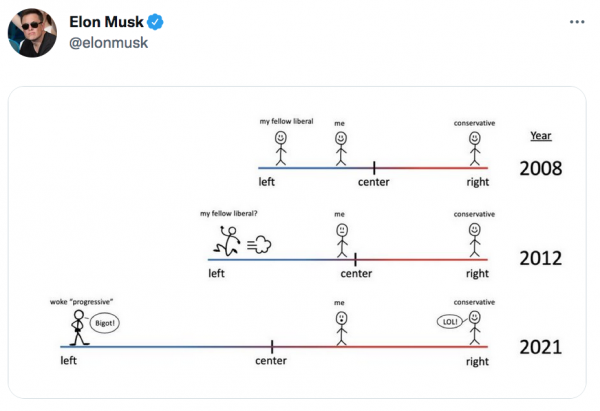
1. Ethics lesson: Integrity should trump Loyalty. Elon Musk, responding to to the absurd ad hominem attacks from progressives calling him a fascist, a white supremacist and, worst of all, a conservative, provided this handy dandy sketch via, of course, Twitter, explaining that his beliefs have remained relatively stable, while his critics’ perspective has shifted:

2. And we trust these people with educating or rising generations…The University of Southern California former dean of the University of Southern California asked the law firm Jones Day to investigate allegations that its education school directed administrators to omit information from its U.S. News & World Report rankings submission to boost the school’s placement.  at least as far back as 2013, According to the just-release investigation results,   former dean Karen Symms Gallagher made sure that the Rossier School of Education only included information on its Ph.D. program, which has a lower acceptance rate than its Ed.D. programs,  despite explicit instructions in the questionnaire to include both Ph.D. and Ed.D. programs. Gallagher stepped down in 2020 after 20 years as dean. She’s now a professor at Rossier.

The probe turned up what Jones Day referred to as “irregularities” in how the education school calculated and reported research expenditures, and it identified other possible misreporting of faculty metrics, online program enrollment, graduates’ job-placement rates and more.  USC had pulled the  school from consideration in the U.S. News & World Report graduate-school rankings prior to the report.

Will she be sacked as a professor? What’s your guess? Continue reading

Sunday Morning Ethics Warm-Up, 9/16/2018: “Ozark,” Slandering Irving, And Language Showdown At Taco Bell [UPDATED!]

Good Morning!

1. Call me an old ethics fogey, but I don’t think these kinds of TV series are culturally healthy. I’ve been watching the Netflix series “Ozark,” and hating myself for it. The show is well acted and even has its ethics dilemmas, but like “Breaking Bad,” which was obviously its inspiration, there are no admirable characters, and the “heroes” are criminals. In the Golden Age of TV, there were unwritten (and sometimes written) rules that shows could not rationalize, trivialize or romanticize illegal, immoral or unethical behavior, and needed to reaffirm positive values. In “Ozark,” “Breaking Bad” and “Better Call Saul,” the latter’s spin-off, as well as “House of Cards,” and “Shameless,” among others, there are virtually no admirable characters at all. I have been watching “Ozark” in part because I like the actors, in part because there’s nothing I want to watch anywhere else except baseball, and, yes, in part because of voyeurism. Still, it makes me want to take a shower, and I fell that the increasing tendency of Hollywood to portray everything and everyone as corrupt makes a “the ends justify the means” rationalization seem like a matter of survival.

2. Post-mortem slander, again. This is a recurring theme here: a famous person is deliberately misrepresented in a dramatic depiction, and legally there is nothing that can be done about it. The First Amendment protects the practice, but it is still wrong, it still leads to public misconceptions, and it still sullies the reputations and legacies of important figures in history who deserve better.

In a recent one-man show Off- Broadway about American song-wrting legend Irving Berlin, writer-performer Hershey Felder portrays Berlin in his dotage as ” a miserable fossil so twisted with rage and zonked on Nembutal that he shooed away carolers who came to his Beekman Place window to serenade him with ‘White Christmas’,”  shrieking “They don’t deserve it,”  meaning the gift of his iconic song. That’s not what happened, however; not even close, according to the Times review of the show:

When he was 95, Berlin not only let those carolers into the house on Beekman Place but also kissed and hugged them and (according to some reports) poured them hot cocoa. “This is the nicest Christmas gift I ever got,” he said.

UPDATE: I relied on the New York Times review for this comment, and not for the first time, trusting the Times to play straight may have been a mistake. Reader Eric Herrault has a very different view, and I am appending his comment here:

In a website however that discusses ethics I think it is important to call attention to the real serious problem here. The quoted “review” in the New York Times of The BERLIN piece, was some kind of personal grudge hatchet job against the performing artist. This brainless reviewer does not describe the show I saw, or in fact the show at all. This is easily provable by seeing the show itself, or having a look at every other New York outlet, major and minor. Nowhere does anyone suggest this twisted and bizarre take on Irving Berlin. The one place it is suggested however, is by the reviewer himself, as he links to and then lauds a review of the book As Thousands Cheer about Berlin, that calls Berlin terrible things and worse. And yet, somehow this neanderthal supports that utter nonsense. The show is full of joy and laughter from beginning to end, with a sad feeling lived too long and the world having passed him by. The ethics violation here is that this disturbed reviewer (for whatever reason) is allowed to write in the first place.

Continue reading