The latest tactic of the anti-gun Left is especially bizarre, but it nicely exposes the desperation and the essential dishonesty of the Parkland shooting extension of the Sandy Hook Ethics Train Wreck, which started its long journey of ethics carnage when gun control advocates decided to jettison fair and civil debate as well as any mooring to reality in exchange for demonizing, emotionalism, and hysteria.
In an op-ed in the Washington Post, gun-opponent Adam Weinstein accused pro-Second Amendment defenders and of bullying and deflection by what he called “gunsplaining.” The term was originally coined by Cosmopolitan four days before the massacre at Marjory Stoneman Douglas High School, though Cosmo’s version was that “gunsplaining” is just a sub-set of “mansplaining,” where men, the theory goes, inherently condescend to women by pointing out when they are wrong about anything. Weinstien’s version was a different, and even more foolish, a rationalization for ignorance:
“While debating the merits of various gun control proposals, Second Amendment enthusiasts often diminish, or outright dismiss their views if they use imprecise firearms terminology. Perhaps someone tweets about “assault-style” weapons, only to be told that there’s no such thing. Maybe they’re reprimanded that an AR-15 is neither an assault rifle nor “high-powered.” Or they say something about “machine guns” when they really mean semiautomatic rifles. Or they get sucked into an hours-long Facebook exchange over the difference between the terms clip and magazine.”
The Horror. In fact, what Weinstein is complaining about is that mean old gun-ownership supporters point out when a knee-jerk, emotion-filled gun control advocate obviously doesn’t know what he (or she!!!,Cosmo) doesn’t know what the hell they are talking about. Note the Post’s Eric Wemple, in the tweet above, calls this a “bad faith” tactic. It’s funny: pointing out that an opponent is full of malarkey has always been a valid debate tactic before, and for good reason. It means that that an advocate’s position is based on ignorance and laziness rather than sound research and facts. Why is this suddenly bad faith. “bullying” and below-the-belt tactics now?
The reason is that the anti-gun Left has bet all its chips on the power of children claiming moral authority to finally lead the anti-gun army to victory over the Second Amendment, and those children wield passion and anger but little else. Despite proclaiming themselves as “experts” on gun policy, as David Hogg recently did on Bill Maher’s “Real Time,” their expertise extends only as far as “Guns Bad!” Thus the “gunsplaining” dodge: who ever said you actually need to know what you’re talking about to be a respectable advocate? Continue reading →
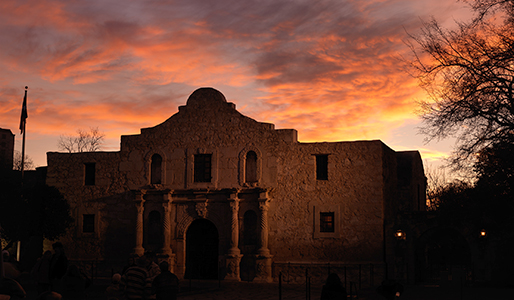
While the Alamo was under siege, the provisional Texas government organized at Washington-on-the-Brazos. On March 2, the convention declared independence and the Republic of Texas was born, at least on paper. The Alamo’s garrison showed its support for independence from Mexico by sending its own delegates to the convention.While they were unaware that Texas had declared independence, the roughly 200 Alamo defenders stayed at their post waiting on help from the settlements. Among them were lawyers, doctors, farmers and a former congressman and famous frontiersman from Tennessee named David Crockett. While the youngest was 16 and the oldest defender was Gordon C. Jennings, age 56, most defenders were in their twenties. Most were Anglo, but there were a handful of native Tejano defenders as well. Legendary knife fighter and land speculator James Bowie was in command before falling ill and sharing duties with Travis. Several women and children were inside the Alamo, including 15-month-old Angelina Dickinson. Just before the final battle, Travis placed his ring around her neck, knowing she would likely be spared. One of the last messages from the Alamo was a note from Travis asking friends to take care of his young son Charles.
The final attack came before dawn on March 6, 1836. As Mexican troops charged toward the Alamo in the pre-dawn darkness, defenders rushed to the walls and fired into the darkness. Travis raced to the north wall but was soon killed. Bowie was most likely killed in his bed, while reports differ as to Crockett’s death. Many believe Crockett survived the initial attack but was put to death by Mexican soldiers soon afterward.
Mexican soldiers breached the north wall and flooded into the compound. The fierce battle centered on the old church, where defenders made a last stand.
BEXAR, Texas, March 6, 1836 — Alas, alas! Forever more, the name of the Alamo shall stand alongside that of Thermopylae in the annals of history as a tale of unmatched bravery to be handed down from generation to generation.
The bastion of Texas Liberty has fallen, and to a man, Lt. Col. William Travis and his fellow defenders — like the immortal 300 Spartans — have been martyred.
After withstanding an unrelenting siege of twelve days’ duration by one of the mightiest armies ever assembled on this continent, the walls of the old mission that had housed Travis (a man as brave as the fabled King Leonidas), Col. James Bowie, the Hon. David Crockett and some 200 other defenders were breached before the sun rose to-day.
Savagery was unleashed therein as a juggernaut orchestrated by the modern-day Xerxes, Mexican Gen. Antonio López de Santa Anna, swept over the Alamo….
Since I was a small boy, this episode in American history moved me more than any other. It still does. I first learned about the Alamo when I watched Fess Parker as Davy Crocket, swinging his rifle like a baseball bat at Mexiacn skulls, the last man standing as behind him we could see more of Santa Anna’s soldiers pouring over the wall. We never saw Davy fall—my dad explained that this was appropriate, since nobody is sure how or when he died, unlike Travis and Bowie, and the last verse of the Ballad of Davy Crocket played…
His land is biggest an’ his land is best from grassy plains to the mountain crest He’s ahead of us all meetin’ the test followin’ his legend into the West Davy, Davy Crockett, king of the wild frontier!
The politics and complexities of the Texas war of independence don’t alter the essential facts: a group of men of different backgrounds, under the command of three prototypical American figures—the pioneer (Crocket), the settler (Bowie), and the law-maker (Travis), all of whom were trying to recover from dark periods in their lives—chose to make the ultimate sacrifice for a cause they believed in fervently enough to die for, in the company of others who felt the same. It was, after all, the perfect ethical dilemma, the choice between an ethical act for the benefit of society and a non-ethical consideration, the most basic one of all: staying alive. They all had the same choice, and rejected life for a principle.
That’s what I remember about the Alamo.
2. There is hope. Once again, I gave a 90 minute presentation to a Boy Scout troop and parents last night, and challenged them this time with several hypotheticals that Ethics Alarms readers would recognize, such as this one, the plight of Ryan Seacrest and those who snubbed him on the red carpet, the “Mrs. Miniver” flower show, and this one, from personal experience, which set off the most lively debate of all:
The Option
Your professional theater company has limited funds, so it offers its actors an option. They may choose a flat fee for their roles, or get a percentage of the show’s profits, if there are any, on top of a much smaller base fee.
The company just completed an extremely profitable production, the biggest hit your theater has ever had. Nine of the show’s ten cast members chose the percentage of profits option, a gamble, because most of the shows lose money. One, the star, who you know could not afford to gamble, took the flat fee for the role. After the accounting for the production is complete, you realize that every member of the cast will make $1000 more than the star, because of the show’s profits.
Question 1: What do you do?
Give him the extra $1000. It’s only fair.
Pay him the flat fee. A deal’s a deal.
You can weigh in:
Question 2: You remount the production, and the exact same thing happens. The actor chooses the flat fee, the show is again a huge money-maker,,and the rest of the cast will make much more than him because they chose the percentage. Do you give him the extra amount again?
No. Now he’s taking advantage of me.
Yes. Nothing has changed.
As before, the approximately 50 11- and 12-year old boys were astute, serious, thoughtful, and gutsy, and their ethical instincts were superb. Continue reading →
1 Programming young victims to lie. In my mailbox today is a message from the Democrats.org, which, I must note, has ignored multiple requests to stop sending me their hackery. I have unsubscribed: it apparently makes no difference. This is both illegal and unethical, and only reinforces my previous conclusions about the House of Clinton, Perez, Pelosi, Wasserman Schultz, et al.
The message is allegedly authored by Sarah Imam, who announces herself as Parkland shooting survivor and writes in part,
On February 14th, I lost 17 members of my community in a mass shooting at my school, Marjory Stoneman Douglas. But we, the survivors, refuse to let their names be forgotten. We refuse to let their deaths be in vain. We have decided to take action to ensure that an event like this will never happen again. We are calling for stricter gun laws. We are calling for change.
Now, is Sarah lying, or is someone lying to Sarah, or to us? There is no “change” that will ensure that no mass shooting, in a school or anywhere else, will ever happen again. This is a false promise. Does Sarah know that, or is she just a puppet, being used to promote a dishonest message? Then we must ask, is Sarah smart enough to know that the only “change” that could even theoretically “ensure that an event like this will never happen again” is to ban and confiscate all guns. Is that what she means? Is that what Democrats really want to do, but can only express it that desire in code, and through the willing, naive mouths of grieving teens?
2. David Brooks doesn’t get it.Again. New York Times Stockholm Syndrome-addled formerly- conservative op-ed writer David Brooks nicely encapsulates the central delusion of “the resistance” and others, arguing that the gun control battle will be the tipping point for a progressive victory in the culture wars because…
“Progressives could be on the verge of delegitimizing their foes, on guns but also much else, rendering them untouchable for anybody who wants to stay in polite society. That would produce social changes far vaster than limiting assault rifles. Two things have fundamentally changed the landscape. First, over the past two years conservatives have self-marginalized. In supporting Donald Trump they have tied themselves to a man whose racial prejudices, sexual behavior and personal morality put him beyond the pale of decent society. Second, progressives are getting better and more aggressive at silencing dissenting behavior. All sorts of formerly legitimate opinions have now been deemed beyond the pale on elite campuses. Speakers have been disinvited and careers destroyed. The boundaries are being redrawn across society.”
This is essentially a Cognitive Dissonance Scale argument by an elitist who can’t distinguish between the public’s scale and his own. Donald Trump is President of the United States because he was elected, despite what Brooks calls his racial prejudices, sexual behavior and personal morality. Can’t Brooks see that he’s essentially making Hillary’s deplorables argument? He is saying that nobody who voted for Trump is a member of “polite society’! Incredibly, he’s also saying that supporting the President of the United States is marginalizing. Wow: get out of that echo chamber, David—RUN! No, you idiot, refusing to support the institution of the Presidency and the integrity of elections marginalizes Democrats, the “resistance,” the New York Times, and YOU. Then Brooks writes that progressives will win because they are getting “better” at totalitarian methods, like suppressing speech. Nah, this isn’t self-marginalizing, not at all! Americans love to have their freedoms disrespected, and to be told that only pre-approved opinions and viewpoints will be allowed when Democrats are in power. Continue reading →
(Wind storms all over Virginia, knocking out power and my e-mail, and blowing over a tree that narrowly missed my son’s car!)
1 Lack of Transparency? What lack of transparency? During a lecture and moderated discussion at U.C.L.A. this week in which he was a a participant and invited guest, Treasury Secretary Steven Mnuchin was heckled with hisses, jeers, shouted insults and profanity from students and protesters, some of whom were ushered and even carried out by police officers. A programmed sixth grader in the audience even questioned him about the fairness of passing permanent tax cuts for companies and expiring cuts for individuals, because as we all know, 10-year-olds are well-versed in tax policy theory.
Afterwards, Mnuchin revoked his consent for the official video of the event to be released, perhaps because he was flustered by the harassment and it showed. In response to criticism of this virtual censorship,
The Treasury Department, through a spokesperson, said that what the Secretary did wasn’t what he obviously did—a Jumbo, aka “Elephant? What elephant?”—saying,
“The event was open to the media and a transcript was published. He believes healthy debate is critical to ensuring the right policies that do the most good are advanced.”
He just doesn’t want anyone to see or hear the debate.
A related point: The protests were organized by Lara Stemple, a U.C.L.A. law professor, and students and faculty members participated. Protests are fine; disrupting the event is not. Faculty members who assisted in the heckling should be disciplined, and students who participated should be disciplines as well. It’s an educational institution, and all views sgould be openly explored and heard without interference. No guest of the university should be treated this way. Ever. No matter who it is or what their position. The treatment on Mnuchin was unethical.
2. More Supreme Court fun with ethics! Minnesota’s law banning “political” clothing and buttons from polling places is being challenged as an affront to free speech. The law prohibits people from wearing a “political badge, political button or other political insignia” at a polling place on an election day, and a member of the tea party movement sued after his “Tea Party” message got him in trouble when he came to vote.
“How about a shirt with a rainbow flag?” asked Alito. “Would that be permitted?”
“A shirt with a rainbow flag?” Rogan repeated. “No, it would — yes, it would be — it would be permitted unless there was — unless there was an issue on the ballot that — that related somehow to — to gay rights.”
Justice Alito: Okay. How about an NRA shirt?
Mr. Rogan: An NRA shirt? Today, in Minnesota, no, it would not, Your Honor. I think that that’s a clear indication—and I think what you’re getting at, Your Honor—
A T-shirt bearing the words of the Second Amendment? Alito asked.
Probably banned because of the gun-control issue, Rogan said.
The First Amendment? Alito asked. Probably not, Rogan answered.
Got it. The First Amendment isn’t a political statement, but the Second Amendment is. That led Justice Neil M. Gorsuch to observe: “Under your interpretation of ‘political,’ it would forbid people from wearing certain portions of the Bill of Rights into a polling place but not other portions of the Bill of Rights. And I guess I’m just wondering what compelling interest Minnesota has identified that requires a statute that goes so much further than the vast majority of states?”
In contrast, Justice Anthony M. Kennedy asked J. David Breemer, a lawyer for the Pacific Legal Foundation, representing the challengers, “Why should there be speech inside the election booth at all, or inside the what you call the election room? You’re there to vote.”
This is a problem requiring an “all or nothing” solution. Either all forms of political speech must be allowed, or no speech at all. In a sick time where citizens honestly argue that a MAGA cap or a picture of a gun makes them feel threatened and “unsafe,” the ethical option would seem to be Justice Kennedy’s. No speech, messages, no logos, no photos, no American flags. Last fall I voted wearing my Red Sox jacket.
Night commenter Zanshin—he is one of the participants whose commentary frequently greets me in the morning–delivered a fascinating exercise expanding on my post about students in crisis situations defaulting to texting and social media rather than actively considering survival and defense alternatives. He was responding to yeoman commentator Chris, a teacher, who appeared to take deep offense at my suggestion that the texts of the Stoneman High School students reflected an unhealthy obsession with electronic devices rather than a healthy acculturation in self-reliance and fortitude in the face of danger.
I’ll mention here what I have said in the relevant comment thread: I know the issue flagged by commenter (and also a teacher) Andrew Myette was not the one I wrote about based on the link he sent me, but my job is to get everyone thinking about values and ethics even when it hurts, and I knew this angle would be especially uncomfortable to explore.
I can’t speak for Jack, but I sure can come up with,
a specific action the students could have taken that had a strong likelihood of being a better alternative than staying where they were.
Disclaimer 1. The text below is a possible scenario for a fictitious class involved in a school shooting. This is in no way intended to criticize schools, teachers, students and others who have been confronted with real school shootings.
One specific action could be … Oh, this is so good; this one is for you Chris … Haven’t you seen MacGyver? I believe he was part of (y)our generation. He would be so proud of this fictitious class who by relying on their unconventional problem-solving skills saved not only theirs but also other lives.
The teacher and about 5 of the strongest kids, may be members of the wrestling club, and yes, someone like Mack Beggs, who was born female and is transitioning to male while taking steroids, can also participate.
The entrance, the closed door is the one spot where one can get very close to the shooter if he/she tries to get in. That’s his/her vulnerable spot. So, the other kids hide in the safest spot. But the ‘welcoming committee’ stands on both sides of the door. With all the weapons and shields they can garner. Sticks and stones, a sharpened pencil, a can with hot water, pepper spray may be, certainly some chairs and tables. [I am here assuming the door opens to the outside.] On one side of the door you stack a few tables with one of the smaller kids on top with the can of hot water or a bag with the content of the waste bucket or what-ever one can throw on him from above (and that will not endanger the attackers on the ground).
On the other side of the entrance one of the kids has a broom. Continue reading →
Actually, that’s dishonest: it’s been a terrible day, morn to now.. A catalogue retailer took an email address my wife sent them a year ago and bombarded her account with hundreds of promotional messages yesterday, crashing her email. Then her efforts to fix the problem resulted in a Proethics system email crash that I have been trying to address for the past five hours. I finally decided to get something productive done, so I’m getting up this post while talking to my tech people. UPDATE: They just gave up.
1 Trump Tweets.Ugh. The President criticizing his own Cabinet member, in this case Jeff Sessions, in public via tweet, is horrific leadership and management practice. If I were Sessions, I would resign, It is disrespectful, disloyal, undermines morale on the President’s team, and is just plain stupid. I don’t understand how Trump had any success at all treating employees and subordinates like this. While we’re on this perpetual subject. the fact that the President would say out loud that he would have rushed the Parkland shooter without a weapon is just more evidence of a) a flat learning curve b) the lack of the usual filters from brain to mouth and c) the unethical tendency of third parties to critique the actions of others in rescue situations. No question: the resource officer who was required by policy, assignment and duty to try to intervene in the shooting deserves all the criticism he has been getting, and is accountable. But the President of the United States announcing that he is Batman is something else entirely.
My objections to the non-stop personal ridicule of our elected leader stands, but he also has a duty, as the steward of the Office, not to make himself look ridiculous.
2. An unethical boycott tactic, but I repeat myself. The anti-gun zealots have decided to attack a free and constitutionally protected Bill of Rights advocacy group as part of the news media-assisted effort to demonize the NRA as being somehow responsible for a school shooting that none of the proposed “common sense gun reforms” would have prevented. Now the Second Amendment-gutting crowd is using the boycott, a particularly odious weapon favored by progressives, which depends on the venality and spinelessness of corporate executives to constrict free speech. Delta Airlines announced it was ending a promotional discount with the National Rifle Association after threats and a social media campaign, then tried the weaselly explanation that its decision to stop offering discounted fares to the N.R.A. “reflects the airline’s neutral status in the current national debate over gun control amid recent school shootings.” Continue reading →
When I hear or read an obvious rationalization that somehow had been left off the Ethics Alarms list, now closing in on ninety ( the new addition makes 89), I think, “That must be on the list somewhere!” When I check and it is not, I marvel, “How did I miss that one?” This was especially true with Rationalization #42, which, please note, bumps “The Hillary Inoculation” to 43, and every subsequent rationalization up one. This is not just a rationalization, but one of the near-evil ones, employed by unrepentant miscreants who count on gullibility, generosity, kindness, forgiveness and fading emotions to allow them to avoid accountability, and harm the same people again later
I almost christened the new arrival “Jake’s Rationalization,” for it was CNN’s Jake Tapper, once a real journalist, now in the final throes of Sienenization, who uttered it. The topic was the recent CNN “town hall” on guns (described here and here), with an audience packed with angry Florida students and their families, yielding questioners who were rude, hostile, and frequently full of misinformation.
The The Hollywood Reporter described the reactions of CNN head Jeff Zucker and Tapper as they tried to deny that their disgraceful stunt was what it so obviously was:
…[E]ven as the town hall was receiving plaudits from the mainstream media, the Florida event was being used as an example of how CNN has morphed into a partisan player. “CNN has decided to take this path where they are kind of left-wing advocates,” says Matt Schlapp, chairman of the American Conservative Union and organizer of CPAC.
It’s a characterization that CNN president Jeff Zucker finds insulting. “That criticism is silly,” Zucker tells The Hollywood Reporter. “The fact is we were there, we presented both sides. People who want to criticize are looking to just criticize before they even think about it.” He points out that Sen. Marco Rubio could have been joined by Trump or Republican Florida Gov. Rick Scott, but both declined CNN’s invitation. “That’s not CNN’s problem,” he adds.
Yes, it was being used as an example because it was an example. The fact that the mainstream media gave this monstrosity “plaudits” confirms that it isn’t only CNN that has morphed into a partisan player. “Both sides” were represented like “both sides” were represented at the Alamo. The audience was unbalanced (in more ways than one), the questions were ridiculously unbalanced (but that’s what happens at town halls when the audience is unbalanced), anti-gun activists and pandering anti-gun Democrats were allowed to make factually misleading statements on national television without corrections from the passive moderator (Tapper, in slug-mode), and the two designated defenders of the Bill of Rights on the stage, Marco Rubio and NRA pretty face Dana Loesch were inept and defensive (or perhaps defensive and inept.) Continue reading →
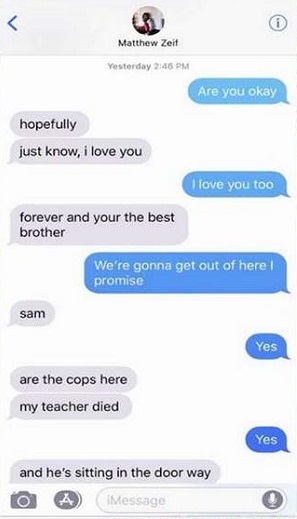
Cross the Parkland shooting with the ethical problems created by technology, and you get this..
One of our engaged readers sent me this story, about how real-time texting and tweeting have become standard fare during mass shootings and other crisis situations. The story is full of positive words for the phenomenon….
The texts hit a nerve with people because they’re so gut-wrenching and real, Pamela Rutledge, director of the Media Psychology Research Center, tells Yahoo Lifestyle. “They are highly emotional, and enable people to feel empathy and a connection to what the students were feeling at the time,” she says. Social media in particular is good for sharing these texts, Rutledge adds. “Removing the sense of mediation in connection is what social media does best,” she says. “It transports people into events and allows them to share the feelings more intensely.”
The messages are also stimulating to people and create a horror-story-type feeling — except they’re not made up, clinical psychologist John Mayer, author of Family Fit: Find Your Balance in Life, tells Yahoo Lifestyle. That can also make the experience more real. “They bring the reality of the dangers in the world into one’s life and right into your personal space,” Mayer says. “Therefore, it becomes even more frightening.”
The texts also allow people to experience the events vicariously, albeit from a safe distance, and can prompt feelings of gratitude and appreciation for the safety they do have, Rutledge says.
But these kinds of texts really resonate because they’re authentic and straight from the source. “They are real-time reporting of feelings and events,” Rutledge points out.
Well, it’s certainly nice that vivid reporting comes out of massacres! What would we do without social media and cell phones!
My reaction is completely different: Why are these people texting and tweeting in the middle of a crisis?Continue reading →
1 One of my favorite Hollywood ethics scenes. I watched “Mrs. Miniver” again last night, the 1942 WWII drama starring the magnificent Greer Garson. It has a wonderful ethics moment late in the film, when Lady Beldon, the wealthy town battleaxe (and the grandmother Mrs. Miniver’s recently minted daughter-in-law, soon to die tragically) presides over the English village’s annual flower show, in which she has won the coveted “Best Rose” prize every year. But beloved old stationmaster Mr. Ballard has developed a magnificent new rose (named after Garson’s character) and desperately wants to win as well. The Minivers tease their elderly relative about the near certainty that she will win as always regardless of the relative merits of her entry and “The Miniver” entered by Mr. Ballard, since the judges are terrified of her, and Lady Beldon has made it clear to all that she regards the annual prize as a virtual entitlement. After all, the prize is even called “The Beldon Challenge Cup.” Sure enough, the judges, who seemed to be having a harder time than usual concluding that Lady Beldon’s rose deserved the award, hand her a slip that places her rose in first place, and Mr. Ballard’s in second.
Lady Beldon shows the slip to Mrs. Miniver with an air of triumph.
MINIVER: This is really important to you, isn’t it?
LADY BELDON: Yes. It’s stupid of me, but there it is. I’ve won that cup for as long as I can remember.
MINIVER: Mr. Ballard’s terribly keen too.
BELDON: Well, he’s had his chance. Hasn’t he? You have such a way of looking at people. What do you expect me to do? Reverse the judges’ decision?
MINIVER: I wouldn’t put it past you. If you happened to disagree with it.
“But I don’t!” she harrumphs. She keeps looking at the two competing roses, though, and also at old Mr. Ballard (played by Henry Traverse, later to portray Clarence the Wingless Angel”in “It’s a Wonderful Life.” His look of anticipation and hope approximately mirrors the expression of a six-year-old on Christmas morning. And when it comes time to announce the winner, Lady Ballard pauses, looks at the two roses again, ponders, crumples up the judges’ slip, and announces that “The Miniver” wins the prize.
Dame May Witty, one of the best character actors England ever produced, shows us with her face that she realizes she did the right thing as soon as she sees Ballard’s reaction to winning. And the assembled crowd gives her an even louder ovation than they give the winner. They didn’t even have to see the slip like the Minivers: they know what she did. And she knows they know.
I had a Lady Beldon moment many years ago, before I had even seen the movie. Continue reading →
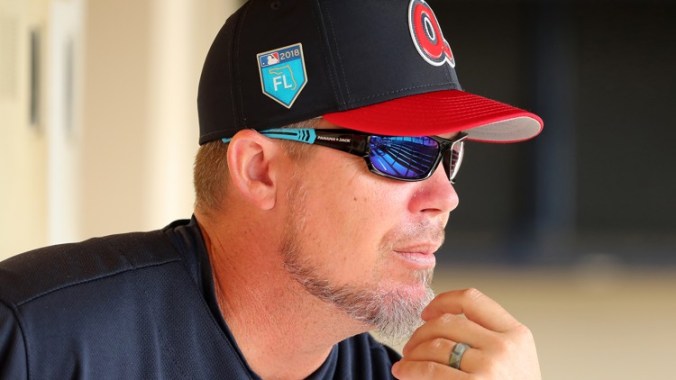
Second Amendment authority Chipper Jones. He’s an expert because he had a .303 lifetime batting average, and shoots deer….
It was gratifying that the weekend post about the “weapons of war” anti-gun rhetoric attracted a great deal of thoughtful commentary here. I was thinking about the post again today when, as is increasingly the case, a sportswriter gratuitously injected politics into sports commentary. Baseball season is fast-approaching, and while one of the many reasons I follow the game so passionately is its ethics content, I look forward to the game to get away from politics, and incorrigible social justice warrior agitators like NBC’s Craig Calcaterra, lapsed lawyer, can’t resist misusing their sports platforms as a political soap box.
“I believe in our Constitutional right to bear arms and protect ourselves,” Jones said. “But I do not believe there is any need for civilians to own assault rifles. I just don’t.
“I would like to see something (new legislation) happen. I liken it to drugs – you’re not going to get rid of all the guns. But AR-15s and AK-47s and all this kind of stuff – they belong in the hands of soldiers. Those belong in the hands of people who know how to operate them, and whose lives depend on them operating them. Not with civilians. I have no problem with hunting rifles and shotguns and pistols and what-not. But I’m totally against civilians having those kinds of automatic and semi-automatic weapons.”
Calcaterra makes sure that we knew that the ex-Braves player is an avid hunter and owns a rife, because he apparently wants us to think that owning a gun makes an athlete an expert on the Bill of Rights. (It doesn’t, and I’m pretty sure Calcaterra knows that.)
“While debate, often acrimonious, will no doubt continue about these matters indefinitely, it’s striking to see someone like Chipper Jones come out so strongly on the matter in the particular way that he has. It has to make people at the NRA and those who support it wonder if, when you’ve lost Chipper Jones, you’ve gone too far.”
Thus we have a lawyer appealing to the authority of a man who played baseball all through highs school, and signed a contract to be a pro baseball player at te age of 18. Call me skeptical, but I question whether he has devoted much research to the history and philosophy underlying the Second Amendment, or has read any of the judicial opinion and scholarship analyzing it. I especially question Jones’ flippant “denouncement” given the tell-tale signs that he doesn’t understand the right to bear arms at all, beginning with the misnomer “assault rifles” and the assumption that the most popular civilian rifle in the U.S. is a “weapon of war.” He also makes the offensive assumption that he is qualified to decide what kind of fire arms other citizens “need,” a commonly expressed attitude sharply discredited in this essay by playwright and screenwriter David Mamet.
I find myself increasingly impatient with uninformed opinions on important matters relating to our personal liberty, expressed by celebrities with no more understanding or special expertise than the typical semi-informed citizen, and often less. I am even less tolerant when I am told by journalists that attention must be paid.





 Ethics Alarms