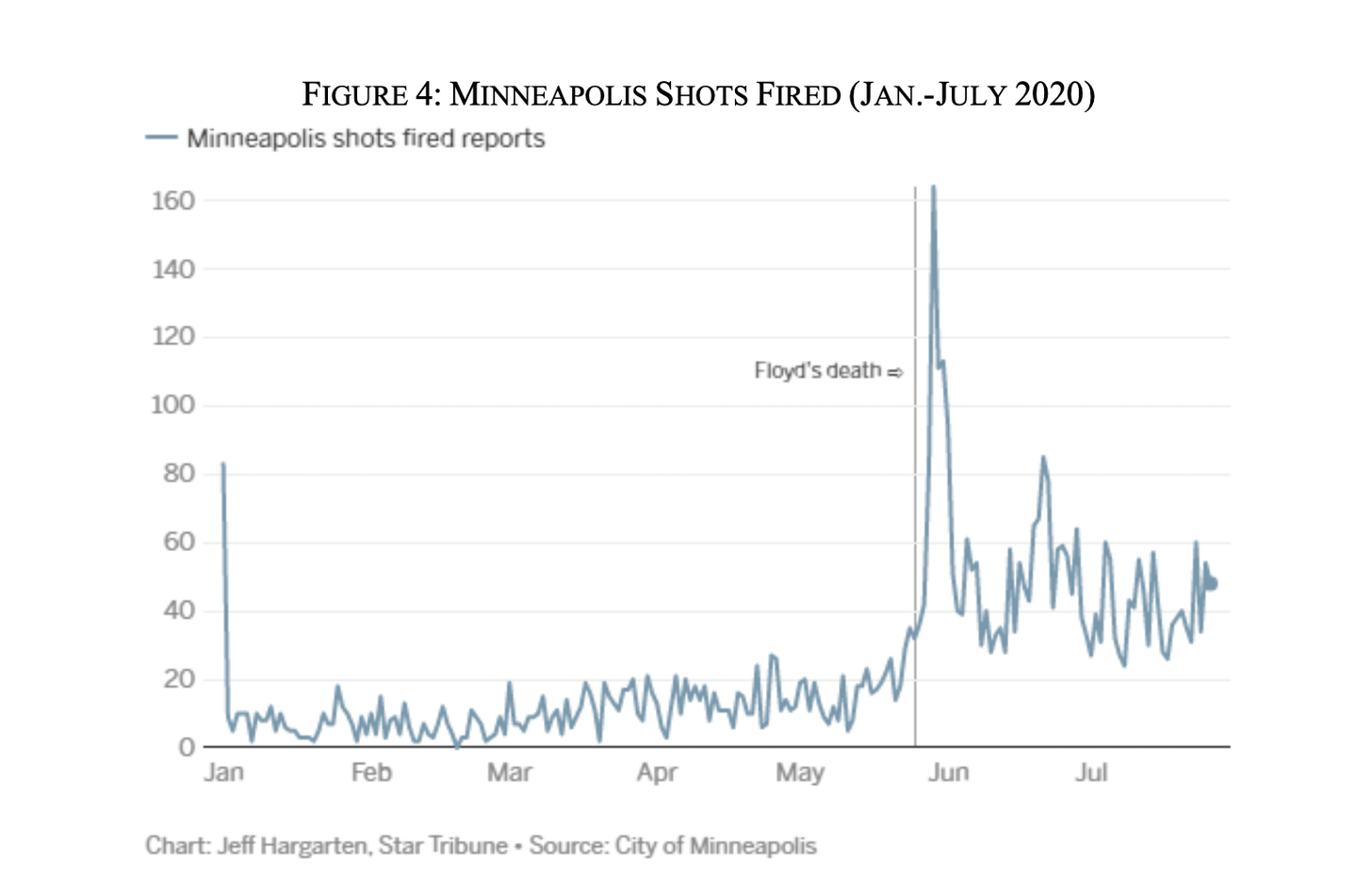
Andrew Sullivan Points Out The Obvious Inconvenient Facts Like They Are A Revelation, But Since He’s Not A Conservative, Maybe Progressives And The News Media Will Accept Reality

death after Floyd

Nah.

In his latest essay on substack, once-conservative-blogger-turned-progressive-shill (because he cared about gay marriage more than anything else)-turned-independent-gadfly Andrew Sullivan demonstrates in detail that what Ethics Alarms (and everyone else paying attention) knew would happen has, in fact, happened. If we ruin every police officer who shoots a black citizen in the line of duty, and allow Black Lives Matter to demonize such officers regardless of the circumstances, we get dangerously hesitant law enforcement, passive policing, more crimes by blacks and and police actively avoiding confrontations with black suspects.

Well, of course. This isn’t hard. But Andrew, a moderate at heart, is a kind-of progressive and always hated Donal Trump, so at least he won’t be accused of “mouthing Fox News talking points” when he states the obvious. Sullivan is also smart, a fine writer, and knows how to make a case, but during the Great Stupid in the course of the George Floyd Ethics Train Wreck, Facts Don’t Matter. But at least he tries. His case, however, is a bit like arguing that the night follows day.

His careful if annoying article deserves a full read, but here are some excerpts and some comments.

Let’s begin with data quoted by the Times,and in turn by Sullivan:

“Homicide rates in large cities were up more than 30 percent on average last year, and up another 24 percent for the beginning of this year, according to criminologists … Homicides in Portland, Ore., rose to 53 from 29, up more than 82 percent; in Minneapolis, they grew to 79 from 46, up almost 72 percent; and in Los Angeles the number increased to 351 from 258, a 36 percent climb … Homicides in Philadelphia are up almost 28 percent, with 170 through May 9, compared with 133 in the same period last year; in Tucson, Ariz., the number jumped to 30 from 17 through May 13, an increase of 76 percent.”

After considering and rejecting other explanations (In a typical Times bit of misdirection, a headline today reads “As Virus Recedes, Mayors Confront An Old Adversary: Rising Crime.” It’s the pandemic’s fault, and if it isn’t, this is nothing new!), Sullivan (correctly) fingers the George Floyd incident:

Before Floyd, no big increase in homicides, aggravated assaults, and shootings. After, a huge spike.Of course, that is not causation. But it’s one hell of a correlation — and no other event seems relevant. It’s as if the Floyd murder, and the subsequent urban chaos, sent a signal: the cops are on the defensive. Which means murderers can go on the offensive. And once lawlessness establishes itself, it tends to compound. A few gang murders can soon morph into tit-for-tat urban warfare.”

Gee, ya think?

Continue reading

Observations On A Bad Police Stop


The ACLU of Colorado last week posted the above  video of an Aurora, Colorado police encounter with two black citizens last February.

The sequence, drawn from one of the officers’ body camera, shows Darsean Kelley and another man being stopped by police after they had received a call about a man allegedly pointing a gun on a child, but with no description of the man. Kelley and his companion were standing on the sidewalk in the vicinity of the alleged incident. Police asked the men  to sit down, which Kelley said was impossible to do because he had a groin injury. Officers then told both men to put their hands behind their heads and turn around. As his friend remained silent and apparently compliant, Kelley kept his hands raised and asked why he was being detained. Immediately after he said, “I know my rights!” one of the officers shot him in the back with a stun gun. He fell backwards into the street.

The police then arrested Kelley on a charge of disorderly conduct for failing to obey a lawful order. In his report, the officer wrote that he thought he might be reaching for a weapon. The ACLU of Colorado then filed a motion to dismiss the case arguing that Kelley was unlawfully detained and arrested without probable cause or reasonable suspicion.

Observations:

1. Kelley and the other man were unlawfully detained and arrested. Were they unlawfully stopped? No. The police could stop men in the vicinity of a complaint like the one they had received in order to investigate it. When people become belligerent or uncooperative during such legal stops, cops sometimes become suspicious, or decide to use their power to stick it to an individual who shows hostility when the officers feel they are just doing their jobs, or trying to. This is when such situations escalate.

I’m sure the officers regarded the “I can’t sit down” claim as suspicious and provocative. I would. Note that no harm befell the other man, who remained quiet and followed the officers’ instructions. This is the correct way to respond.

2. I’m sure Kelley felt that he was being “stopped for being black.” I would if I were him. How are police officers today supposed to allay this suspicion at the outset of a legitimate stop? (Or maybe they WERE stopped for being black…)

3. What is the policy for tasing? The typical hierarchy for the use of force in police departments used to be this:

Table 1: Use-of-Force Continuum
Suspect resistance Officer use of force
1. No resistance 1. Officer presence
2. Verbal noncompliance 2. Verbal commands
3. Passive resistance 3. Hands-on tactics, chemical spray
4. Active resistance 4. Intermediate weapons: baton, Taser, strikes, nondeadly force
5. Aggressive resistance 5. Intermediate weapons, intensified techniques, nondeadly force
6. Deadly-force resistance 6. Deadly force
(Adapted from the Orlando, Florida Police Department’s Resistance and Response Continuum)


After the introduction of more powerful electronic control devices, many departments changed  their use-of-force directives  for handling suspects who were only passively resisting the lawful orders of the officer, and increased the required level of resistance by suspects to warrant use of stun guns or tasers from passive resistance to active, physical resistance.

Table 2: Levels of Resistance Defined

Passive Resistance The subject fails to obey verbal direction, preventing the officer from taking lawful action.
Active Resistance The subject’s actions are intended to facilitate an escape or prevent an arrest. The action is not likely to cause injury.
Aggressive Resistance The subject has battered or is about to batter an officer, and the subject’s action is likely to cause injury.
Deadly-Force Resistance The subject’s actions are likely to cause death or significant bodily harm to the officer or another person.
Adapted from the Orlando, Florida, Police Department’s Resistance and Response Continuum

I don’t know what the Aurora police policy is, but certainly under the kinder, gentler, saner revised standards above, stunning Kelley was excessive. Police brutality is not an unfair description of what he experienced. Continue reading