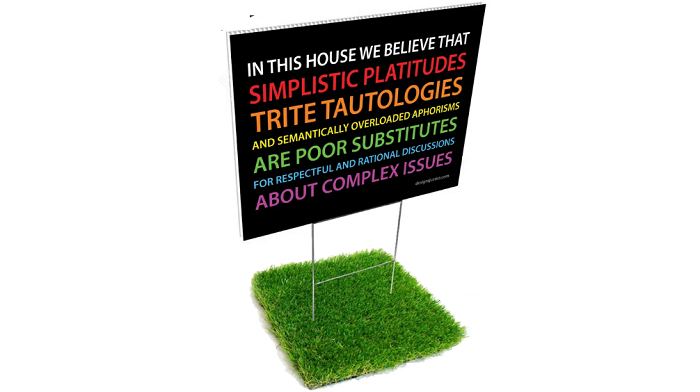
Many thanks to reader and commenter Jeff for bringing that lawn sign to my attention. It’s available here. I wish I had thought of it; one of these days I’ll get around to making a “Bias Makes You Stupid” T-shirt as an Ethics Alarms accessory. I would never post such a sign on my lawn for the same reason I object to the virtue-signaling signs in my neighborhood: I didn’t ask to my neighbors’ political views thrust in my face, and I don’t inflict mine of them. However, if a someone living in a house on my cul-de-sac inflicted a “No human being is illegal” missive on their lawn where I had to look at it every day, the sign above would be going up as a response faster than you can say “Jack Robinson,” though I don’t know why anyone would say “Jack Robinson.”
1. Roger Angell on caring…It’s September, and the Boston Red Sox and New York Yankees start a three game series tonight with nine games left to the season. It could well determined which of the two teams will go on to the post-season, with a shot at the World Series. The encounter brings back a flood of memories, wonderful and horrible, about previous Sox-Yankee battles of note, including one from 1949, before I was born. I worked with a veteran lawyer at a D.C. association who was perpetually bitter about all things, and all because the Red Sox blew a pennant to New York that year by choking away the final two games of the season. For me, moments like this are reassuring and keep me feeling forever young: as I watch such games, I realize that I am doing and and feeling exactly what I was doing and feeling from the age of 12 on. Nothing has changed. Roger Angell, one of my favorite writers, eloquently described why this is important in his essay “Agincourt and After,” from his collection,”Five Seasons”:
“It is foolish and childish, on the face of it, to affiliate ourselves with anything so insignificant and patently contrived and commercially exploitive as a professional sports team, and the amused superiority and icy scorn that the non-fan directs at the sports nut (I know this look — I know it by heart) is understandable and almost unanswerable. Almost. What is left out of this calculation, it seems to me, is the business of caring — caring deeply and passionately, really caring — which is a capacity or an emotion that has almost gone out of our lives. And so it seems possible that we have come to a time when it no longer matters so much what the caring is about, how frail or foolish is the object of that concern, as long as the feeling itself can be saved. Naivete — the infantile and ignoble joy that sends a grown man or woman to dancing and shouting with joy in the middle of the night over the haphazardous flight of a distant ball — seems a small price to pay for such a gift.”
A small price indeed.
2. PBS may be a progressive propaganda organ, but the facts will out. A streaming service offers the channel’s documentaries for a pittance, and they are a reliable source of perspective and enlightenment. One that my wife and I watched this past week was about the development of the FDA and other federal agencies that protected the public and workers. When workers at manufacturing plants making leaded gasoline started dying of lead poisoning, the government scientists’ solution was to just ban the product. General Motors and Standard Oil fought back and overturned the ban, assuring Congress that they could make leaded gas safe to produce, and they did. This was a classic example of why we must not let scientists dictate public policy: leaded gasoline transformed transportation and benefited the public. The scientists’ approach was just to eliminate risk; they didn’t care about progress, the economy, jobs or anything else. Science needs to be one of many considerations, and when scientists have been co-opted by partisan bias, as they are now, this is more true than ever.
Continue reading →





 Ethics Alarms