Now We Know: Patriots Quarterback Tom Brady Is A Fick*

Yechhh.

Watch, if you can, this smirking, wink-wink-nudge-nudge exhibition by Tom Brady yesterday in front of his drooling, cheering, bleating, sheep-brained and ethically corrupt fans, as he mocks, in every expression, tone of voice and gesture, the idea that he should be even slightly ashamed of  the NFL’s finding that he cheated to ease his team’s path to the Super Bowl, and that finding’s implication that Brady lied about it, blatantly and repeatedly:

If, after this intentional poke in the eye to anyone who believes sports contests should be played with fairness, honor and integrity,  the NFL doesn’t give Brady a major suspension, and nothing less than half a season will qualify as major, fine the Patriots, fine Coach Belichick, and take some action to permanently label the team’s division and league championship as rotten, then we should declare pro-football a dangerous cultural menace, promoting cheating, lying and rule-breaking rather than sportsmanship to our youth. Continue reading

Tales of “The King’s Pass”: Pete Rose and Jeremy Clarkson

King

The King’s Pass has been much in the ethics news of late—Brian Williams, Bill O’Reilly, David Petraeus, Hillary. Let’s review, shall we?

11. The King’s Pass, The Star Syndrome, or “What Will We Do Without Him?”

One will often hear unethical behavior excused because the person involved is so important, so accomplished, and has done such great things for so many people that we should look the other way, just this once. This is a terribly dangerous mindset, because celebrities and powerful public figures come to depend on it. Their achievements, in their own minds and those of their supporters and fans, have earned them a more lenient ethical standard. This pass for bad behavior is as insidious as it is pervasive, and should be recognized and rejected whenever it raises its slimy head.  In fact, the more respectable and accomplished an individual is, the more damage he or she can do through unethical conduct, because such individuals engender great trust. Thus the corrupting influence on the individual of The King’s Pass leads to the corruption of others…

1. The BBC just demonstrated how the King’s Pass should be rejected—with courage and gusto.

Jeremy Clarkson, the main host of the popular BBC auto show “Top Gear,” spent March misbehaving. He got in a shoving match with a producer, verbally abused staff and was recorded trashing the network. When Clarkson topped it off with a physical altercation with a show staffer, the BBC decided not to renew his contract. BBC head Tony Hall said in a statement:

It is with great regret that I have told Jeremy Clarkson today that the BBC will not be renewing his contract. It is not a decision I have taken lightly. I have done so only after a very careful consideration of the facts…I take no pleasure in doing so. I am only making [the facts] public so people can better understand the background. I know how popular the programme is and I know that this decision will divide opinion. The main facts are not disputed by those involved.

The BBC is a broad church…We need distinctive and different voices but they cannot come at any price. Common to all at the BBC have to be standards of decency and respect. I cannot condone what has happened on this occasion. A member of staff – who is a completely innocent party – took himself to Accident and Emergency after a physical altercation accompanied by sustained and prolonged verbal abuse of an extreme nature. For me a line has been crossed. There cannot be one rule for one and one rule for another dictated by either rank, or public relations and commercial considerations… Obviously none of us wanted to find ourselves in this position. This decision should in no way detract from the extraordinary contribution that Jeremy Clarkson has made to the BBC. I have always personally been a great fan of his work and “Top Gear”…The BBC must now look to renew Top Gear for 2016. This will be a big challenge and there is no point in pretending otherwise. I have asked Kim Shillinglaw [Controller of BBC Two] to look at how best we might take this forward over the coming months. I have also asked her to look at how we put out the last programmes in the current series.

The show, without Clarkson, is toast, and Hall knows it. Nonetheless, he had the guts to do the necessary and ethical act: not allowing its indispensable star to abuse his power and popularity . Once Clarkson did that, “Top Gear” was doomed anyway; firing him now just minimizes the carnage. Although Hall has no responsibility to other networks and organizations, his decisive handling of the episode has saved other programs even as it destroys his own. It is a precedent and a role model for employers refusing to allow themselves to be turned into enablers  by stars assuming the King’s Pass works. When they say, “You can’t fire me, I’m irreplaceable! There’s no show without me!”, the response now can be, per the BBC: “If there’s no show without a jerk like you, then there’s no show. Bye!”

2. Once again, Pete Rose is sucking the ethics right out of people’s brains.

Ah, Pete Rose. He was the topic of the first ethics post I ever wrote, way back in 2004. Then, in 2007, he became my first and only Ethics Dunce Emeritus.

The Pete Rose case is simple. Baseball has an absolute, no exceptions rule that demands a lifetime ban of any player, coach or manager who gambles on major league baseball games. Such banned players can’t be hired by major league teams for any purpose, and cannot be considered for Hall of Fame membership., ever, even after they are dead. Everyone in baseball knows why this rule exists—baseball was nearly destroyed in 1919 when gamblers bribed the Chicago White Sox to throw the World Series—and the rule is posted in every clubhouse. Rose bet on baseball while a major league manager, and also bet on his own team. Thus he is banned.

The significance of the fact that he is, as a player, the all-time hits leader and was the face of the game is that it led Rose to believe that the game would never ban him, and that if caught, he would be treated with special leniency. His excellence on the playing field doesn’t mitigate his conduct, or justify minimizing the ban it earned, at all.

The New York Times published a story about Rose’s efforts to get baseball to lift the ban, now that a new Commissioner, Rob Manfred, is in office. You can read the article here, which is remarkable for the many jaw-droppingly unethical arguments put forth by the baseball people the article quotes, contrasted with the occasional quote that shows that a speaker comprehends the concepts of consequences, accountability, and why letting stars break the rules is suicidal to any culture. It would be an excellent ethics exam.

Here are the quotes; my comments follow in bold. Continue reading

Ethics Dunce: Skechers

http://www.youtube.com/watch?v=GYEGUzV-tOs

Do you know who the very first Ethics Dunce was? It was Pete Rose. This was in January of 2004, on the newly launched Ethics Scoreboard, and Pete had just admitted that he did indeed bet on baseball while managing the Cincinnati Reds, even though he had been loudly denying it (and smearing the reputation of Bart Giamatti, the baseball commissioner who banned him from baseball and entry into the Hall of Fame for it) for 10 years.

Now another decade has past, and Pete still doesn’t really get it. Helping him make money for not getting it is the “relaxed fit footwear” people, Skechers, with  jaw-dropping TV spot showing Pete in his own home (supposedly), padding down a hallway festooned with his many trophies, Silver Bats and other symbols of his days as “Charley Hustle,” as he revels in the comfort of his Skechers and the joys of being in “the hall.” Then his wife or girlfriend (with Pete, it’s hard to keep up…if she’s his wife now, then someone else is his girlfriend)) sticks her head out of a doorway and tells him, “Pete, you know you’re not supposed to be in the hall!”

HAR! What a hoot it is, being disgraced in your own sport for undermining its integrity! Pete has never quite comprehended what all the fuss is about—after all, his bets were always in favor of his team, never against it, and never affected his management decisions! He says. And why wouldn’t everyone believe him about that, just because he knowingly broke baseball’s biggest taboo (Pete can tell you Shoeless Joe’s batting average down to the 5th decimal: believe me, he knows all about the Black Sox), lied about it everywhere and often, and got himself thrown in jail for cheating on his taxes?

What would make anyone, in any company, think that an unapologetic lifetime sleaze like Pete Rose being associated with their product would make people run out and buy it? Continue reading

Being Clear on Pete Rose and the Hall of Fame

Hall OFLast week, I raised the greasy topic of Pete Rose, in fact defending Pete against the unethical efforts by Topps to avoid invoking his name on their cards, as if he were baseball’s Voldemort. Somehow, the comments morphed into debate about whether Pete deserves to be in the Hall of Fame, and I fear that my position regarding Pete’s qualifications was muddled in the various exchanges.

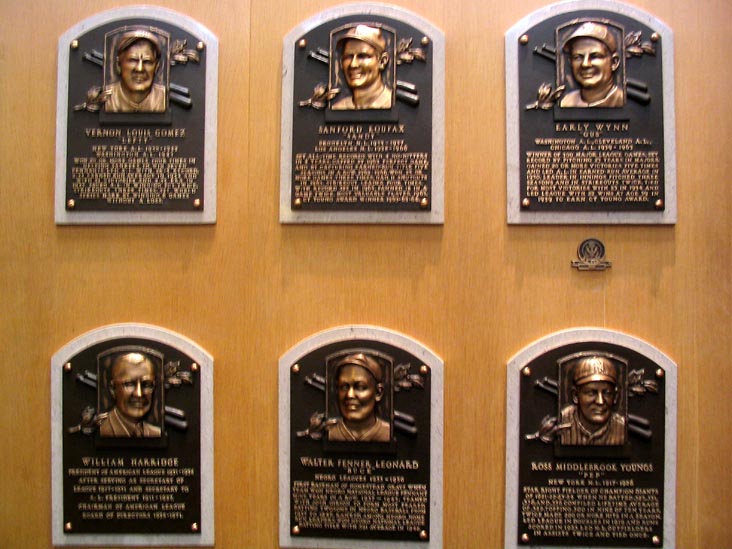
No, Pete doesn’t deserve to be in the Hall of Fame, for two very clear reasons. His conduct in betting on baseball games, including his own team’s games, while he was a Major League manager requires that he be banned from baseball for life under Rule 21 of Major League Baseball’s official rules, and the Major League Baseball Hall of Fame in Cooperstown has its own rule that makes any player so banned ineligible for enshrinement. Rose is prevented from admission to the Hall by those rules, which were in place when his conduct brought them into play. He doesn’t deserve to be in the Hall, because the rules say so. Pete Rose broke a cardinal rule that potential Hall candidates cannot break. The ethical reason he should not be in the Hall is accountability, or as Tony Baretta used to say on the old TV show, “Don’t do the crime, if you can’t do the time.”

Is there anything at all about Rose’s career record as a player that doesn’t qualify him for the Hall, indeed, over-qualify him? No. Unlike Barry Bonds or Mark McGwire, his statistics are beyond challenge or criticism. He didn’t cheat. He was a great and admirable player in every way.

Was there anything in his conduct as a player on the field, as a player off the field, or off the field as a retired player, that constituted such egregious misconduct that it would justify refusing his admission the Hall of Fame under its so-called character clause? [ “Voting shall be based upon the player’s record, playing ability, integrity, sportsmanship, character and contribution to the team(s) on which the player played.”]

Here is where I want to clarify my position. My answer to this is “No.” Continue reading

Topps’ Pete Rose Abuse

Pete Rose now, with his Playboy model wife (he calls his marriage "Tits and Hits"), and as a player, when the fact that he was a low-life didn't seem to matter.

Pete Rose now, with his Playboy model wife (he calls his marriage “Tits and Hits”), and as the  player called “Charlie Hustle,” when the fact that he was a low-life didn’t seem to matter.

Baseball season is fast approaching, and with it the usual welter of fascinating ethical issues that sport always generates. Here is an early one, arising out of one of the first signs of Spring Training, the release of the Topps’ baseball cards.

Pete Rose, as every educated American should know, was a wonderful player on the baseball field and a certifiable low-life off of it. Though he is the all-time leader in career hits, the former Cincinnati  Reds icon has been banned from baseball for two decades, the result of defying baseball’s “third rail” by gambling on the game after his playing career, when he was a manager. (Rose also lied about his conduct, helped send a Commissioner of Baseball to an early grave, and has served time for tax evasion…and even without all this, he would still be an insufferable slime-ball. Trivia note: Pete was in the very first group of “Ethics Dunces” in 2004, along with Bindi Irwin‘s dad, and Fox.  See? Nothing changes!) Never mind, though: Rose’s records have never been regarded as anything but legitimate, unlike those of baseball’s other living major miscreant, lifetime home run champ, steroid cheat and ethics corrupter Barry Bonds.

Yet as Aaron Gleeman reports on NBC sports, Topps is now, based on the evidence of its 2013 line of baseball cards, going out of the way to purge Rose’s name from all honor and memory: Continue reading

Lance Armstrong and the Sociopath’s Dilemma: When Honesty Is No Longer Ethical

Welcome to the club, Lance.

Welcome to the club, Lance.

Rose

In 2004, 15 years after he had been banned from baseball after a finding by the Major League Baseball’s Commissioner’s Office that he had violated the games rules against betting on Major League Games, Pete Rose publicly admitted that his denials over that time were all lies. Yes, he had bet on baseball, and he was very, very sorry. Rose’s admission did little to change the verdict in and out of baseball that he was a rogue and a liar. His confession was obviously part of a cynical and calculated strategy to get reinstated in the game, after the strategy of denial and waiting proved ineffective. In addition, Rose needed money, and the confession was part of the hook for his new autobiographical book, which was released at the same time he withdrew his protestations of innocence.

For Pete Rose, honesty was not an ethical value that he respected or returned to in penance after years of straying. It was just another means to an end.

Clinton

In 1998, President Bill Clinton was in the midst of the Monica Lewinsky scandal, denying that he had ever “had sex with that woman.” He called up his old friend, advisor and pollster, Dick Morris, and asked what he should do. Together they decided that Morris ought to take a poll to see what the public’s reaction would be if Clinton retracted his denials and admitted the affair. Morris reported back, after taking such a poll, that while the public would forgive the sexual relationship, anger over the President’s untruthful denials might sink his administration. Clinton decided that honesty would not work to his advantage, and continued to lie.

To Bill Clinton and Morris, honesty was just one of several tactical options to solve a political crisis. If had nothing to do with ethics, or doing the right thing.

Armstrong

It is 2013, and the New York Times reports that Lance Armstrong, now stripped of all his cycling titles, banned from athletic competition worldwide and separated from his commercial sponsors and the cancer charity that bears his name,

“has told associates and antidoping officials that he is considering publicly admitting that he used banned performance-enhancing drugs and blood transfusions during his cycling career, according to several people with direct knowledge of the situation. He would do this, the people said, because he wants to persuade antidoping officials to restore his eligibility so he can resume his athletic career.”

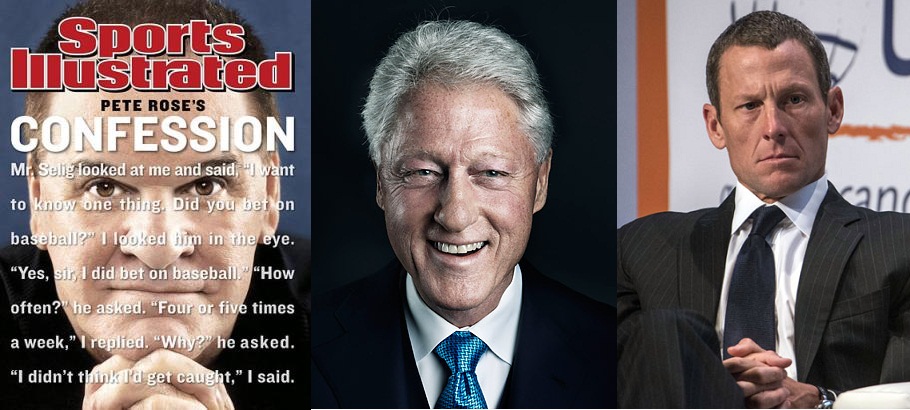
Armstrong, it is clear, is traveling in the well-worn and slimy footsteps of Rose and Clinton, fellow sociopaths to whom conscience, shame, contrition and remorse are alien concepts and for whom atonement and redemption are just games to win, with honesty being an indispensable, if unpleasant, tactic. When one is considering whether or not to be honest and admit what one has long denied based on cold calculations of personal costs and benefits, truth-telling is no longer a matter of ethics, or doing the right thing regardless of consequences. It is merely another weapon, along with lies, manipulation, deceit and posturing, in the arsenal of one of the lifetime predators whose sole goal in life is to prevail and profit over the rest of the trusting suckers who share the Earth with them, and who will do anything, even to the extent of briefly embracing ethical principles, to get what they want.

Should he decide to finally admit what everyone knows and he has long denied, even to the extent of suing those who declared his guilty, Lance Armstrong should be seen as no more ethical or noble than the criminal who pleads guilty in court on the advice of his lawyer, because the evidence is overwhelming, conviction is certain, and confession is the only route to a lighter sentence.

Individuals like Pete Rose, Bill Clinton and Lance Armstrong defile ethical values by their brief embrace of them.

Major League Baseball, Forgivability, and List Ethics

Unforgivable?*

Bleacher Reports is an enjoyable sports website, and it gives opportunities to aspiring writers and bloggers, some of whom are quite talented.  In addition to typical opinion pieces and reporting, the site has a fondness for lists, often trivial to the extreme, like “The 50 Ugliest Athletes of All Time.” The titles are all misnomers, because there is almost never any criteria given for the choices or their relative ranking. An accurate title would be, “The Fifty Athletes I Think Are The Ugliest.”  And of course, who cares? (Don Mossi, by the way, was the ugliest athlete ever, no matter what anybody says.)

A recent list, however did bother me. It is called “The Fifty Most Unforgivable Acts in Baseball History,“ and much of the problem with it lies in the title itself. If you are going to write about history, there is a duty perform diligent research, even for a silly online list. Misrepresentations online have a large probability of misleading people.  The title is a misrepresentation, like “The 50 Ugliest Athletes,” but unlike that list, there is some harm done. The list isn’t close to complete; it isn’t consistent; it isn’t well-researched. I’d bet that the author, Robert Knapel, wrote it off the top of his head.  Anyone who looked at the list and assumed, as the author represents, that these are truly the low points—“the dark side,” as the author puts it—of major league baseball would be seriously misinformed.

There are unequivocally, probably universally recognized incidents and events that are infinitely worse that most of the items on the list.  Just a  few samples: Continue reading

The Ethical Significance of Pete Rose’s Corked Bat

To cut to the chase: there is now irrefutable evidence that Pete Rose, Major League Baseball’s all-time hit leader who is currently banned from the game for betting on baseball, used a corked bat. How often he used it, how many other bats were similarly doctored, and what results he got from the illegal bat (s) are all unknown, and probably unknowable. The long, interesting and well-researched article about Rose’s bat on the website “Deadspin” points out that:

  • Corked bats (which have been doctored with a hollow chamber that is filled with cork, on the theory that it lightens the bat without sacrificing power) are forbidden by the rules of baseball, and their use constitutes cheating.
  • Their use is almost impossible to detect; only a handful of players have ever been caught using one, but it is believed that the cheaters are many and notable. Amos Otis, a star for the Kansas City Royals, admitted after he retired that his bats were corked for the majority of his career. Norm Cash, who won a shocking batting championship in 1961 with an average far above any he posted before or after, attributed his career year to a corked bat.
  • It is quite possible that corked bats don’t have any positive effect at all, and might even be worse than regular bats.

The last point cuts no ice with me. Continue reading