Steve-O-in NJ has stepped into a temporary (I hope) vacuum of ambitious comments to monopolize the COTD field. Steve is a lot more pessimistic than I am, and prone to Jeremiads (THE END IS NEAR!) but he also is willing to make observations that most are reticent to put into print. A few of you out there hang out on my Facebook page, where my alleged friends had a meltdown over a repeat of my musings here about whether Juror 8 in “12 Angry Men” would have bothered fighting for reasonable doubt in the trial of a defendant whom he thought was probably guilty if he knew that a not guilty verdict would trigger violent riots. How dare anyone suggest that there was reasonable doubt in the Chauvin trial? How dare anyone imply that the trial wasn’t fair!
Steve-O’s point about police being in an impossible position still applies to Derek Chauvin, cruel and untrustworthy cop that he undoubtedly was. Usually that impossible position girds police from conviction in all but the most egregious examples of police misconduct, as in the case of Michael Slager. I think the public’s acknowledgement of the dilemma is appropriate and generally ethical, but it is ready-made for accusations of racism when the victim is black.
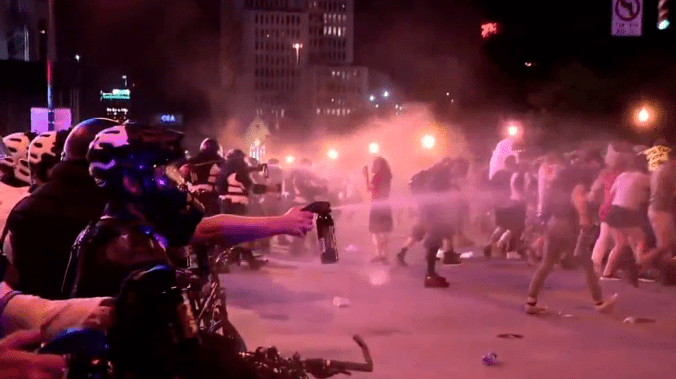
Back to the post that sparked Steve’s COTD, “Ethics Observations On The Shooting Death Of Peyton Ham”, there has been no news coverage of Ham’s death for a week. He was 16, just like the girl shot in the act of trying to stab another teen in Columbus, Ohio, but nobody in Congress or anywhere else is arguing that his youth demanded restraint by police. The reason is that Peyton Ham was a white male, and Ma’Khia Bryant was a black female. The police were supposed to understand that different standards applied. (The photo above is of the Columbus riots in response to the girl’s shooting. Somehow I can’t locate any similar photos of the protests of Ham’s death.)
Here is Steve-O-in-NJ’s Comment of the Day:
Policing in the United States is fast becoming a lose-lose proposition and a job fewer and fewer people are going to want. If you take action, you are considered a thug, a bully, and automatically a racist. If you take no action, you are either lazy or dead from the neck up and need to be fired. We’ve been over this half a dozen times since the death of George Floyd. Policing is by nature a dangerous and demanding job. Policing by nature sometimes requires split-second decisions which have a tiny margin for error and possibly grievous consequences if gotten wrong. Policing is not just about crossing schoolkids, directing traffic, getting lost children home, making reports of fender benders, and once in a while giving out a ticket to someone driving a little too fast or parked in a place clearly marked “no parking.”
Even in the safest small towns in America there are always going to be domestic violence calls, holdups, drunk and disorderly conduct, kids getting into drugs, or the mentally ill who do crazy things that endanger themselves or others. Like it or not, a big part of policing involves making unwilling individuals comply with lawful orders necessary to keep order. Sometimes there is no way to make that happen but to use force. Using force isn’t pretty. It’s not pretty to slam a violent husband or boyfriend down on the kitchen table and cuff him before he hits the woman in his life again. It’s not pretty to cuff a drug-addled, emaciated streetwalker who you’ve told to move along for the umpteenth time and been met with a torrent of profanity each time. It’s not pretty to throw a reeking homeless person who’s been harassing shoppers into the back of a police cruiser to take him somewhere where he can (hopefully) get the help he needs. And no, it’s not pretty to arrest some dreadlocked thug who’s spent his whole life doing nothing but commit crimes when he commits yet another one. It’s also not pretty when a hapless wife or girlfriend gets a broken jaw or a spiral fracture of the arm from a partner who she “just wouldn’t listen to.”
It’s not pretty when a family can’t walk down the street without seeing some skeletal prostitute shooting up. It’s not pretty when everyone has to avoid the block that “Crazy Joe” has claimed as his own. It’s not pretty when DeShawn, out of prison barely a week, sticks up a bodega with a gun or hits somebody over the head because he has no money and few prospects.
 Ethics Alarms