Ethics Quiz: Photojournalism And The President’s Meaningful, Meaningless Bowed Head

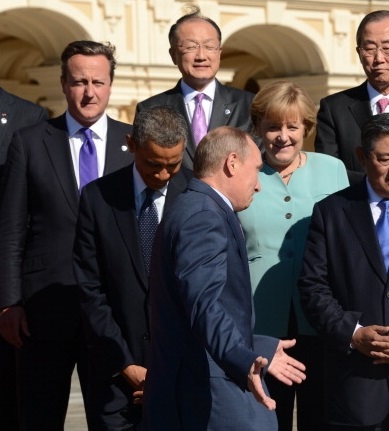
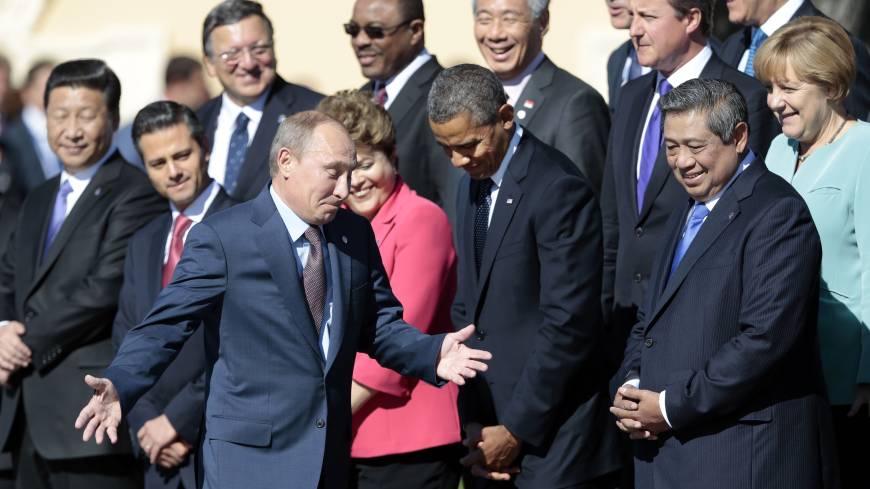
Putin and Obama

I am looking at a black and white AP photograph re-published from the Washington Post’s front page on September 7. It is similar to the one above, taken seconds before it, and from straight on rather than an angle. That photo, like the one above, shows Vladamir Putin, joining the other attendees at last week’s Group of 20 summit for their formal group photo, but in the one I am looking at Putin is striding across the group to the end of the line, eyes forward, as the rest look on. President Obama alone is standing head bowed as Putin passed, while the other leaders look forward. Unlike the photo above, Obama’s bowed head appears to be in reaction to Putin, but not an effort to listen to something the Russian leader is saying or has said, which is how I would interpret the photo above. The photo above seems relaxed and collegial; the one I am looking at depicts tension. [UPDATE 9/21: A much closer version of the photo is question can be seen here.]

That photograph prompted these criticisms from two Post readers over the weekend.

Mary-Anne Enoch wrote in part…

“I was upset by the photo chosen for the Sept. 7 front page, showing the assembly of the Group of 20 leaders for their traditional “family photograph.”
In that photo, Russian President Vladimir Putin is confidently striding across a stage while others are smiling and probably paying no attention to him. Except for President Obama: In sharp contrast to the rest, he appears to be subservient, shrunken and diminished. His stance reminded me of Forest Whitaker’s portrayal of a long-serving White House butler in a recent movie….it is outrageous that The Post should have selected [ the photo] to accompany an article on the very important and delicate negotiations involving the United States, Russia and Syria.”

Reader Charlotte Stokes had a similar reaction:

“Surely, the wire-service photographer took dozens of pictures, including at least one when the Group of 20 leaders formally posed. So why did The Post choose this one to grace the front page? The photo presented our president in a less-than-honorable light. Given the challenges he faces internationally, why cast doubt on his abilities by sending subliminal messages of this kind?”

[I recognize that it would be better if you could see the actual photo rather than read my description of it accompanied by one that is similar but not quite the same. Interestingly, the Post appears to have purged the picture I am writing about from its website: it does not even use it to accompany the letters about the photo, which it normally would, and which good practice would demand. The photo above, which was widely used by other sources, is the closest I could find, other than the print version that was in my Post on Saturday. If someone can find the actual photo and send me the link, I’d be very grateful.]

Here is your Ethics Alarms Ethics Quiz to kick off what promises to be an ethically alarming week, on the always tricky topic of photojournalism:

Was it unethical for the Post have prominently run a photograph that presented President Obama in an unfavorable, arguably subservient or weak posture? Continue reading

Comment of the Day: “Ethics Dunce: Photographer Jill Greenberg”

Tornado ruin

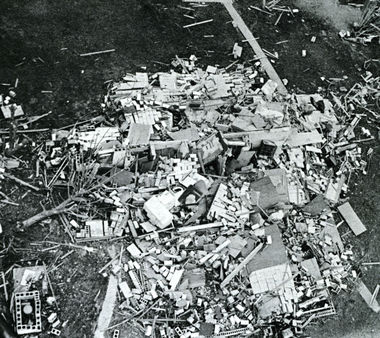
A home in Tanner, Alabama, after the events of April 3, 1974…

Here are the always thoughtful and often profound Fattymoon’s reflections, in the Comment of the Day, inspired by the post, Ethics Dunce: Photographer Jill Greenberg:

“This reminds me of the time I made a critical decision, on the spot, while covering the aftermath of a killing F5 tornado at Tanner, Alabama the night of April 3, 1974.


“Walter McGlocklin was walking away from me, carrying one of his two surviving daughters. He was cradling this little girl, her upper body and tear streaked face peeking just above her father’s right shoulder. The look of utter horror on her face! The lighting was perfect, an eerie cross hatch of flashlights and spotlights – I KNEW I had the picture of the year. I raised my Minolta 35 mm and focused in. And that’s when it happened. Something inside me said, Do NOT violate this little girl’s privacy. Do NOT allow this little girl’s unbearable pain to act as fodder to sell newspapers across the country. I slowly lowered my camera. It’s a decision, one of only a very few, of which I will forever be proud of.”

_______________


Ethics Dunce: Photographer Jill Greenberg


"No emoticons were upset in the writing of this post."

“No emoticons were upset in the writing of this post.”

In Slate, renowned photographer Jill Greenberg returns to the topic that gained her unwanted notoriety in May: her exhibition of photographs of children crying their little eyes out. Greenberg revealed at the time that she captured the powerful photographs by giving the very young children lollipops or something else they liked or wanted and then having family members ask the kids to return the item. Strangely,  as Drew Curtis’Fark, one of my favorite web  sources for stories is wont to say, some people had a problem with this.

Greenberg revisits the issue because she has a book of the weepy photographs coming out. Seldom does one read a more casual, “What is the matter with people?”, utterly clueless display of invalid rationalizations for unethical conduct as Greenberg belches out. Unfortunately, another tendency illustrated by the article is far more common: a news sources examination of an ethics issue without any apparent sensitivity or understanding of the ethics issues involved.

Here are Greenberg’s rationalizations, or at least the ones she gave to Slate. I’m sure she has many more.

  • The Trivial Trap, or “Don’t sweat the small stuff.” “I have two children of my own. Crying is not evidence of pain or any real suffering. It’s really just the way children communicate.” Ah. Not real suffering. Then it’s all right, then. The bottom line is that Greenberg is intentionally upsetting the children, who, it can be fairly said, are less anxious and happier when they are not crying. Children who are teased, frightened or otherwise made uncomfortable can also be said not to be in pain or “real” suffering. It’s still cruel, and an abuse of power, to treat them this way. Come to think of it, Greenberg could make the same argument about some of the models in child pornography. Would she, I wonder?
  • “Everybody does it” and the “They’re Just as Bad” Excuse. “Making children cry for a photographer can be considered mean. But I would say that making children laugh and show off their jeans for an apparel ad is just as exploitative and less natural.” And, I suppose, making a Bangladesh child cry by taking food from her to make her cry is just as exploitative  and more natural than giving her food to make her smile, because, after all, she’s usually starving anyway.
  • The Saint’s Excuse or “It’s for a good cause” a.k.a “The ends justify the means.” Slate:  “The still image continues to have a ton of strength. An image taken out of context from one fraction of a second to the next can tell a story, and if photographers are looking to tell a certain story, they can curate those slices of time to their advantage. What’s weird about the images is they seemingly can be applied to all these random disparate causes. My husband was saying they’re like emoticons.” True, Jill, but those little smiley faces don’t have to be tortured to get them to frown or cry, because, unlike babies, they aren’t real human beings.

The bottom line is that Greenberg made money and got a lot of ink by making children unhappy, so she can’t see why anyone would argue that the conduct wasn’t justified, and based on the article, neither does Slate or its writer, Jordan G. Teicher. The photographer’s methods are, of course, obviously and indisputably unethical:

  • She exploited the children for her own agendas and benefit.
  • She abused her superior power over the children to get the reaction she wants.
  • She induced anxiety in another, causing needless harm.
  • She created a product, the photo, which memorializes a form of child abuse.
  • She recruited the children’s parents into assisting in the exploitation for the artist’s purposes, rather that doing their job as parents, thus inducing a breach of loyalty and a betrayal of parental duty.
  • She created and profited from a materialization of an unethical abuse of a child, which is identical to what child pornography does.
  • She encouraged others to create similar photographs, which will be created, in some cases, with even less humane methods.

Of course her methods were unethical. She deserves every bit of criticism and hate mail that she has received. But the sophisticates, like Slate and others, just shrug off the concern as foolishness, much ado about nothing. So she made kids cry! They cry all the time! What matters is that she got some great pictures!

Many of society’s problems arise from the fact that our media can’t recognize, and thus encourages, unethical behavior, even obvious examples like making little children cry for fame and fortune.

__________________________

Pointer: Alexander Cheezem

Sources: Bored Panda, Slate, Fully M


Why Photographer Arne Svensen Is An Unethical Creep

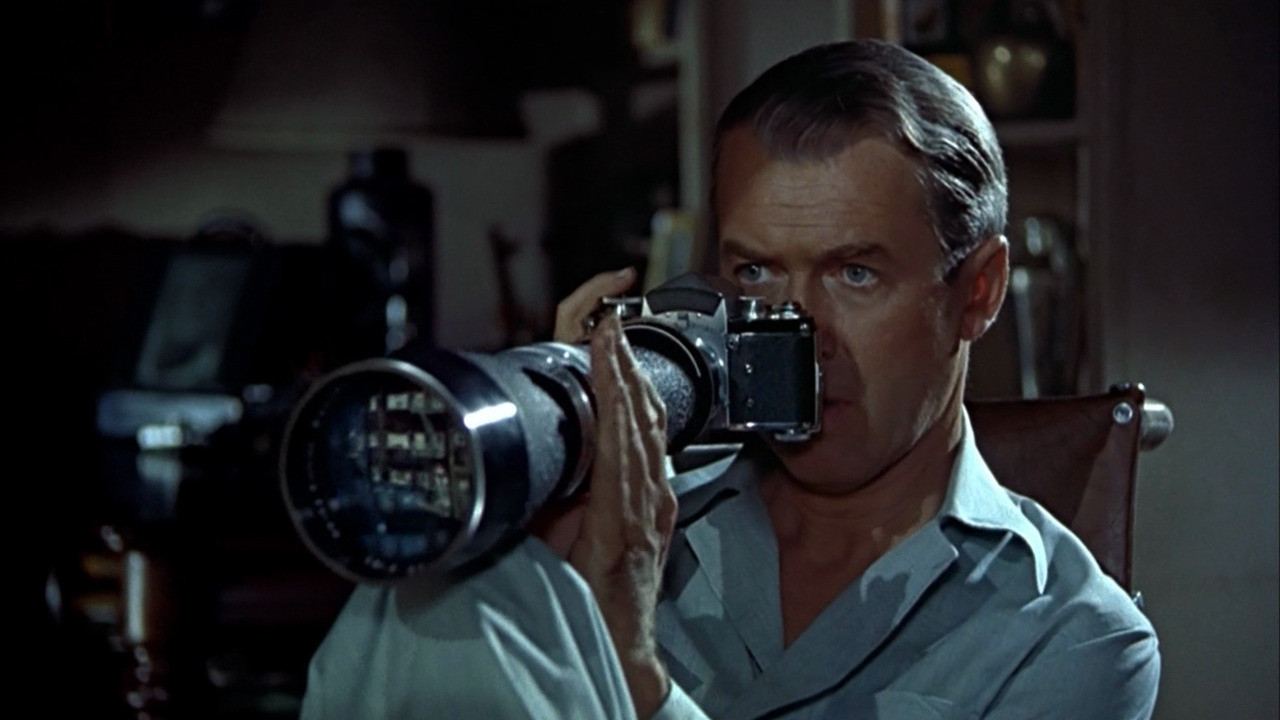
Photographer/artist/ Peeping Tom Arne Swenson as played by Jimmy Stewart in "Rear Window."

Photographer/artist/ Peeping Tom Arne Swenson as played by Jimmy Stewart in “Rear Window.”

“For my subjects there is no question of privacy; they are performing behind a transparent scrim on a stage of their own creation with the curtain raised high. The Neighbors don’t know they are being photographed; I carefully shoot from the shadows of my home into theirs.”

Believe it or not, this is how photographer Arne Svensen justifies his wildly unethical photographic peeping Tom excursions into his neighbor’s bedrooms for his own profit. This artist has provoked a controversy by 1) stalking the people who live in the New York apartment building across from his, 2) keeping a camera lens on them when they dare not to keep their windows shuttered as if they were vampires, 3) shooting photographs of whatever he sees that tickles his artistic sensibilities, fetishes or perversions, 4) choosing photos that do not show the faces of his subject victim, and 5) exhibiting and selling the results as artwork.

Amazingly, his neighbors object!

Let me cut to the chase here and be direct, because any minute now we are likely to find out that President Obama’s EPA has been secretly causing coal mine cave-ins and assassinating oil execs to forestall global warming, and that the President is outraged and just heard about it when we did, and will take strong action by telling the officials involved that they have to sit in the back during the next White House concert, and I’ll be distracted. Continue reading

Ethics Quote of the Week: Tom Hawking

“It’s not the role of our media and our journalists to shield us from truth; it’s their job to confront us with it. In this respect, the plurality of imagery is both a blessing and a curse, because in the sort of panic that follows an event like yesterday’s bombing, anything could be real. But equally, it’s also the volume of images and coverage — graphic and otherwise — that help us get a clearer picture of reality than we ever did in the days when our opinion was shaped by one journalist and a few photographs.”

—- Tom Hawking in his essay “The Ethics of Disaster Photography in the Age of Social Media,” discussing the controversy over whether graphic images from catastrophes like the Boston Marathon bombing ought to be published by the mainstream media, or should be toned down, edited, or withheld altogether.

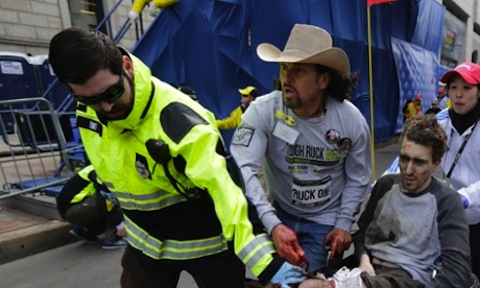
Boston Marathon ExplosionHawking’s conclusions are spot-on, and you should read the entire essay here. Obviously horrendous photographs shouldn’t be thrust in readers’ and viewers’ faces; we should all have the opportunity to avoid seeing images we know would upset us. ( I have not looked at any of the graphic images from Boston. The text descriptions are plenty for me, thanks.) Leaving it to editors and journalists to decide how much realism we can stand, however, is folly. To be blunt, there is no reason to trust them. One of the blessings of the web and social media is that the traditional media no longer have the power to withhold information based on their biased and paternalistic judgement, which they are thoroughly unqualified by intellect, education  to render.

______________________________

Source and Graphic: Flavorwire (Tom Hawking)

Ethics Alarms attempts to give proper attribution and credit to all sources of facts, analysis and other assistance that go into its blog posts. If you are aware of one I missed, or believe your own work was used in any way without proper attribution, please contact me, Jack Marshall, at  jamproethics@verizon.net.

Now Here’s A Terrible Idea: Mandated Disclosures for Photoshopped Images of Celebrities!

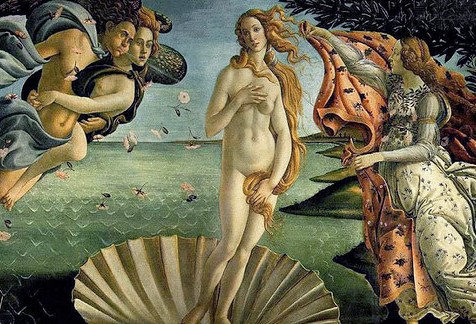
And if you look real closely at the lower left corner, you'll read, "The model for Venus was a short, middle-aged bald man named Gino. His appearance was altered by the painter in the creation of this painting."

Here is another candidate for enshrinement in the Pantheon of Well- Intentioned But Terrible Ideas.

In an article published Monday in the journal “Proceedings of the National Academy of Sciences,” Dartmouth researchers Hany Farid, a professor of computer science, and Eric Kee, a doctoral student, propose a rating system of publicly displayed photographs of models, actors and celebrities to let viewers know exactly how and how much an image has been altered by photoshopping, airbrushing or other means.

“Impossibly thin, tall, and wrinkle- and blemish-free models are routinely splashed onto billboards, advertisements and magazine covers,” the two write. “The ubiquity of these unrealistic and highly idealized images has been linked to eating disorders and body-image dissatisfaction in men, women, and children.” In the interest of limiting the damage caused by unrealistic images of human beauty, the researchers argue that graphic images should include labels that disclose  “geometric adjustments” such as slimming legs, hips and arms, as well as adjusting facial symmetry—reducing a nose in size, or slightly enlarging eyes.  Users of such photos should also flag photometric adjustments that change the appearance of skin tone, blemishes and texture, such as wrinkles, dark circles under the eyes or cellulite, say the researchers.

Please, for the love of God, nobody introduce these guys to Sarah Deming and her lawyer, who are suing the distributers of the film “Drive” because the trailer was more exciting than the movie. And let us all remember this proposal when we are tempted to pooh-pooh accusations that the government is regulating creativity, commerce, art and enterprise right out of existence, and with them, individual liberty as well.The tea parties should use Farid and Kee’s article for recruitment. Continue reading

The 9-11 Photo And A Columnist’s Character

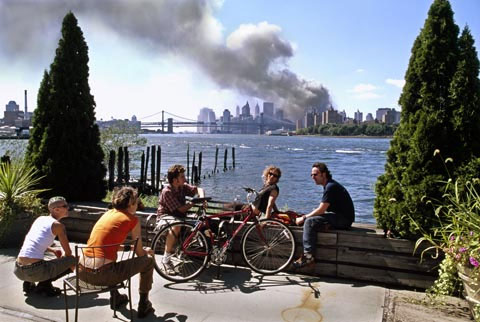
One thing I have learned about personal ethics: they are imposible to hide. Ethical individuals eventually show their values in grand style, and those without ethics, or whose ethical values are corroded, frayed and rotting, show their true colors as well. Thus it was no surprise to me when Frank Rich, once one of America’s most unfair drama critics who turned into one of the media’s most vicious opinion columnists, exposed the content of his character in grand style with a New York Time column last month about 9-11. Continue reading

What Do you Call A Newspaper That Defends Outrageous Journalistic Practices? How About “Di Tzeitung”?

If Di Tzeitung had covered the Civil War

If I could pronounce it, the Brooklyn-based Hasidic newspaper Di Tzeitung would be useful shorthand  for “shamelessly using rationalizations to defend indefensible conduct.”

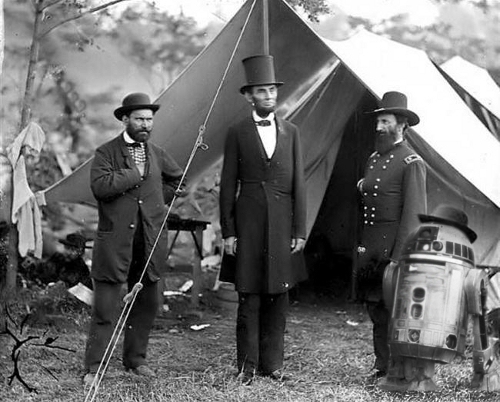
Last week, the newspaper ran the now-familiar photo of President Obama, Secretary of State Hillary Clinton, and others in the White House Situation Room, except that in Di Tzeitung’s version, Clinton  and the only other woman present, Director for Counter-terrorism Audrey Tomason, had magically vanished. Di Tzeitung had airbrushed them out, Politburo-style.

Of course, publishing the photo of a historic news event and altering it to convey misleading or false information (in this case, “Hillary wasn’t there”) is a substantial and wide-ranging violation of core journalism ethics, a breach of the reader’s trust, unfair, dishonest, misleading, incompetent and disrespectful. The altered photo was alternately condemned and mocked all over the media and blogosphere. Yet Di Tzeitung is largely unapologetic, and made it clear that it would do the same thing again if the opportunity arose. In a prepared statement, the editors explained why they did nothing “wrong”…well, almost nothing…challenging the Olympic record for rationalization by a news organization along the way: Continue reading

Parental Responsibility, Child Exploitation, and Billboard Ethics

Here’s a rule of thumb: Don’t give the rights to reproduce your child’s photograph to a photographer or ad agency unless you are prepared to accept however it is used, and certain that your child will not be harmed or embarrassed as a result.

Is that so hard?

Tricia Fraser has sued Life Always and Majella Cares Heroic Media, an anti-abortion group, claiming it used her daughter’s picture in “a racist, controversial advertising campaign” that is “defamatory, unauthorized, and offensive,” posting the 4-year-old girl’s photo on a giant billboard by the Holland Tunnel and another in Florida.

Nice try. But there is nothing racist about the campaign, and nothing defamatory about using her daughter’s photo in it.  Continue reading

The Ethical Callousness of Photojournalists

Eric Kim Street Photography launched an ethics controversy by running two photographs. One, a prize-winning photo of 15-year-old Haitian Fabienne Cherisma, who was shot and killed by Haitian police after stealing two plastic chairs and three framed pictures in the chaos following the nation’s devastating earthquake last year. The other picture showed the origins of the photo and others like it, a crowd of intent photographers in a group, snapping away at the horrible scene like paparazzi trying to get a good shot of Lindsay Lohan.

Kim agreed that the initial photo is crucial news journalism, but worried that the second photo showed callousness on the part of the photographers, who appeared to be exploiting a tragedy.

Judge for yourself. Photojournalism, like medicine, law enforcement, social work, government leadership, and many other professions, is an ethically-conflicting job by nature,  because it requires dispassionate calculations in situations where non-professionals would be overwhelmed with emotion. This is purely utilitarian conduct. The pictures need to be taken. The public is served by vivid illustrations of the world and events. Competent and effective pictures require pragmatism, opportunism and professional cool that will often seem repugnant to observers. That is unavoidable, and fully justified by the importance of the work.

Verdict: the photographers are ethical.

But how they do their job sure can look awful.