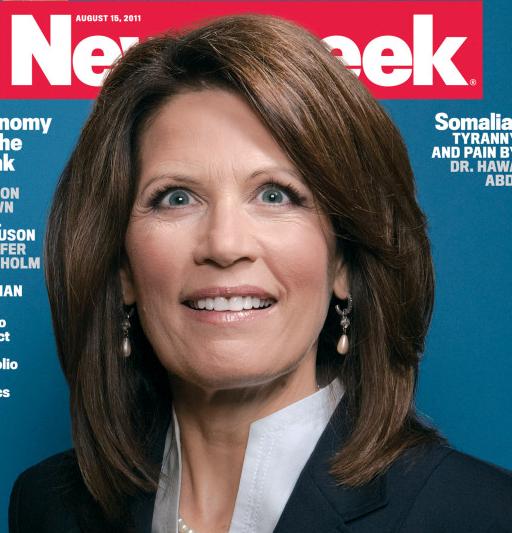
Dear Newsweek: We Can Figure Out That Michele Bachmann Is A Little Off Without The Crazy Photos, But Thanks For Your Concern.

Holy Crap!

When I put up yesterday’s post about Nancy Pelosi’s excessive and uncivil accusations about Republicans, I went searching for an appropriate photo. I found one that I came this close to using, because it was angry, like the quote, and just a little bit deranged-looking. (Pelosi has a lot of photos out there that make her look quite mad.) I didn’t use it. I decided it wasn’t fair.

Of course, I have to try to be fair; I’m an ethicist, and this is an ethics blog. Journalists, however, don’t…wait, aren’t they supposed to be fair too?

Not in Tina Brown’s book, or rather magazine. Newsweek made the choice to be the MSNBC of pulp even before Brown took over, and now it is officially shameless. Because Newsweek, like its almost as moribund rival Time, once was a respected journalistic enterprise, some of Newsweek’s now non-operable reputation for integrity remains. It can still do damage with its cheap tricks. That’s why its wild-eyed cover photo of Michele Bachman is so despicable. Continue reading
Ethics Dunce: CBS

"That's Entertainment!"

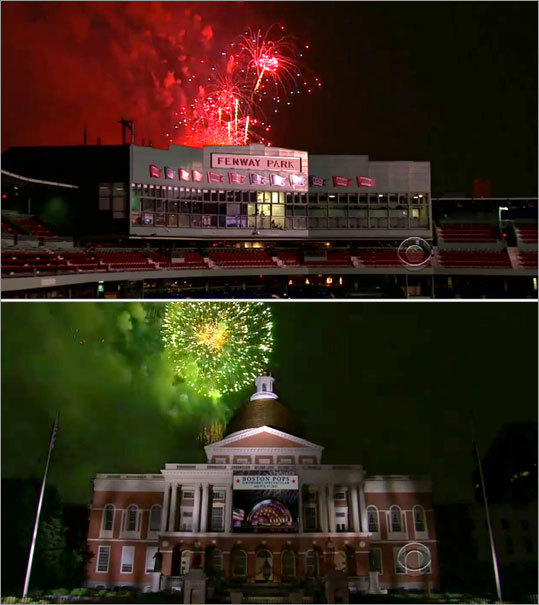
It took a few days, but Boston viewers finally figured out that CBS’s broadcast of the city’s famous Fourth of July fireworks display was digitally altered to present a spectacular view of the display that is geographically impossible. Yes, CBS, network of Murrow and Cronkite, presented a phony, enhanced version of the fireworks without bothering to disclose to viewers what they were really seeing.

Yesterday Boston bloggers and observers began pointing out that it was  impossible to see the fireworks above and behind such famous locales as the State House, Quincy Market, and home plate at Fenway Park, because the display, as always,  was launched from a barge in the Charles River, located where it could not be seen from those places.

“According to CBS, you can see the fireworks from the right side of Quincy Market, even though Beacon Hill is in the way,’’ wrote Karl Clodfelter, a research scientist and a commenter on the Boston blog UniversalHub.com. “Also, they come up behind the State House when you’re standing across the road . . . which means the barge must have been parked on the Zakim* this year.’’ Continue reading

Newsweek’s Biased Cover Ethics

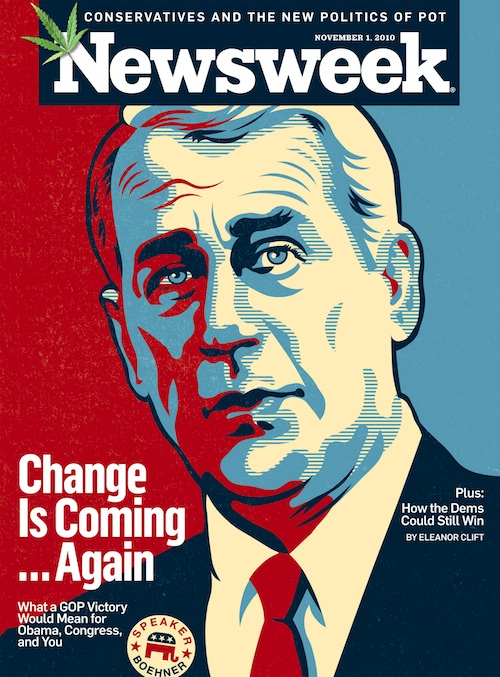
I am looking at the current cover of Newsweek. I am frightened.

According to the magazine, change is coming, and the cover photo makes it clear that it can’t be good. Some monster named “John Boehner”  seems to be involved, and he is a vampire, or cannibal, or something worse. A serial killer, maybe, like Jason in “Friday the 13th.” One whole side of his face is dripping with what looks to be blood. There is blood around his mouth, and a scary, demonic eye looks out from a mask of blood on his right side.  He is clearly from Hell.

Or a Republican. Continue reading

Photo Ethics: Kagan at the Bat

The Wall Street Journal is being assailed by some gay and lesbian advocates for running an old photo of Supreme Court nominee Elena Kagan, bat raised, waiting for a pitch in a softball game. “It clearly is an allusion to her being gay. It’s just too easy a punch line,” said Cathy Renna, a former spokesperson for the Gay and Lesbian Alliance Against Defamation who is now a consultant. “The question from a journalistic perspective is whether it’s a descriptive representation of who she might be as a judge.”

What???? Continue reading

The Ethics of Those “Thousand Words”

The site BravoBox has a provocative post on an ever-present ethical issue on print journalism that has been with us for decades and seems to be intensifying: manipulative photo-journalism. Ethics watch-dogs come down hard on images that are photoshopped or deceptively cropped, but a publication’s choice of photo can be equally unfair when the picture hasn’t been altered at all.

A photo doesn’t have to be manipulated to be manipulative. If a picture is indeed “worth a thousand words”—and many are— responsible journalists and editor have a duty  to choose those words with as much attention to even-handedness and fairness as the words that appear in type.

As BravoBox notesContinue reading