What A Fine, Fine Role Model This High School Principal Is…If The Idea Is To Graduate Short-Cut And Rationalization Addicted Students Who Try To Tap-Dance Their Way Out Of Trouble!


Abby Smith, a graduating student at Parkersburg High School in West Virginia, noticed something vaguely familiar about  the speech given by the school’s principal, Ken DeMoss, at her graduation last week. Later, she went home and looked for a video of a speech actor Ashton  Kutcher (formerly the goof on “The 70s Show,” the goof who succeeded Charlie Sheen on “Two and a Half Men,” and the guy who took over froim Bruce Willis when Demi Moore decided she wanted a husband with hair) gave at the 2013 Kid’s Choice Awards. Then she edited DeMoss’s speech and Kutcher’s together, and posted them on YouTube.

There’s no doubt about it, as you can see above. The principal ripped off the speech.

Some might say that what Smith did was mean and unnecessary. No, it was responsible, essential, and gutsy. Students are taught in school, or are supposed to be,  to do their own work, a lesson especially hard to convey when the internet makes plagiarism  easy to do and hard to detect. The distinction between being inspired by another person’s creative output, using it as a foundation for an original work, borrowing phrases and ideas (with attribution), and, in contrast, stealing intellectual property and presenting it as your own, is a crucial one for students to understand. When a role model, a school administer, flagrantly does what the school must teach students not to do, and worse, does this  in front of students, and even worse than that, does it in the course of a speech about the virtues of hard work, such cynicism, laziness, and cheating must not be allowed to pass unnoticed, and I hope, unpunished.

After he was caught, “Kenny” issued this epicly horrible statement, incorporating rationalizations, unethical apologies, multiple logical fallacies, a Jumbo and, of course, lies: Continue reading

Memorial Day Weekend Ethics Warm-Up, 5/25/2019: Julian, Conan, Naomi, and Ousamequin

Happy Memorial Day Weekend!

It’s going to be a Sousa weekend here. The piece above is one I bet you haven’t heard before. President Chester A. Arthur ordered Sousa to compose a replacement for  1812’s   “Hail to the Chief,” which had announced Presidents since John Quincy Adams, although it went in and out of fashion. (President Polk, it is said, always had “Hail to the Chief” played because he was so physically unimpressive that nobody noticed when he entered a room without the fanfare!) After Arthur left office, Presidents returned to to”Hail to Chief,” and Eisenhower made it the official tune of the office in 1954.

1. A First Amendment stretch. Julian Assange has been indicted. Good. He conspired with a weak-minded and troubled soldier to prompt him, now her, to steal U.S. secrets so he could publish them and promote his anarchist website, Wikileaks. The act almost certainly got U.S. agents killed and did other irreparable harm. Assange isn’t a journalist, and publishing stolen classified information isn’t journalism. Naturally journalists are lining up to defend Assange, especially the New York Times, which was the beneficiary of the Pentagon Papers ruling. They see a conviction of Assange the way abortion zealots see bans on late-term abortions: a camel’s nose in the tent, the slippery slope.

The use of journalistic publications as illegal document laundering devices has always been the least compelling aspect of First Amendment protection of freedom of the Press. I have never believed that it was a wise and fair protection, and if Assange’s just desserts weaken the right of newspapers to publish troop movements,  private citizens’ tax returns, and grand jury proceedings, good.

2. Did Conan O’Brien steal a writer’s jokes? You decide! Here is a joke Robert Kaseberg wrote on Twitter on June 9, 2015: Continue reading

Happy Saturday Ethics Warm-Up, 4/27/19: Conniff, Cohen, California, And Co-opting A Classic

http://www.youtube.com/watch?v=w1xjwzQf7DI

Weekends, unfortunately, are only a rumor when you run a business out of your home…but I’m still HAPPY!

1. “To Kill A Mockingbird” ethics. I asked an old friend and talented director to give me her review of the controversial “To Kill A Mockingbird” on Broadway (previously discussed here, and here…). What I was most interested in was whether the new version (by “The West Wing” auteur and liberal political advocate Adam Sorkin) actually meets the contractual requirement insisted upon by Harper Lee’s estate, that “the Play shall not derogate or depart in any manner from the spirit of the Novel nor alter its characters.”  Well, I knew it would not be; Sorkin and the producer held out for being able to make a “woke” “Mockingbird” reflecting “current sensibilities,” and Lee’s greedy relatives wanted the money more than they cared about what Harper Lee might have wanted, like preserving the integrity of her novel.

Sure enough, my friend reported that the play was full of anachronisms and felt nothing like a story set in a small Southern town in the 1930’s. Most jarring of all, she said, was the oft repeated message that the racially prejudiced individuals in the town were “bad people.” This is the exact opposite of what Atticus Finch tells his daughter in the novel.

2. The GDP. Today the New York Times had the good and unexpected GDP news on its front page, so I’ll retract yesterday’s criticism  of the Times for burying that important news, and evidence of some Trump success. Instapundit pulled out this LA Times article  from 2017. It begins, Continue reading

Pacific Coast Time Morning Ethics Warm-Up, 3/20/19: Guys and Dolls

Good morning from San Diego!

Well, I was speaking to 600 seats just now, but only about 300 lawyers. Several came up to me afterward, inspired or stimulated, and thankful. In ethics, as in the theater, I have come to adopt William Saroyan’s creed that if just one person sings your song, your life as an artist has meaning. Like Saroyan, I have come to adopt that out of self-preservation and to stave off insanity.

1. It looks like a Saturday Night Live writer plagiarized at least two skits this season. The story is here.

The combination of SNL’s insane schedule, the pressure to be different and edgy week after week, and the temptation of YouTube made this inevitable. The rules on borrowing, adapting, copying comedy material has always been a gray area, often settled by the good faith and collegiality—or not—of the comics themselves. By accident, I just saw an old “Everybody Loves Raymond” episode which was an obvious rip-off of an even older Dick Van Dyke Show episode in which Laura writes a children’s book, and professional writer Rob offers to help her improve it.? Plagiarism? Comedy skits in vaudeville were passed around like the flu: Abbot and Costello weren’t the first to do the “Who’s On First?” routine, they just did it so much better than anyone else that they owned it. Was Lucy plagiarizing Red Skelton with her “Vitameatavegimin” skit, where a pitch woman gets drunk doing multiple takes of a TV ad that requires her to drink the alcohol-laced product, when Red had been doing the same routine for years as “Guzzler’s Gin”? Continue reading

How Do We Know The Democrats Can’t Find Any Ethical Reason Not To Confirm Judge Gorsuch? Because They Searched And Searched, And The Best They Could Come Up With Was THIS [UPDATED]

Pathetic. Desperate.

Typical.

“And it’s a HAIL MARY PASS!!!!!!!”

Today headlines screamed—do mark the journalists and news organizations, for they exemplify Prof. Glenn Reynold’s jibe, “Democratic operatives with  bylines”—that Supreme Court nominee Neil Gorsuch had committed plagiarism in four passages of his 2006 book “The Future of Assisted Suicide and Euthanasia,” which was based on his 2004 Oxford dissertation, before he became a judge.

That’s a stretch, and more than that, making this a major new story now indicates bias.

In the most egregious of the passages cited, Gorsuch included a description of the famous “Infant Doe” case that tracks closely with the description in a 1984 law-review article by Abigail Lawlis Kuzma. Both versions primarily quote from the court opinion: Kuzma’s article tracks equally closely to the original opinion, a 1982 Indiana court ruling that was later sealed, a  pediatrics textbook, “Rudolph’s Pediatrics,” and a 1983 article in the Bloomington Sunday Herald. Gorsuch cited all of these, but did not cite Kuzma’s article.

He should have. That’s a citation error, but probably not plagiarism. Several the sentences in the book and the article are identical or close to it, and Gorsuch should have used quotation marks. However none of the sentences involved anything but factual  and technical descriptions. For example,the article states that “Esophageal atresia with tracheoesophageal fistula indicates that the esophageal passage from the mouth to the stomach ends in a pouch, with an abnormal connection between the trachea and the esophagus,” and Gorsuch wrote, “Esophageal atresia with tracheoesophageal fistula means that the esophageal passage from the mouth to the stomach ends in a pouch, with an abnormal connection between the trachea and the esophagus.” 

Now, if I were writing about esophageal atresia, about which I know nothing, in the course of an analysis of a larger issue, I would probably re-phrase that passage, perhaps writing, “When the esophageal passage from the mouth to the stomach ends in a pouch, with an abnormal connection between the trachea and the esophagus, this is the condition called esophageal atresia with tracheoesophageal fistula.” I haven’t added anything original, though. There are no new thoughts or content. My re-phrasing would just dodge the accusation of plagiarism. When I wrote my thesis, which involved reviewing multiple biographies of every U.S. President, it was not uncommon for me to find paragraphs in the earliest materials that were worked over and re-phrased again and again, with no quotes but citations.

The National Review, a conservative publication, so its position will be discounted as biased and partisan, tracked down Kuzma, who waved off the plagiarism charges:

“These passages are factual, not analytical in nature, framing both the technical legal and medical circumstances of the “Baby/Infant Doe” case that occurred in 1982. Given that these passages both describe the basic facts of the case, it would have been awkward and difficult for Judge Gorsuch to have used different language.”

Weeell, that’s laying it on a bit thick. Gorsuch certainly could have done a more academically acceptable job of re-stating the substance of what she wrote; it’s not THAT “awkward and difficult.”

Continue reading

Romanian Flag Ethics, or “Who Cares About Chad?”

The national flag of Romania (above left)  is designed with vertical stripes colored blue, yellow and red. It has a width-length ratio of 2:3. So does the national flag of Chad (right). In fact, they are identical. (One or the other supposedly has as slightly darker blue, indigo vs. cobalt, but I can’t see it.)

Romania established the colors and the design by law in 1989, when its Communist government fell.  It essentially ripped off Chad’s flag, and Chad immediately protested. True, these had been the Rumania/Romania colors forever, but not in this exact form. Do you think Romania bothered to check whether than design was, like, taken? Nah. “There were more important things to care about,” rationalized the nation’s president at the time,  Ion Illiescu. More important to Chad, though? This is the essence of ethics: thinking about the other parties affected by your conduct. It is not the Romanian way, at least when it comes to flags.

What does Romania care about Chad? It’s one of the bleakest, poorest third world nations in the world. Who cares if Chad objects? Who listens to Chad? “It’s too far away,” reasons a Romanian quoted by the Wall Street Journal. Now there’s the keen logic, sense of fairness, and respect for the rest of the world we like to see from our fellow citizens of the planet.

There is no authorized body that referees flag theft. Of course, there shouldn’t have to be, as this is an act without plausible defenses. If a nation takes another country’s flag, it is either being spectacularly arrogant, disrespectful and dishonest,  or incredibly negligent. There is no third explanation. Continue reading

“Singin’ In The Rain” Ethics: The Strange Saga of “Make Em’ Laugh”

Last month Turner Movie Classics arranged for MGM’s classic musical “Singin’ in the Rain” to be shown on big screens in selected theaters around the country.  At the theater where I saw the film again with my wife and some friends, the place was packed with a multi-generational crowd including many children seeing Gene Kelly-Donald O’Connor-Debbie Reynolds (and Jean Hagan…mustn’t leave out “Lina Lamont”!) romp for the first time. Of course, they loved it; I’m worried about anyone who can see the film and not love it.

The timing of TCM’s limited revival was felicitous in two ways. One was that  it occurred just after the death of Debbie Reynolds, and provided a lovely way to salute her memory. Another was that “La La Land” was surging in buzz and box office around the country, culminating in last week’s 14 Oscar nominations. There are several visual references to “Singin’ in the Rain” in the film; ironically, enjoying “LaLa Land” may rely on unfamiliarity with its 65-year-old predecessor, because calling what the stars in “La La Land” do “dancing” seems unduly generous compared to the performances of Gene, Donald and Debbie.

Seeing the film reminded me, however, of the strange ethics breach behind one of the movie’s most famous numbers. Donald O’Connor’s solo “Make ‘Em Laugh” is the high point of the movie for me, and I am not alone. It finished at #49 in AFI’s 100 Years…100 Songs survey of top tunes in American cinema, but that doesn’t do it justice: this is not just a great musical number, it is one of the greatest four minutes of physical comedy ever put on screen, featuring dozens of jumps, pratfalls, and as its grand finale, O’Connor running up two walls and flipping backwards to the ground. (He checked into a hospital for several days as soon as filming  the routine was over). The problem is that “Make ‘Em Laugh” was plagiarized, and everyone knew it. Continue reading

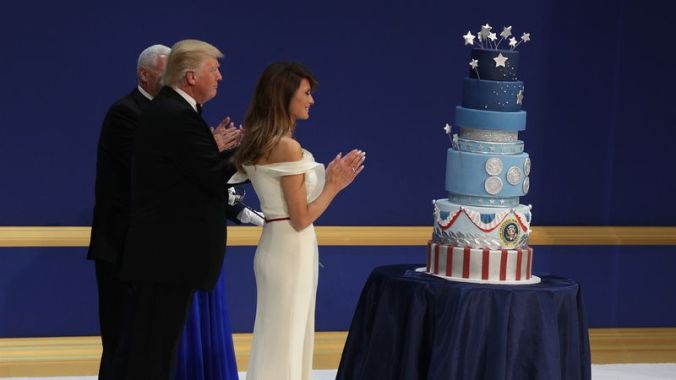
Inauguration Cake Ethics (No, I Can’t Believe I Wrote That Either)

cake-2

THE LATEST PROOF OF PRESIDENT TRUMP’S DEPRAVITY!

He specifically asked for an exact replica of Barack Obama’s 2013 Inauguration cake! The HORROR!

Apparently nothing is too trivial to use to attack Donald Trump. Focus, guys, focus!

The scandal:

Trump asked the baker who made the official Inauguration cake—until today, I hadn’t given any thought to the Inauguration cakes of either Trump of Obama. and I was a happier man for it—to make an exact replica of one of Obama’s cakes. Why, I have no idea. I think both the original and the copy are tacky. Don’t you?

cakes

Celebrity baker Duff Goldman of TV’s “Ace Of Cakes” then tweeted that the cake at one of Trump’s Inauguration balls was a rip-off of his design. Social media Trump-haters immediately pronounced this as “100% plagiarism.” Donald Trump is plagiarizing cakes now! Is there anything he won’t do? I bet Hitler plagiarized cakes.

Whether this really is plagiarism is an interesting, if stupid, question. A design made for one-time only use commissioned by the White House was duplicated and used again by the White House, though with new occupants, four years later. Was it a derivative work? Homage? Fair use? Does the White House own the design, having commissioned it originally? All we have is a two-dimensional representation, and there is no definitive evidence since both were, you know, eaten. I’d say a copyright infringement claim would be futile, and petty. Here, you try to figure it out. Continue reading

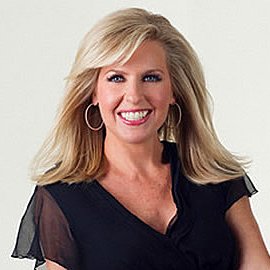
The Monica Crowley’s Plagiarism: Oh-Oh…This Does NOT Bode Well For Trump’s “We’re Going To Appoint The Best People” Boast

Really? This is "the best"?

Really? This is “the best”?

Many times, during the campaign, candidate Trump assured us that he “would appoint the best  people.” This was always a bit dubious, for a couple of reasons, but the main one was that the people we saw Trump appoint to represent him as his media surrogates were almost uniformly moronic to a degree never seen before on behalf of any public figure—and political surrogates are not generally shining lights. Trump  surrogates  Katrina Pierson, Corey Lewandowski, Scottie Nell Hughes, Jason Miller, Kayleigh McEnany, the horrible Michael Cohen, Boris Epshteyn and Jeffrey Lord all head-banging-on-a-wall embarrassing, making veteran Clinton shill Lanny Davis look like George Bernard Shaw by comparison, and Lanny’s a shameless hack. If these were “the best people” Trump could appoint to represent him publicly, what is his definition of “best”?

It is becoming clear that these fears were not exaggerated. I’m not speaking of the Cabinet positions, as all of those appointments are at least individuals of independent success and demonstrable accomplishments. The crucial appointments for Trump, however, are the staff around him. Both President Bush and President Obama saddled themselves with weak advisors of questionable wisdom at best, and Donald Trump really does need to have  “the best people” to lean on, even more so than his predecessors.

So far, it doesn’t look good. The latest thud came this weekend, as it was revealed that conservative author, radio talk show host and Fox News television personality Monica Crowley, who will be Trump’s senior director of strategic communications for the National Security Council, plagiarized large sections of her 2012 book, “What The (Bleep) Just Happened.” CNN found more than 50 long passages lifted without attribution from the National Review’s Rich Lowry and  Andrew C. McCarthy, Michelle Malkin, conservative economist Stephen Moore, Karl Rove, Ramesh Ponnuru of Bloomberg View, Wikipedia, Investopedia, various think tanks, and a podiatrist’s website, among other sources. There’s no dispute, or argument about this to be made: she was caught. She did it. She stole material that was not hers, and used it in her book.

This is signature significance. Authors who plagiarize are not “the best people;” they are not even good people. They are lazy, dishonest people who fake it, and who thrive by exploiting others who are smarter, harder working and more talented to succeed. Anyone who ever listened to Crowley on the radio for more than five minutes—that was about my limit–will not be surprised by this. She is facile and smug, but without substance, all ideology and mockery, but no real insight. Naturally, the only way she could write a book longer than 35 pages was to steal.

Thus when one learns that an employee cheated like this, there is only one responsible response, and that is to fire her. If you don’t fire her, that is an admission that either you don’t understand the term “best people,” or that you don’t really care about having the best people, and just want reliable toadies and slugs.

When CNN contacted the Trump transition team and laid out its evidence (some of which you can peruse here), it received this disheartening response: Continue reading

Remember California Attorney Mary Frances Prevost, Who Plagiarized Ethics Alarms? Guess What!

Yup, I saw THIS coming...

Yup, I saw THIS coming…

She’s been suspended.

For the third time.

Good.

To recap…Back in 2012, Mary Frances, who  describes herself on her website as “California’s Top Criminal & DUI Attorney,” posted an essay allegedly authored by her called  “The Trayvon Martin Case Trainwreck: George Zimmerman’s Attorneys Need To Shut Up!”

Oddly, it was posted the same day and shortly after my Ethics Alarms post, “Next To Board The Trayvon Martin Ethics Train Wreck? Why, The Lawyers, Of Course!”

Mary Frances’s was almost word for word the same post, plus some original material at the end. She had ripped me off. She hadn’t even tried to disguise it. This is called stealing, and I believe, shows that an individual lacks the honesty and trustworthiness to practice law.

I took three deep breaths, wrote a post about her plagiarism, e-mailed Prevost and required four things. First, an explanation if she had one; then an apology, a retraction, and proper credit. I didn’t demand damages, as I could have.

Mary Frances’s response was astounding. She didn’t have the courtesy to respond to my e-mail, but went on Facebook to accuse me of plagiarizing her, a neat trick, since my post pre-dated hers. Then she insulted me repeatedly, apparently unaware of how hypocritical it is to claim another lawyer is lacking in legal analysis skills and writing ability when you just published his essay as your own. I posted her whole rant here; it is deranged, making it especially funny that she accused me of being “off my meds.”

The Facebook post was defamation per se: malicious, and deliberately false. I contacted a California attorney, who agreed it was defamation, but said that based on her reputation, he felt it would  not be worth the money, the trouble or all the attacks she was capable of to go to war with her. He also dissuaded me from filing an ethics complaint, saying that unlike some states, California frowns on ethics complaints when there are grounds for lawsuits, and also tends to discount complaints from non-California lawyers.

“Just wait,” he said. “She’ll get hers. Lawyers like this almost always do.” Continue reading