American Lessons from the English Riots

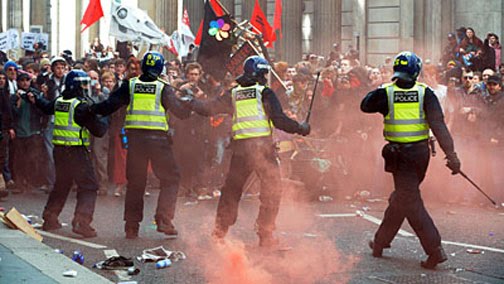
I am going to refrain from joining the ranks of amateur psychologists trying to identify the “root cause” of the English riots. People of any age or economic status who riot are, it is fair to say, assholes, like lesser social miscreants such as vandals, computer virus inventors, Leroy Fick and Pastor Terry Jones. If I were convinced that these riots were in response to necessary government cutbacks in social programs, I would have something arguably useful to say, but that doesn’t seem to be the case.

There is no question, however, that in allowing the riots to go on so long and harm so many citizens, businesses and homes, the British government has failed one of its most basic duties. Great Britain has been the anti-gun zealot’s Nirvana for a long time: not only can’t citizens own guns for their personal protection, neither can the police. That can work, if the culture is reliably non-violent, and if social and community institutions do a good job making sure that the culture of non-violence is strong, self-reenforced, and deep.

Well, it isn’t, is it?
Continue reading

Hate Thy Neighbor: the Cranston Ethics Train Wreck

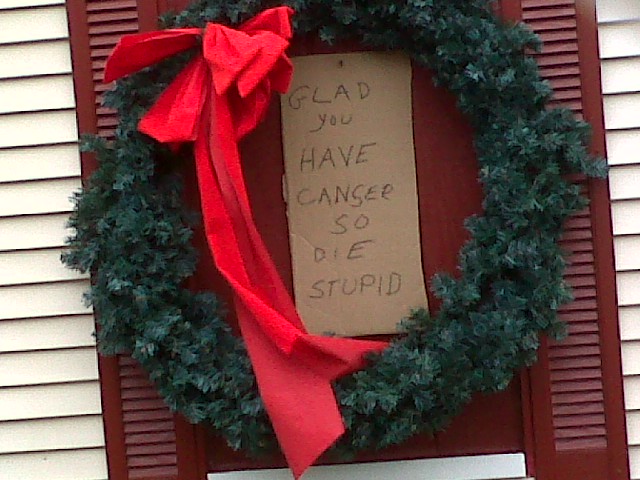
Cranston, Rhode Island resident Edward Jimmis, it is fair to say, is an idiot.

That’s okay. There are a lot of idiots, and they do very well. Many of them, perhaps a majority, are even in Congress. Now, when the constituents of a Congressional districts represented by an idiot get tired of the idiocy, they have a very effective remedy. They can vote the idiot out of office, and this is fair, ethical, and effective, though not exercised nearly as often as it should be. What is the ethical response, however, when you discover that your neighbor is not only an idiot, but an especially hateful and uncivil idiot? This is the challenge facing the neighbors of Edward Jimmis. They may not have the right answer. Continue reading

An Appropriate Limit on the First Amendment Right To Be A Total Jerk

"Pardon? I'm not sure I understood that last remark."

If you peruse the various debates on Ethics Alarms, you will note that every time someone writes or says something cruel, dishonest or uncivil that appropriately brings down criticism or worse on the miscreant’s noggin, he and his defenders  will argue that the First Amendment should render them immune from the consequences of their words. This is not what the First Amendment is about, however. It is about the government not being able to punish them for what they say, with some exceptions. Even then, it is possible to be so inarticulate in your jerkish expression that your utterances are beyond even that constitutional protection.

For example, when you bark like a dog.

Or to be more accurate, when you set out to tease and annoy a police dog by barking. Mason, Ohio has an  ordinance making it a crime to “willfully and maliciously taunt, torment, [or] tease … any dog used by the Police Department in the performance of the functions or duties of such Department.” That’s exactly what Mason Police Officer Brad Walker found a drunken Ryan Stephens doing to Timber, a K-9 German Shepard behind a screen in his police cruiser. Continue reading

The Strange, Unethical Saga of Junius Puke

Junius Puke

This week seems to mark the end of a perfect storm of ethical misconduct that almost drowned a young student in legal persecution for the non-crime of exercising his First Amendment rights. An insufferable and humorless bully with a professorship collided with an irresponsible prosecutor wielding an unconstitutional law, and it has taken eight years to undo the carnage.

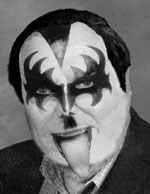
A man named Junius Peake was an economics professor at the University of Northern Colorado,  who due to his parody-inviting name and undoubtedly also the character traits that he was soon to display so prominently, found himself being lampooned in a student satire blog called “The Howling Pig.”  The editor-in-chief of the blog was facetiously identified in the newsletter as the obviously fictional “Junius Puke,” who was portrayed with an outrageous photograph of Professor Peake altered to include sunglasses, a different nose,  a Hitler-esque mustache, and, on occasion, Kiss make-up and a Gene Simmons tongue.  Junius Puke, with tongue. “Junius Puke” wrote prose like this:

“This will be a regular bitch sheet that will speak truth to power, obscenities to clergy, and advice to all the stoners sitting around watching Scooby Doo. This will be a forum for the pissed off and disenfranchised in Northern Colorado, basically everybody. I made it to where I am through hard work, luck, and connections, all without a college degree. Dissatisfaction with a cushy do-nothing ornamental position led me to form this subversive little paper. I don’t normally care much about the question of daycare since my kids are grown and other people’s children give me the willies.” Continue reading

Comment of the Day: “The Death of Ryamond Zack”

The story about the Alameda firefighters and police, as well as many citizens, standing useless on the shore as a suicidal man slowly drowned continues to receive  outstanding commentary. Here is the most recent, from Peter, doing some follow-up and pointedly critical analysis: 

“ABC asked Alameda Fire Division Chief Ricci Zombeck  whether he would save a drowning child and he said: “Well, if I was off duty I would know what I would do, but I think you’re asking me my on-duty response and I would have to stay within our policies and procedures because that’s what’s required by our department to do.”

“This quote essentially makes any indefensible defenses, or apologetics for how big and scary the victim was, moot. Perhaps they should make off-duty the new on-duty by assigning first responders to permanent off-duty roles. At least then they would go in after a drowning child. Continue reading

Comment of the Day: “The Death of Raymond Zack”

Raymond Zack

Buck Best, a Northern Virginia firefighter and supervisor, weighs in with his expert perspective and nuanced insight regarding my post on the Alameda, Cal. incident involving a suicide by drowning. His wife Lianne had another Comment of the Day earlier this week; if this keeps up, I will have to call the feature “Best Comment of the Day.”

“As an 18 year veteran of the Fire Dept. and the last ten years as the Officer of a Technical Rescue team that would be responsible for just such a rescue, let me offer another perspective to this ethical question. The Fire service much like many other organizations in recent history are governed by politics and litigation. The management of the organizations are always looking to the risk analysis of any potential situation based of the money that is available. The risk analysis is not based as much on the physical risk as it is on the financial or political risk. Continue reading

Flashback: “What Hugo Alfredo Tale-Yax Can Teach America”

The Late Hugo Alfredo Tale-Yax

[Not many people were checking in on Ethics Alarms when I wrote this post in response to yet another example of bystanders choosing to do nothing when a human being was in peril. Some of the comments to the Alameda post, those making excuses for the 75 faint-hearted or apathetic citizens in that city who would rather gawk at a tragedy than try to stop it,  caused me to recall the essay, which explores related issues.  I wrote it, but I had nearly forgotten about the story; when I re-read it today, I got upset all over again.Here, for the second time, is “What Hugo Alfredo Tale-Yax Can Teach America.”]

The one with the premium-grade ethics alarms bled to death on the sidewalk. The people who never had theirs installed at all took pictures. Is this the way it’s going to be? Continue reading

The Death of Raymond Zack: No Heroes, Only Bystanders

50-year-old Raymond Zack waded into the surf on an Alameda, California beach and stood calmly in the 54-degree water, apparently waiting to die. His suicide took nearly an hour, but eventually he drowned, with no rescue attempts from any of the 75 San Franciscans who gathered on the shore to watch the entire tragedy.

Why didn’t anyone try to rescue the man?

Apparently it was because nobody was paid to do it. You see, stopping Zack from killing himself wasn’t anyone’s job.

The media’s focus in reporting yet another disturbing incident with echoes of the murder of Kitty Genovese has been exclusively on the inert Alameda police and firemen who witnessed Zack’s suicide. “Fire crews and police could only watch,” wrote the Associate Press.

What does the AP mean, “they could only watch”?  Were they shackled? Held at gunpoint? Were all of them unable to swim? They didn’t have to watch and do nothing, they chose to watch and do nothing, just like every one of the bystanders who weren’t police or firemen chose to be passive and apathetic when saving a life required action and risk. Continue reading

The Professions Most Likely to Cheat on Their Taxes?

Gee, where do "Treasury Secretaries" fall on the list?

A study of I.R.S. data by a University of Chicago graduate student, now Doctor, Oscar Vela,  produced the following list of the professions most likely to file fraudulent tax returns, at least according to his analysis. Make of it what you will. The Time Magazine website blog post about the list is worth reading, first for the blogger’s highly questionable theories explaining, for example, why lawyers aren’t on it, but mostly to see conclusive proof that Time is hiring English-as-a-second-language night students, relatives of Ko-Ko the talking gorilla, or stroke victims to write their blogs. Sample sentence: “His conclusion was that as much as we would like to think so we pay taxes out of  the goodness of our hearts, or even because we are fearful of fines or worse.” Henry Luce just did a back-flip in his grave.

Dr. Vela’s theory is that the professions that are required to maintain a perception of integrity are less likely to cheat. Let us say that I am dubious. Why then are scientists so high on the list?

Here it is: Continue reading

Ethics Lost in Dallas Lost and Found Policy

Texas schoolteacher Gwen Patterson in Dallas found $470 cash and turned it in to the police as lost. The police said they would make the usual efforts to locate the owner. Gwen assumed she would hear if the money was claimed, and if it was not, that she would be contacted to pick up the cash herself. “I didn’t plan a big party, but I thought I could donate to some animal charities, and a relative is out of work,” she said. After four months of futile calls and being given the runaround, she was told that Dallas’ official policy is not to return lost money and valuables to the honest finder who turned it in, but to keep it. Continue reading