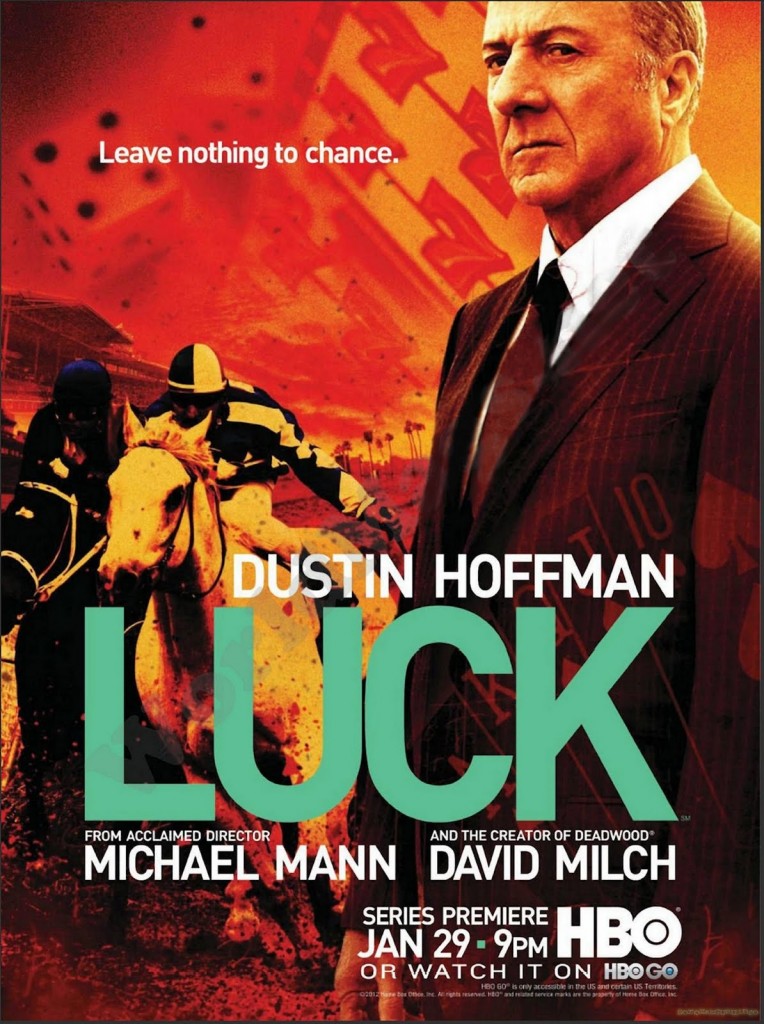
“Luck,” Causation, and the Complex Computation of Mixed Motivations

Was it good luck, or bad luck?

HBO has announced that it is cancelling “Luck,” its well-reviewed series about corruption in the sport of professional horse-racing. Why? Well, that’s an interesting question.

The immediate impetus for the decision was the death of a one of the horses used in the series. It was the third horse to die, so the announcement took the form of a sensitive and humane decision based on concerns for the animals. “While we maintained the highest safety standards possible, accidents unfortunately happen and it is impossible to guarantee they won’t in the future,” HBO’s statement said. “Accordingly, we have reached this difficult decision.”

I was initially impressed, but a couple of things about the move, which seemed uncharacteristically ethical by show business standards, bothered me. “Luck” was much-praised but low-rated, despite a cast headed by Dustin Hoffman and Nick Nolte and a production team headed by respected film director Michael Mann. Though it had been renewed for a second season, some felt that the renewal was dictated by a corporate decision not to embarrass its Hollywood royalty. Continue reading
Comment of the Day: “Ethics Quiz: The Case of the Fake But Accurate Social Security Card”

My ethics conundrum regarding the fake but accurate Social Security card solution—the Dan Rather approach, if you will— continued to garner a wide range of responses. Rick, as usual, has delivered one of the most thoughtful and provocative, and it is a worthy Comment of the Day.

Here is his comment on “Ethics Quiz: The Case of the Fake But Accurate Social Security Card”:

It strikes me that sometimes—not always, but sometimes—ethics is on a continuum. There’s the truly ethical, the not unethical, and the unethical, with many finer distinctions to be made.

I don’t running screaming into the night at the idea of faking a card, under the circumstances. Still, the truly ethical thing to do in this situation is to tell the prospective employer the truth. And the availability of all those other possible means of identification is indeed relevant. Provide one of the non-Social Security card alternatives and whatever other documentation is available. Importantly, if the employer, for whatever reason, is unwilling to accept this legally sufficient documentation, you don’t want to work for this person, no matter how much you need a job. Continue reading

No, It Still Doesn’t Justify Torture

No.

The news of how Osama bin Laden was finally tracked down and killed has caused a predictable outbreak of consequentialism. It appears that Khalid Sheikh Mohammed provided some of the key intelligence that led to the successful operation in Pakistan while he was undergoing “enhanced interrogation” in CIA prisons in Rumania and Poland. “See?” Dick Cheney’s fans are saying today. “Rendition and torture work. We wouldn’t have killed Bin Laden without them. So what do you think of those tactics now?” The opponents of torture who foolishly argued against it based on pragmatic considerations—“Torture doesn’t work!”—rather than ethical ones–-“It is absolutely wrong!“—set themselves up for this.  Now what should they say? Continue reading

Comment of the Day: “The Cabbie and the Jewelry”

Prodigal Commenter Penn re-entered the ethics fray with two anecdotes about ethics and Japanese culture in reaction to the Ethics Alarms quiz, “The Cabbie and the Jewelry.” This was the second COTD to be inspired by that story of the ethical—or pragmatic—cabbie who rescued $100,000 worth of jewelry left in his cab by a careless fare.

Here is Penn’s “Comment of the Day”:

“70s, Tokyo, 2 anecdotes: Continue reading

Comment of the Day: Ethics Quiz: “The Cabbie and the Jewelry”…Ethics or Pragmatism?

Karl Penny puts the perfect topping on this post, about the praise being heaped on the NYC cabbie who returned $100,000 in jewels to an absent-minded fare, when he could have made a dash for the Bahamas. I obviously couldn’t say it better myself, because I didn’t.

Here is Karl, a long-time and cherished reader, on Ethics Quiz: “The Cabbie and the Jewelry”…Ethics or Pragmatism?

“Well, it would be a pretty swell world if everyone did the right thing in cases like these, simply because it never occurred to them to do it any other way.  But that’s not the world we live in.  But, in either type of world, people like Mr. Jalloh should be highly praised:  in the world as it is, because he becomes an exemplar of the way things should be; and in the better world, because virtue never goes out of style and should be reaffirmed whenever an example of it occurs.”

Ethics Quiz: “The Cabbie and the Jewelry”…Ethics or Pragmatism?

Cable news, the New york press and the blogosphere are singing the praises of Big Apple cabbie Zubiru Jalloh, who, when he discovered that an absent-minded passenger, John James, had left a bag containing about $100,000 worth of jewelry in his back seat (“Doh!”) of his cab, rescued the bag from the next passenger, took it home for safekeeping, and eventually got it back to its rightful owner. Continue reading