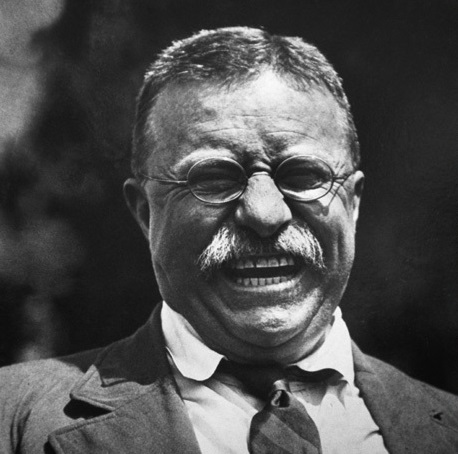
Comment Of The Day: “Today’s Chaos, Ethics And Alternate History Note: Teddy’s Fateful Decision”

This unique Comment of the Day, by Steve-O-in NJ,  has come closer to cheering me up than anything else today. Taking of from my post about the historical chaos set off by Theodore Roosevelt’s decision to split the Republican Party in 1912, Steve-O draws on his impressive knowledge of history to give us what Paul Harvey called, “The rest of the story. Well, what would have been the rest of the story.

Here is Steve-O’s Comment of the Day on the post, “Today’s Chaos, Ethics And Alternate History Note: Teddy’s Fateful Decision”:

I’m late to the table, but I love playing “what if?” So, here’s my take on the alternative future where Teddy Roosevelt did not run in 1912. He was a year back from Europe and disgusted that Taft was approaching the task of governing completely different than he had. To Roosevelt, a president was a trustee of the people’s power, to use it for them as best he saw fit. Taft saw the president as more a chief magistrate, who should be careful not to exceed his enumerated powers – when not hitting the links. Roosevelt swore he’d topple Taft, if not as the Republican nominee, then as the nominee of his own party. However, a few of his friends who could talk to him frankly told him, “Ted, there are times you act like you’re about six years old, but this is the six-year-oldiest. You can run, but all it will do is split the Republican vote and hand the White House to that dead-eyed, ivory-tower, political neophyte from Princeton. Is that what you want? This country isn’t yours to use for your own vendetta or destroy when you don’t get your way.”

Angry, but seeing the point, Teddy dropped out of public life and retired to Sagamore House in Oyster Bay to write and figure out what was next for him at 54. Although he took no part in the 1912 election, his neutrality was enough to guarantee Taft a second term and send Woodrow Wilson back into academia. Vice President James Sherman died shortly before the election. As a gesture to his former friend, who he still respected, Taft replaced him with political sage and longtime Republican public servant Elihu Root. Roosevelt’s account of his many meetings with the rulers of Europe during his time there, “The Gilded Path,” was published in 2013, and his proposal for a stronger international community and a possible international court, “A Firmer Foundation,: was published the next year…a month before the assassination of Franz Ferdinand touched off a war between Serbia and Austria-Hungary, and the Kaiser foolishly delivered “the German Blank Check.” Continue reading
Today’s Chaos, Ethics And Alternate History Note: Teddy’s Fateful Decision

On this day in 1912, Theodore Roosevelt was nominated to run for  Presidency by the newly formed Progressive Party, quickly dubbed “the Bull Moose Party” after Teddy said he felt like Bull Moose. Roosevelt’s platform called for the direct election of U.S. Senators, woman suffrage, and many social reforms based on fair business competition and increased welfare for the poor. As anyone could have told Roosevelt and many tried, this move was based on vanity and anger, and almost certainly ensured that Woodrow Wilson would end up President after Republicans split their votes between Roosevelt and President Taft. Wilson was indeed elected, and the result for the country was disastrous. A proud racist, Wilson endorsed Jim Crow and eliminated what had been the gradual racial liberalization of government agencies. He took the U.S. into World War I, something a re-elected President Taft would not have done (but, alas, Teddy would have, since he liked wars), helping to spread the Spanish flu world -wide. Wilson allowed the treaty ending he  war to be excessively punitive to Germany, planting the seeds of World War II, the Holocaust, and the rise of the Soviet Union. Continue reading

A Presidential “Othering” Ethics Puzzle: What IS This Statement? Misleading? Ignorant? Biased?

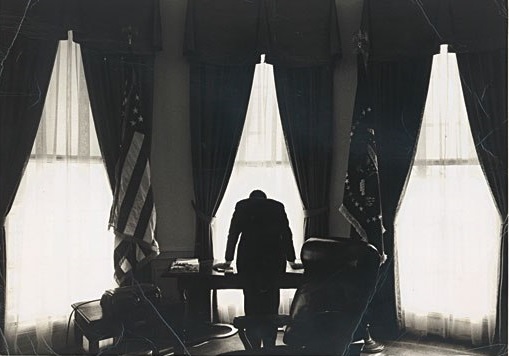
jfk-oval-office

In a column today, Washington Post political columnist Chris Cillizza writes,

“The simple fact is that Trump has never had real friends in the sense you or I think of the term. The relationship world of Trump has long been split into two groups: (1) his family and (2) people who work for him. And people who work for you are rarely your actual friends.”

This was written in the context of an article titled “The very peculiar isolation of Donald Trump.”

What’s going on here? It is definitely one more “othering” exercise from the news media, part of a concerted effort to avoid “normalizing” this President so that tactics previously regarded as unthinkable, undemocratic and unAmerican will be accepted by the public when they are used against him. The message is that this President is strange, weird. He’s not like us. He’s a monster. Today, for example,  MSNBC’s Katy Tur insinuated that the President might be planning to start murdering journalists, asking a guest.

“As we know, there’s, since 2000, been a couple dozen suspicious deaths of journalists in Russia who came out against the government there.Donald Trump has made no secret about going after journalists and his distaste for any news that doesn’t agree with him here. Do you find that this is a dangerous path he is heading down?”

I was struck by Cillizza’s column  because the topic is one of several upon which I wrote my honors thesis in American government. (If you are in Cambridge, Mass., you can find a copy in Widener Library.)  Cillizza’s statement made me realize, for the first time, really: Ah! There’s at least one aspect of his personality that is typical of American Presidents!” I studied exactly that aspect of Presidential biographies to test my thesis that the U.S. Presidency attracted a specific character type, and the type was not “normal” by the public standards. Continue reading

Bill Clinton’s Unethical Fun at the Expense of Obama’s Presidency

With friends like Bill Clinton, President Obama hardly needs enemies.

In the middle of a crisis in his Presidency, with former supporters and allies joining critics in questioning his character, judgment, courage and leadership, Obama turned to a former president for counsel, just as many Chief Executives before him have done when the wolf was at the door. William Jefferson Clinton, however is nothing if not a hound for attention, and while Obama struggles with the mantle of leadership, Clinton is especially comfy in it. Thus when what was supposed to be a White House brief photo-op for the press gave Clinton a clear path to an open mike, he grabbed it, and promptly made look weaker than ever. As the Washington Post described the scene:

“After brief remarks by Obama, Clinton slid behind the lectern as if he’d never left the building. For a time it looked like he might never leave, as he fielded questions from a White House press corps eager to keep him as long as it could. He stroked his chin. He folded his arms and looked pensive. He gesticulated expansively. He was part professor and full politician enjoying the spotlight.

“After a few minutes, Obama seemed to conclude that he would be better served by being out of the picture than as a bystander. “I’ve been keeping the first lady waiting for about half an hour, so I’m going to take off,” he said. Clinton responded, “Well, I – I don’t want to make her mad. Please go.”

“And with that, Clinton had the stage to himself.”

He just couldn’t help himself. Continue reading

Should Jimmy Carter Annoint Himself As The Best Former President Ever?

Last week, former President Jimmy Carter told NBC’s Brian Williams:

“I feel that my role as a former president is probably superior to that of other presidents’. Primarily because of the activism and the — and the injection of working at the Carter Center and in international affairs, and to some degree, domestic affairs, on energy conservation, on — on environment, and things of that kind. We’re right in the midst of the — of the constant daily debate.  And  the Carter Center has decided, under my leadership, to fill vacuums in the world. When — when the United States won’t deal with troubled areas, we go there, and we meet with leaders who can bring an end to a conflict, or an end to a human rights abuse, and so forth. So I — I feel that I have an advantage over many other former presidents in being involved in daily affairs that have shaped the policies of our nation and the world.”

Many commentators felt that Carter’s self-annointment as the best post White House POTUS was unseemly at best, immodest and ungracious at worst. Continue reading