Christopher Fountain, Address Outing And The Golden Rule Distortion

Here we go again.

If it's unethical to do it to Harry, it's unethical to do it to anyone.

If it’s unethical to do it to Harry, it’s unethical to do it to anyone.

In the pantheon of distortions of the Golden Rule–-“Do Unto Others What They Did Unto You;” “Do Unto Others What You Think They Would Do Unto You If You Gave Them The Chance;” “Do Unto Others Before They Do It Unto You,” “Do Unto Other As You Wish They Would Do Unto You Even Though You Deserve A Hell of a Lot Worse,” and many others—perhaps the most popular is “Do Unto Others What They Did Unto Others, or You.” This is the “Tit for Tat” rationalization, the invalid ethical theory that when someone does something wrong, it waives the ethical rule making it wrong if the conduct is applied to them. I discussed this in the post and the thread about the Right’s “Harry Reid is a pederast” meme, devised as retribution for Reid’s admittedly despicable assertion that Mitt Romney was a tax evader, as vivid a modern example of “Big Lie” politics as we are ever likely to see. I don’t want to repeat myself. You can review it here; this was the most viewed post on Ethics Alarms in 2012. Continue reading

Gross Abuse of the First Amendment: The Journal News’ Attack on Gun Owner Privacy

"Here are the names and addresses of people with blood on their hands, Just thought you might be interested."

“Here are the names and addresses of people with blood on their hands. Just thought you might be interested in paying one of them a little visit.”

New York’s Journal News has published a map showing the homes of pistol permit holders in two New York counties. (They are acquiring data for a third.) Now, on the Journal News website, you can click on any of the dots indicating a permit holder and see his name and address—very useful, should you want to go to the owner’s home and kill him, since we all know gun owners have “blood on their hands” after the massacre in Newtown. The Journal News acquired the personal information through the Freedom of Information Act.

A story like this one renders me depressed, confused and lost. It should not be unnecessary for me or anyone to explain what is wrong with this conduct, and yet not only has a media organization done it, but many Americans undoubtedly will cheer them on. If people can’t figure out on their own what is wrong with this—the ethical offense is “publicizing citizens’ names and addresses in an attempt to intimidate them and expose them to harassment for exercising their legal, Constitutionally protected rights in a responsible fashion”— I suspect that it is a waste of time trying to enlighten them. Continue reading

Lisa Long’s Unethical, Despicable Bargain: Betrayal For A Blog Post

No silver for this mother's betrayal...just blogging fame..

No silver for this mother’s betrayal…just blogging fame..

I hope free-lance writer Lisa Long enjoys her brief notoriety as a result of her blog post on The Blue Review that was  re-published on the Huffington Post and  Gawker, guaranteeing millions of readers. That should be worth at least a few more published articles for her, and maybe even a cable interview or two. After all, it would be a pity  to deliberately and callously burden the life of her emotionally disturbed son and get nothing out of it at all.

One thing she is already getting as the result of her sensationally-titled essay “I am Adam Lanza’s Mother” is harsh criticism for making such a cynical and self-serving bargain. In her post, Long relates the harrowing tale of her life with her 13-year-old son, whose erratic behavior and emotional outbursts terrify and dismay her. In the most quoted portion of the post, she proclaims his equivalence to well-known serial killers:

“I am sharing this story because I am Adam Lanza’s mother. I am Dylan Klebold’s and Eric Harris’s mother. I am James Holmes’s mother. I am Jared Loughner’s mother. I am Seung-Hui Cho’s mother. And these boys—and their mothers—need help. In the wake of another horrific national tragedy, it’s easy to talk about guns. But it’s time to talk about mental illness.”

Gee, thanks Mom! Continue reading

Comment of the Day: “The Idiot, the Ex, and the Consequences”

I’ve been remiss in posting “comments of the day” of late; it is not a reflection on comment quality, which has been excellent, but rather on my own distractions. Here is a new one at last, from new commenter Kathryn. It appeals to me because it nails the subtext of the original post, and like most Comments of the Day, takes the original topic to the next stage of analysis. I hope we hear more from her. Here is Kathryn’s Comment of the Day on the post, “The Idiot, the Ex, and the Consequences.”

“I am waiting, perhaps overly optimistically, for culture to catch up with information availability and develop new ways of handling privacy outside of responding to information when it is made public, regardless of the source or context for that information. Everyone says/does something particularly unwise/unwell/without grace during their life. Technology is getting to the point that these moments, rather than being forgotten or a story told among friends, are fairly permanently in the public record. (The Internet is public, whatever Facebook settings attempt to convince you.) Continue reading

The Idiot, the Ex, and the Consequences

Denise Helms, who will probably not look like this the next time you see her if she knows what’s good for her.

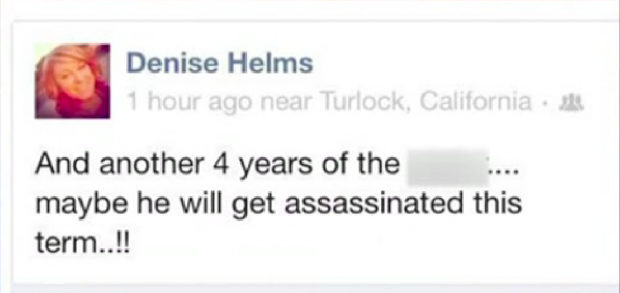
My position would usually be this: for an employer to use a privacy setting Facebook post as justification for firing an employee is unfair. That applies to vacation photos of an elementary school teacher holding a beer and looking bleery-eyed at a pub, a Sunday school teacher doing a strip tease at a bachelor party, and political posts of a radical, vulgar or offensive nature. Two factors can change the equation, though. Action may be justified if the posting reasonably calls into question the trustworthiness of the employee in his or her job duties, or if the posting becomes public, subjecting the employer to embarrassment or undermining the employee’s ability to do her job, as in the naked teacher cases.

Denise Helms, the idiot referenced in the title above, posted this on her Facebook page, intended only for her closest, presumably most racist or most idiotic friends:

Continue reading

CNN and the Ambassador’s Journal: Unethical or Ick?

Answer: Ick

Ambassador Chris Stevens, murdered in Libya in what is now finally being described as a planned terrorist attack (and not spontaneous film criticism, as the Obama Administration successfully persuaded the media to claim for more than a week), left a brief hand-written journal behind that somehow was retrieved by CNN instead of the U.S. government. When Anderson Cooper revealed that the journal had been reviewed by reporters and used to cover the story of the Benghazi attack, both the slain diplomat’s family and the State Department criticized the network, which said,

“We think the public had a right to know what CNN had learned from multiple sources about the fears and warnings of a terror threat before the Benghazi attack which are now raising questions about why the State Department didn’t do more to protect Ambassador Stevens and other US personnel.Perhaps the real question here is why is the State Department now attacking the messenger.”

Well, there are interesting theories about that, since what the late Ambassador had written suggests that there was fear of a terrorist attack in the vicinity of the 9/11 anniversary, yet both Secretary Clinton and President Obama went to great lengths to characterize the Benghazi violence as prompted by spontaneous and legitimate rage over an American’s exercise of his right of free speech. There is a rebuttable presumption that the State Department was prepared to bury the implications of what Stevens wrote, since everything else it has done in relation to his murder has been misleading or pusillanimous. In the latter category is using Stevens’ family as its excuse for bashing CNN for delivering on its duty to provide what the public “has a right to know.” Continue reading

Comment of the Day: “Is a Transgendered Woman Ethically Obligated To Tell Her Boyfriend That She Used To be Male?”

You never know. My post about the ethics of withholding the fact of one’s past and altered gender from a potential spouse sparked the most passionate, erudite and instructive debate among readers that Ethics Alarms has seen in a long time, involving an all-star squad of some of this blog’s best minds. The prize goes to Zoebrain, though, who scores the Comment of the Day with this three part contribution. It’s long; don’t let that discourage you. It, and the whole thread, which you can find here, is well worth your time, because you will learn something. I did.

“May I give an extended set of replies here please? You see, this isn’t a hypothetical for me, it’s an actual. Continue reading

Is a Transgendered Woman Ethically Obligated To Tell Her Boyfriend That She Used To be Male?

“Is this a bad time to tell you that I used to be a man?”

Sometimes I wonder if Emily Yoffe’s Slate advice column (“Dear Prudence”) is like the old Penthouse Forum, where it was clear to any reader who hadn’t purchased the Brooklyn Bridge twice that a team of giggling writers was coming up with the feature’s bizarre letters about orgies with amputees and people having sex in piles of fresh fish. But never mind: her most recent column makes an interesting ethical assertion is response to a woman who is troubled that her transgendered cousin refuses to tell her serious boyfriend about the jockstrap in her past:

“I think you should tell your cousin she’s living in a dream world and that she’s being unfair to John, even if he has a lack of desire for children. Of course, it could be that John flees, or it could be that he says, “She’s more than woman enough for me.” But it’s his right to know the crucial piece of history.”

I agree with Yoffe that the cousin is deluded if she thinks she can keep her past gender hidden forever if the relationship continues, and that the revelation of a secret of such magnitude is bound to be more disruptive the longer it is hidden. But is she correct that he has a right to know about it? Elsewhere Yoffe suggests that not telling him is dishonest. Why?

I understand the theory that couples shouldn’t withhold personal information from one another in the interest of mutual trust. Surely each member of a committed couple has an obligation to reveal any personal information that has the potential to affect the other. Is there an obligation to reveal personal information that one knows a boyfriend or girlfriend will be shocked to learn, or that will tap into visceral fears or biases? Author William Saroyan left his wife on their honeymoon when she revealed to him that she was Jewish, which highlights the irony of the problem: if a woman knows that a secret may cause a lover to reject her, however irrational that reaction would be, then is she ethically obligated to tell him but not obligated if she is sure he wouldn’t care? In other words, is one only ethically obligated to reveal the secrets that will destroy a relationship?

That seems strange. Continue reading

Protecting Rapists and Savanah Dietrich’s Vigilante Tweet

Savanah Dietrich, teen rape victim facing charges for refusing to protect the privacy of her rapists,

One of the Ethics Alarms principles that many find infuriating is my position that violating the law is inherently unethical. Like all rules, this one doesn’t make sense in all cases, and one of them has surfaced in Louisville, Kentucky.

Savanah Dietrich, a 17-year-old rape victim, was infuriated when her teenaged rapists managed to negotiate a lenient plea bargain for sexually assaulting her and circulating pictures of the incident to friends. She took to Twitter, named them and described what they did to her, despite being under a confidentiality order from the judge in the case. Her attackers were juveniles, and the court records were sealed. Now Dietrich is facing a jail sentence longer than her rapists, because their attorneys have asked a Jefferson District Court judge to hold her in contempt. Continue reading

Banning the Privacy Bomb

Yes, I think posting this photo is a lousy thing to do to your dog, too.

The stories come out routinely, and the opposing opinions are predictable. A boorish date dumps a woman via arrogant e-mail, which is promptly forwarded to thousands, making him a national laughing stock and pariah. A movie star sends an angry and mean-spirited message to his teenage daughter, who places it in the hands of the celebrity-devouring media…which then use it to savage the star’s reputation.  A Harvard law student takes an e-mail sent by a friend and fellow-student as a follow-up to a contentious discussion about race, and forwards it to minority advocates on campus, who then condemn the “friend” as a racist. A model live-tweets her encounter with the married actor sitting next to her on a flight, as he engages in awkward flirtation. In each case, defenders of the punitive distributor of the embarrassing communication argue that the victim deserved it, while critics of the conduct insist that it is a betrayal of privacy and trust.
We need to decide, as a culture, whether we believe that reasonable expectations of privacy should be respected or not; indeed, whether they should survive or not. Those who endorse, defend and encourage the kind of conduct in these incidents and many more are, whether they realize it or not, fouling the nest of our national culture and community, making not just privacy, but also friendship and intimacy, almost impossible. Continue reading