Now THIS Is A Witch Hunt! The Northwestern-Laura Kipnis Ethics Train Wreck

Springfiled mob

I really tried to ignore this ridiculous story. Campus political correctness battles, like examples of public school teacher incompetence ( my head just exploded yesterday, so I refuse to write about THIS), are so common and so self-evidently whacked that the blog could easily be over-run by them. The lower education episodes are more important, I’ve concluded, because the victims are children who still might be saved from indoctrination and a life-wrecking warped concept of how authority should be wielded, and children must be protected from the kind of child abuse a lot of these episodes represent. In the college campus fiascos, much of the time, it is the students who are the initial culprits (remember, they are adults, supposedly), and the administrators are mostly the craven enablers. Initially, I thought this episode was just another example of runaway progressive fascism feeding on itself. And it is, but there is more to it than that.

To briefly summarize…Laura Kipnis is a Professor of Radio, TV and Film at Northwestern University. She wrote an entertaining article in the Chronicle of Higher Education about what she termed the ‘sexual paranoia’ on college campuses, including hers, and delivered observations about how these attitudes were strangling discourse and sane human interaction in society at large.

I wasn’t crazy about the article, because Kipnis, as I might expect from a theater prof, appears to know nothing about ethics at all. Her over-arching position is Old Sixties Berkeley: if it involves sex, chill out. I will bet my head that Kipnis was one of Bill Clinton’s defenders on the grounds that lying about sex isn’t lying, even when it’s under oath, even when it’s on TV, even when it’s to the American people’s face, even when you use your power and high office to support it. It’s sex, and sex is groovy. Who knows, she might also have defended John Edwards, and no, I have not had any respect for people like this since the Nineties. Continue reading
Case Study In “When Ethics Fail, Law Takes Over”: Harvard’s Prof-Student Romance Ban

Harvard_yard_winter_2009j

Harvard used to just say “it’s wrong,” but left it up to the faculty’s ethics in the school’s infinite faith in its own superior virtue. My Freshman Humanities professor, poet William Alfred, was married to a former student. As is usually the case in this matter, ethics alone often wasn’t enough to restrain the lust of  many aging, prestigious, powerful professors facing a veritable cornucopia of luscious, young, ambitious co-eds they could court using brains, worldly wiles, charm and the promise of good grades. Now the profs have more to bolster their self-control…from the New York Times:

Harvard University has adopted a ban on professors having sexual or romantic relationships with undergraduate students, joining a small but growing number of universities prohibiting such relationships. The move comes as the Obama administration investigates the handling of accusations of sexual assault at dozens of colleges, including Harvard.

The ban clarifies an earlier policy that labeled sexual and romantic relationships between professors and the students they teach as inappropriate, but did not explicitly prohibit professors from having relationships with students they did not teach.

Harvard said in a statement released Thursday that the change was made after a panel reviewing the institution’s policy on Title IX, the federal law prohibiting sex discrimination in education, determined that the university’s existing policy language on “relationships of unequal status did not explicitly reflect the faculty’s expectations of what constituted an appropriate relationship between undergraduate students and faculty members.” It said the committee revised the policy “to include a clear prohibition to better accord with these expectations…Besides banning sexual and romantic relationships between professors and all undergraduates, the policy also bans such relationships between teaching staff, such as graduate students, and the students who fall under their supervision or evaluation.

Good. Long overdue.

This is also an excellent use of Harvard’s status and leadership, as the oldest and most famous institution of higher learning. Other universities will now suddenly be responsible as well.

Gee, do you think Harvard took my advice?

Nahhh.

Is It Ethical For Professors To Date Students?

teacher-student datingProfsBlog asks the question regarding law professors and law students, but the question doesn’t change by narrowing the definition. The question is really, and only, “Is it ethical for teachers to have romantic relationships with students?” The answer is, has been, and forever shall be, “No.”

The answer to an ethics question sometimes becomes obvious when it is apparent that every argument on one side is either a logical fallacy, an unethical rationalization, or the application of an invalid ethics principle. Such is the case here, and thus I somewhat question the motives of the author of the post, Kelly Anders. Wishful thinking, perhaps? Asking the question creates the illusion that there is a real controversy. In this case, there isn’t.

I addressed this question a long time ago, in an early post here barely seen at the time but among the most frequently visited since. I wrote:

[P]rofessors [are] obligated to maintain a position of authority, objectivity and judgment as mentors and teachers of the whole student body, and [have] a duty to their schools not to allow their trustworthiness to be undermined by having intimate relationships among the same group that they [are] supposed to be supervising and advising. Dating a student is a professional breach of trust, and one that adversely effects the integrity of the entire educational institution…. The appearance created when a supervisor/manager/leader indulges in intimate relations with someone over whom they have authority, status and power—and every professor has authority over every student, in class or out— undermines the institution and the profession, by sending the false message that such relationships are standard, approved, and implicitly desirable in the culture where they occur…A professor has a potential teacher-student relationship with all students at a university, not just those in his or her classes.

Dating a student who happens not to be in one of those classes is what lawyers call “a distinction without a difference.” Many students and professors will reasonably assume that the pairing arose out of the student-teacher relationship, and in some ways it almost certainly did. A teacher always has superior power over any student by virtue of his or her position of authority, and it is an abuse of that power to use it to entice students into dates or bed…

[It] is naive to ignore the extended conflicts such relationships create. Might the professor’s best friends on the faculty be more generous when grading their friend’s significant other if he or she is one of their students? Will the professor consciously or subconsciously be easier on the friends of his student lover if they are in his class? The fact that the question can be asked shows that the situation should not occur where it can be asked.

Students, all students, must be off-limits as romantic partners for professors and administrators in universities, regardless of what rules are in place.Professors who date students risk their jobs because a student body is not their sexual smorgasbord, and it is a breach of trust and duty to treat it like one.

I wouldn’t change a word, except that typo I just noticed, and just fixed in the original. Nor is anything I wrote then revolutionary or new. These are the realities of authority, professionalism, leadership and power. It’s just that sometimes people really, really wish they were not. Continue reading

Ethics Quiz: The Harvard Prof and The Erroneous Chinese Restaurant Menu

Perfect! Just what you need to handle that pesky flea, Professor!

Perfect! Just what you need to handle that pesky flea, Professor!

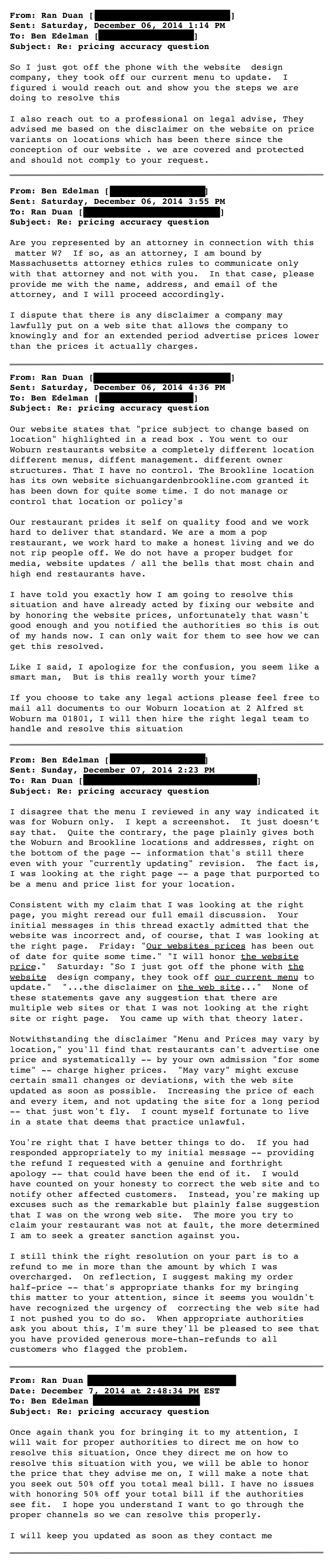
Ben Edelman, a rather well-noted Harvard Business School professor, had this fascinating exchange with a local Szechuan restaurant:

Edelman 1Edelman 2Your Ethics Alarms Ethics Quiz:

“Is Prof. Edelman’s conduct ethical?”

Continue reading

Lessons From The Defenders Of The Wise-Ass “A”

Back at the beginning of the month, some obscure corners of the web were buzzing over the picture of a purported student exam that ranked an “A..Nice job!” despite the student’s smug punt at the end. Here it is…the section in the square is the section of the student’s answer that provoked widespread indignation at the grade. I first saw it in a post titled: “Some teachers don’t even care any more”:

funny-test-A-grade-teacher-kid-school

To be fair, there are many and diverse possible interpretations of this evidence, and not enough context to choose among them. It could be a hoax, for example. The teacher may indeed have skimmed the answer, and not read the paragraph in question. The student’s answer may have already covered the topic sufficiently to justify an “A” (in the teacher’s judgment), and the teacher may have decided to ignore the non sequitur, stream of consciousness ending.

Or perhaps the teacher was like my high school chemistry teacher, Mr. Cosloy. (If you are out there reading this, Mr. C—thanks for the memories!) Mr. Cosloy was a terrific teacher who had a healthy dose of cynicism about the way school operated, as well as a well-developed sense of humor. He poked fun at the process all the time, and allowed his students to do the same as long as they also did the work he assigned and showed some progress toward mastering the subject. I felt comfortable writing asides and irreverent commentary on his tests, and on at least one occasion he wrote on one of them that my answers were only worth a B, but he had given me a B+ because I made him laugh twice. We don’t know what the relationship was between the student who allegedly wrote the test answer above and the teacher grading it. Heck, that teacher might have been Mr. Cosloy…

Thus, I was not going to write yet another “here’s more proof that our schools are going to hell” post, though our schools are indeed going to hell. What intrigued me about the episode were some of the comments about it, especially this one, from a Bridgemont Community and Technical College professor named Machelle Kindle: Continue reading

“Pow Wow Chow” Follow-Up: My Breitbart Interview On Harvard and Professor Plagiarism

Michael Patrick Healy, an author and conservative activist, interviewed me today regarding what Harvard Law School’s response ought to be if indeed Elizabeth Warren engaged in plagiarism with her contributions, as “Elizabeth Warren, Cherokee”, to the cookbook “Pow Wow Chow.”

His article, including the interview, are on the Breitbart Big Government site, here.

Ethics, Porn, and the Creepy Professor

The Ronald Ayers saga raises the intriguing, Weiner-esque ethical issue of whether a college professor being creepy is sufficient reason to fire him.

The former economics professor was fired by the University of Texas for viewing pornography on an office computer, which the University’s policies forbade. The chain of facts has the ring of Kafka: 1) a student claims he hears “sexual noises” emanating from Ayers’ office, which 2) is considered sufficient provocation (the professor denied the accusation that he was not “master of his domain” at work) for the school to search his computer, which 3) uncovers evidence that he looked at some pornographic sites, and 4) also that he searched for the term “teen,” which 5) the university deems sufficient to indicate that he was searching for child pornography, so 6) they fired him, after three decades and tenure on the faculty.

University records say Ayers at first denied the allegations that he viewed pornography, but when confronted with a printout of his computer records, admitted that it may have happened “at the end of a long work day.” Ayers later told administrators seeing the porn was for “academic research.”

Uh-huh… Continue reading

The Times’ New Ethicist Commits Malpractice

The new Times "Ethicst" shows her dark side.

Randy Cohen’s replacement as “The Ethicist” in the New York Times Magazine, Ariel Kaminer, had a flawless maiden flight last week, but crashes and burns on her first question this week. As was too often true of Cohen, she messes up in the area of honesty and legal ethics.

The inquirer, an applicant for law school, had asked a former professor to write a recommendation.  The professor, an apparent creep, said she was too busy—Honestly: writing recommendations for students applying to graduate students is part of her job, and how long does it take?—but if that if the student would write it, she would gladly “edit as needed” and submit it under her own name. Ariel’s inquirer felt uncomfortable writing her own letter of recommendation, but did not “wish to jeopardize my chances of being accepted into my top-choice school by being overly conscientious.” Ariel’s question to answer: is it ethical to draft the letter? Continue reading