Ethics Quiz: Virginia’s Forced Vasectomy

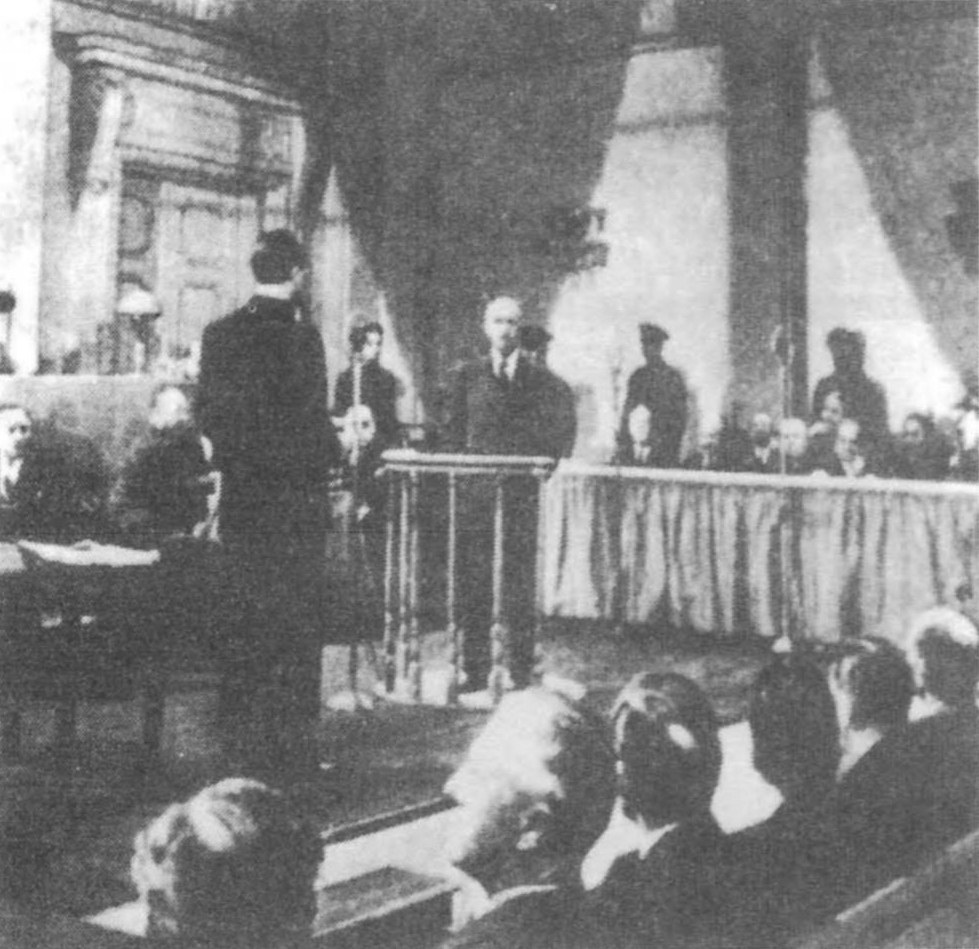
"Well, they can't all be "shouting fire in a crowded theater," Oliver. So you had an off day....it happens.

“Well, they can’t all be “shouting fire in a crowded theater,” Oliver. So you had an off day….it happens.

One of the skeletons in the Old Dominion State’s closet is the 1924 “Virginia Eugenical Sterilization Act,” a  law allowing the sterilization of citizens adjudged to be in a long line of mentally deficient idiots. The law was upheld in the infamous  1927 Supreme Court opinion in Buck v. Bell, in which the great Justice Oliver Wendell Holmes, to his undying shame, wrote,

“It is better for all the world if, instead of waiting to execute degenerate offspring for crime or to let them starve for their imbecility, society can prevent those who are manifestly unfit from continuing their kind…Three generations of imbeciles are enough.”

So approved, Virginia’s eugenics law lasted into the 1970s, allowing the state to sterilize more than 7,000 people in mental institutions. The law was repealed in 1979, and victims are seeking reparations. Now the ghost of that law is hovering over the resolution of a current case.

The only thing Virginian Jessie Lee Herald has done on his 27 years more than get in trouble with the law is have children: so far he has had seven (with six mothers) and his current wife says she wants more. He recently fled the scene of a car crash with his injured 3-year-old son. Herald pleaded guilty to felony child endangerment, felony hit-and-run, and misdemeanor driving on a suspended license. Investigators who went to his home found his child to have been neglected, with, among other things, shards of glass in his diapers.

A Shenandoah County prosecutor, Illona White, proposed a plea deal that would reduce Herald’s prison sentence to just four years: he would have to agree to a vasectomy. He took the deal, which also requires him to pay for the operation.

Your Ethics Alarms Ethics Quiz of the Day:

 Is it ethical for a state to make a convicted felon choose between prison time and sterilization?

Continue reading

Dear Legal Profession: How Can We Respect And Trust You When You Police Yourself Like THIS?

Justice_broken3

I’ve been defending my profession a lot here lately, but I also recognize that there is a very good reason why such incidents as the surprisingly generous sentence in the “Affluenza” case and the drug court judge who suffered an alcoholic relapse on the bench are wrongly interpreted as proof of inequities and double standards in the legal system. The reason is that those who oversee the system do inexplicable things that appear to the outside world as not only a lack of integrity but also the apparent inability to realize how such conduct undermines the public trust.

Both of these recent news stories are cases in point:

I. The Imaginary Government Lawyer

In 2012, the Nebraska state supreme court disbarred lawyer David Walocha for not paying his bar dues and proceeding to practice law for 13 years with a suspended license. At the end of 2013, the District of Columbia Bar had to decide what to do with former Justice Department attorney Laura Heiser, who practiced 21 years with a suspended license in the District. What was her punishment? She received an informal admonition, which is the least severe form of disciplinary action.  Continue reading

A Prosecutor Is Sent To Jail For Unethical Conduct, And It’s About Time

Good.

Good.

In the resolution of a case already discussed on Ethics Alarms, Former Williamson County (Texas) District Attorney Ken Anderson has been  sentenced to serve 10 days in jail, pay a $500 fine and complete 500 hours of community service as punishment for intentionally failing to turn over exculpatory evidence that would have exonerated Michael Morton, who spent nearly 25 years in prison for a murder he did not commit. Anderson also was forced to surrender his law license and resign his post as a judge because of his ethical breaches in the 1987 case, ultimately overturned after DNA evidence proved that Morton did not beat his wife to death.

Ten days for the prosecutor who disgraced his profession, sullied the justice system and destroyed a life seems like a rap on the wrist, and even an insult to the man who had to spend  nearly 9000 days in jail because of Anderson’s deception. Consider, however: despite blatant prosecutorial misconduct, in every state and for centuries, with untold numbers of innocents jailed and executed, most never vindicated, this appears to be the first time on record that any prosecutor has been punished with jail time. Few, compared to the number deserving punishment, have been punished at all.

It’s a start. It’s a precedent.

The justice system just became a little more accountable.

_____________________________

Pointer: Legal Ethics Forum

Sources: New York Times, ABC KVUE

Ethics Alarms attempts to give proper attribution and credit to all sources of facts, analysis and other assistance that go into its blog posts. If you are aware of one I missed, or believe your own work or property was used in any way without proper attribution, please contact me, Jack Marshall, at  jamproethics@verizon.net.

The George Zimmerman Show Trial

It CAN happen here. Or at least in Florida.

It CAN happen here. Or at least in Florida.

Before George Zimmerman was charged with the second degree murder of Trayvon Martin, the suspicion was already growing that powerful people, much of the news media and perhaps one entire political party was attempting to take his freedom and life for ideological, partisan or political gain. Then came the bizarre and unprofessional public statements by Florida prosecutor Angela Corey, unequivocally proclaiming her alliance with the Martin family and her certainty of Zimmerman’s guilt—neither of which sentiments were appropriate or ethical. Now that we have seen and heard the state’s case, there is little doubt that Zimmerman, contrary to American principles of justice, is being required to prove his innocence, rather than be proven guilty beyond a reasonable doubt. There are reasons for this, not the least of which is that the President of the United States decided to dictate that getting to the bottom of the “Why is Trayvon dead?” conundrum was a matter of national importance, but none of them are honorable,  fair, right or ethical. Continue reading

A Prosecutor Lies, But It’s For A Good Cause…

Yes, Jack McCoy would probably be disbarred in the real world...

Yes, Jack McCoy would probably be disbarred in the real world…

Aaron Brockler, an assistant Cuyahoga County (Ohio, including Cleveland) prosecutor, was fired last month for  using a false identity on Facebook  to try to influence the testimony of  defense witnesses in a homicide case.

He initiated Facebook discussions with two women listed by the defense as alibi witnesses in a murder prosecution. Brockler pretended to be a former girlfriend of the defendant who had a child fathered by him, and urged the witnesses not to “lie for him.”  County Prosecutor Timothy J. McGinty fired Brockler, who by my count violated at least Ohio legal ethics rules 3.4, 3.7, 3.8, 4.1, 4.2 and 8.4, (tampering with evidence, suborning perjury, becoming a necessary witness, prosecutorial misconduct, misrepresentation of facts, contact with a person represented by counsel and dishonesty) and perhaps some others. Prosecutors are not allowed to tamper with defense witnesses, or try to influence any witness testimony. They are not permitted to contact represented parties in connection with a prosecution, unless the lawyers are involved. They are not permitted to lie or pose as someone they are not over the internet. They are not permitted to make themselves witnesses in their own cases. Brockler wasn’t just fired for cause, he was fired for multiple causes, any one of which would have justified kicking him out the door. Continue reading

Further Reflections On The Cheerleading Prosecutor (and an Ethics Pop-Quiz!)

"By the way, counselor, nice work last Sunday..."

“By the way, counselor, nice work last Sunday…”

I wrote the post about Ina Khasin, the Fulton County assistant district attorney in the morning yesterday as I prepared for a morning ethics session for new D.C. lawyers, and had not made up my mind about whether there was or was not a legitimate “Cheerleading Prosecutor Principle” by the time I posted it. I returned to my keyboard late in the day to read the comments on the post, and finally had a chance to consider the issue carefully, benefiting from the varying perspective of the commenters. My conclusion is that for a prosecutor to indulge herself by moonlighting in a high-profile, frivolous and cognitive dissonance-generating activity like NFL cheerleading is not only weird (Ick!) but also irresponsible, and yes, unprofessional.

I’m pretty sure I’m right, too. Continue reading

Is There A “Cheerleading Prosecutor Principle”? Apparently Not.

irina-k-falcons

Fulton County (Atlanta) Assistant District Attorney during the week, sultry, pom-pom-waving Atlanta Falcons cheerleader on the weekend, attorney Ina Khasin (That’s her, above) has, at least so far, dispelled my suspicions that there would be “Cheerleading Prosecutor Principle” along the theory behind the “Naked Teacher Principle” and its relatives, which is that when one’s  sex-related internet images clash dramatically with the expectations and duties of one’s profession, one’s days in that profession are numbered. Apparently Khasin shares some of those suspicions, since she cheers under the (sort of) alias “Irina K.” If there’s nothing about the activity that anyone would find inappropriate, why hide the name?

Now I am assuming this is all in the open, approved by her superiors, and no longer an issue. I am also assuming that there might just be some kinds of cases that the DA’s office might not want prosecuted by a professional cheerleader. In any event, Khasin has dewn a bright line between being a lawyer-cheerleader and being a lawyer-dominatrix, which, as you will recall from this story, didn’t work out so well.

This is clearly not the “ick factor” for me, and perhaps more of a “Humunahumuna!” Factor, but I am not yet certain that professional cheerleading is in fact compatible with the ethical obligations of a prosecutor. I am very sure that it would not be consistent with the dignity and decorum requirements of a judge.

I think I’ll just have to look at the evidence for a while…

__________________________

Facts and Graphic: Above the Law


The “Do You Know Who I Am?” Prosecutor and the Strip Club

"My mistake--that's a POLE, not the Florida BAR! Silly me. I just made a mistake..."

“My mistake–that’s a POLE, not the Florida BAR! Silly me. I just made a mistake. Wrong address…”

Personally, I find few varieties of unethical conduct more nauseating than individuals of fame, position, power or influence who use that status to squeeze special privileges and considerations from ordinary citizens. From the cop who assumes that he won’t be charged for street grocer’s apple, to the judge who talks his way out of a speeding ticket, to the famous actress  who tries “Do you  know who I am?” when she’s stopped while driving drunk, this behavior warps justice, broadcasts unfairness, and saturates the culture with the toxic assumption of class and privilege, the idea that not only are the rich, powerful and famous subject to different and more lenient standards than the rest of us mere mortals, but that they deserve such treatment.

Ari Pregren, a Miami-Dade County prosecutor, was just fired from his job for embracing this tactic, and appropriately so. The fascinating aspect of the incident for me is that I am certain that his miserable conduct does not rise to level that the legal profession would deem professional misconduct. In Pregren’s case, this means that a state prosecutor who uses his position to get special consideration at a strip club is an unethical jerk, but not necessarily an unethical lawyer, at least in the eyes of the legal profession.

Hmmmmm…. Continue reading

Judge Ken Anderson: A Judge With An Ethical Obligation To Resign

Ken Anderson

Regret isn’t enough.

Ken Anderson has been a Williamson County (Texas) district judge since 2002, but in 1987  he was the district attorney who prosecuted Michael Morton for fatally beating his wife to death. Morton was convicted and served 25 years in prison before DNA tests proved he was innocent. (This is yet another triumph of The Innocence Project.) Another man has been arrested for the murder of Morton’s wife Christine, as well as a second woman he allegedly killed in similar fashion while Morton was behind bars.

Last week, a five day hearing examined Judge Anderson regarding his conduct in the case, in a special court of inquiry to determine whether he engaged in criminal wrongdoing as well as unethical prosecution. Among the questions raised was why Anderson never divulged to Morton’s defense team a police report that Morton’s neighbors had said that they saw a suspicious man walking into the woods behind the Morton home shortly before the murder, and why Morton’s three-year-old son’s statement that “a monster,” not his father, beat the child’s mother to death was similarly withheld. On the stand enduring five hours of questioning, a tearful Anderson could only say that he didn’t remember not turning over the evidence to the defense, while defense attorneys adamantly insisted that they never received it. The hearing also revealed that Anderson kept his lead investigator from testifying at trial, when his testimony would have ensured that the child’s statement and the report about the stranger were raised in court, as well as allowing defense attorneys to cross-examine the investigator regarding his peculiar theory of the case.The theory, which was subsequently endorsed by DA Anderson, was that Morton become homicidal after his wife fell asleep when he sought to have sex with her, and donned his scuba wet suit so his son wouldn’t know it was him beating her to death. Continue reading

The Legal Ethics Forum’s Top Ten Legal Ethics Stories of 2012

top-tenOne of my most consulted ethics resources, both for my ethics practice and Ethics Alarms, is the Legal Ethics Forum, created and operated by attorney John Steele with able assistance from some of the best legal ethics experts and scholars in the nation. John has posted the Forum’s Top Ten Legal Ethics Stories of 2012, which you can, and should, read about in detail here. These are John’s headlines: (Ethics Alarms, which is not written for an exclusively legal audience, has covered six of them, #4, #5, #6, #7, #9 (as well as this gem), and #10.) Continue reading