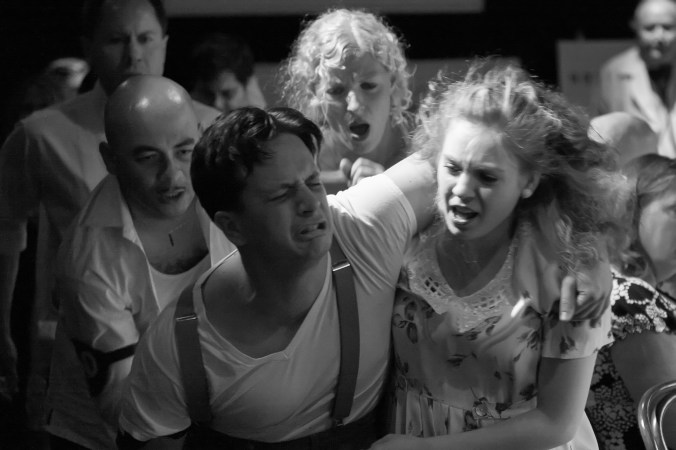
Among the productions I was most proud of during the 20 year run of The American Century Theater: June Havoc’s “Marathon’33”, brilliantly produced by Rebecca Christy with negligible government funding…
President Trump’s proposed budget for the 2019 fiscal year includes deep cuts to public arts and media funding.
Good.
Perhaps my reaction surprises you, given that I co-founded and for 20 years helped run a non-profit professional theater company.
The proposal cuts the Institute of Museum and Library Services and reduces the Corporation for Public Broadcasting’s budget from $445 million to $15 million. It also cuts the funding for the National Endowment for the Arts and the National Endowment for the Humanities by almost 80 percent as prelude to phasing them out. As an aside, it will be interesting to see those suddenly emergent national debt hawks who were in cryogenic sleep during the Obama administration manage the trick of bemoaning the deficit created by the GOP tax cuts while fighting to the death for the superfluous federal expenditures on the arts. If we can’t cut these programs, we literally can’t cut anything.
The Corporation for Public Broadcasting, if it was ever necessary, is no longer. There were just three TV channels when it was launched: there are now hundreds. PBS is no longer commercial-free television: have you watched it lately? That doesn’t even take into consideration the constant fundraising. It is true that the commercial network fare now completely eschews any but the lowest culture, but increasingly so does PBS. The theory, as it has been for years, is that if a TV show is British, it is high culture. It isn’t. “Father Brown” is junk. There are better mysteries on CBS. “Midsummer Murders” is so slow you want to rend your garments. “Downton Abbey” was fun, but it was a soap opera. Taxpayers should not have to underwrite shows like this.
I confess to enjoying NPR, and it has been good to me professionally and personally. But it is partisan, and a publicly funded news station should not be. It is also flagrantly elitist to its core. If NPR is really popular, then some foundations and its wealthy listeners should be able to fund it.
Fox’s Tucker Carlson, a rich kid himself, has called arts spending “welfare for rich, liberal elites.” I agree in the sense that the government is paying for what the wealthy in a community should devote more of their own funds to pay for. The performing arts are now too expensive for anyone but the wealthy. Movies are half the price of a typical community theater show, and movies are seeing their box office numbers dropping. Opera? How many middle class Americans go to the opera? Symphonies? Ballets? Same thing. The entertainment industry doesn’t even pretend to care about keeping their product affordable for anyone not driving a Lexus. Look at the prices to see “Hamilton” or Bette Midler as Dolly on Broadway.
The New York Times unwittingly gives away the real reason they feel we need the government funding the arts, however. It’s indoctrination and propaganda:
[T]he National Endowment for the Arts amplifies the voices of Americans who aren’t the so-called coastal elite, or the aristocratic, or the advantaged. It seeks to diversify the stories we tell and the lives we see. This diversity can take many forms. It can be seen in racial difference and regional difference, in terms of gender and in terms of class…. Over the last 50 years, through Creative Writing Fellowships alone, the endowment funded the work of Tillie Olsen, who wrote stories about the deep fatigue of working-class mothers; Philip Levine, a Detroit-born poet and the “Whitman of the industrial heartland”; Ernest J. Gaines, the descendant of sharecroppers who wrote fiction about rural Louisiana; and Bobbie Ann Mason, a short-story writer from rural Kentucky who, along with Carver, brought “dirty realism” into vogue — a working-class counterpoint to the fictional worlds populated by rich, liberal elites.
Bingo. When the government funds the arts, it cannot help itself from funding artists and art that advance the government’s agenda and those of its agency administrators. What this means, and what honest artists will admit, is that artists change their projects and messages to attract dollars, not to express themselves. My theater company encountered this constantly. It was made clear that we would have a better chance at grants if we did more works by women, about minorities, and exploring gay issues. I am proud of our eclectic and diverse choice of seasons, projects and artists.We also kept our ticket prices lower than almost all of the other small professional theaters. Indeed, we suffered for that: since we charged about what the amateur theaters did, a lot of people assumed we weren’t a professional company. As a company run by straight, white lawyers that attracted older citizens with advanced degrees and explored American stage works 25 years old or older, government funders had steadily decreasing interest in our work, even though it was the only professional theater in the area that admitted children free of charge. What mattered most was whether our art supported the government’s objectives. The quality of the art was secondary.
I don’t fault them for that: they were giving out money, after all, Nonetheless, the power to fund is the power to control, warp and destroy.
Artists will always be with us. So will the performing arts, but new structures, systems and funding needs to be found that does not involve the government, whose participation pollutes art and make integrity impossible and innovation difficult.
Trump may not be seeking to cut government funding of the arts for the right reasons, but it’s still the right thing to do.
 Ethics Alarms