
Sunday Ethics Warm-Up, 6/30/2019: Post Rugby Edition

This just has to be a better day than yesterday.

And I’m not even referring to the Yankees beating the Red Sox 17-13 in the first MLB game ever played in Europe.

Also, much thanks to the many readers who sent their condolences to me and my family. It helped.

1. Keepin’ a-goin’!  Believe it or not,  having to say farewell to our sweet, vocal and witty Jack Russell terrier  was not necessarily the worst part of our Saturday. This makes today another ethics challenge, that being the theme of the intentionally simple-minded poem used by comic actor Henry Gibson on “Laugh-In,” “The Dick Van Dyke Show,” and later as a country music song in Robert Altman’s “Nashville.”

The ditty was “Keep A-Goin,” and Gibson, unethically, left the impression that he had written it. He hadn’t: the poem was written Frank Lebby Stanton (1857-1927), now forgotten, and Henry (who died  in 2009) bears some of the responsibility for that, though the poem was ripe for stealing since the copyright expired long ago.. The “Nashville” credits claim Gibson was the author of the song. Wrong. Here it is:

Ef you strike a thorn or rose,
    Keep a-goin’!
  Ef it hails, or ef it snows,
    Keep a-goin!
  ‘Taint no use to sit an’ whine,
  When the fish ain’t on yer line;
  Bait yer hook an’ keep a-tryin’—
    Keep a-goin’!

  When the weather kills yer crop,
    Keep a-goin’!
  When you tumble from the top,
    Keep a-goin’!
  S’pose you’re out of every dime,
  Bein’ so ain’t any crime;
  Tell the world you’re feelin’ prime
    Keep a-goin’!

  When it looks like all is up,
    Keep a-goin’!
  Drain the sweetness from the cup,
    Keep a-goin’!
  See the wild birds on the wing,
  Hear the bells that sweetly ring,
  When you feel like sighin’ sing—
    Keep a-goin’!

Since around 4:30 pm yesterday, I have felt like doing absolutely nothing other than grieving and helping the rest of my family deal with the sadness that engulfs us. But, as another poet memorably said, I have promises to keep, and miles to go before I sleep.

So do we all. Continue reading
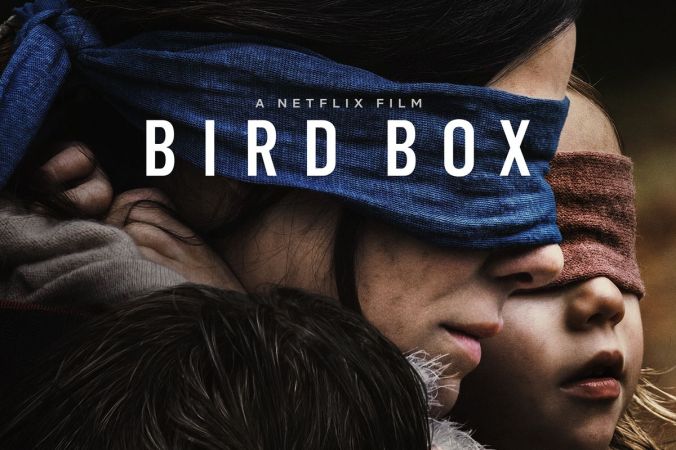
Demanding Blindfolds

From the New York Times:

“Netflix said on Thursday that it would not edit its movie “Bird Box” to remove footage of a disaster that killed 47 people in a Canadian town, rebuffing calls from town leaders who called the use of the video insensitive.”

Good.

This has got to stop somewhere, and “Bird Box,” the sensationally popular sci-fi horror film about Sandra Bullock and her children wandering around a forest blidfolded so they won’t see whatever it is that is driving everyone crazy and making them kill themselves, is a good a place to make a stand as anywhere.

In the movie, some things, or demons, or vibes cause insanity if they are seen: people really aren’t safe if they see them. Images that raise unpleasent thoughst and memories in real life are different, but somehow the idea was pawned that people have the right to expect to be “safe” from thoughts, memories, sights, symbols and ideas that might bother them. Thus “woke” college instructors felt compelled to give students “trigger warnings.” This principle, a really bad one that mistakes censorship for sensitivity, quickly metastasized into historical and artistic airbrushing. The National Park Service banned Confederate flags and their images from battlefield  gift shops—might remind some people of the Dylan Roof church shooting. Or slavery. Or racism.  Then the statues started coming down, because, as Carol Folt, blessedly outgoing chancellor of the University of North Carolina at Chapel Hill explained about why the terrifying pedestal of now toppled “Silent Sam,” a campus statue of a fictional Confederate soldier, must be destroyed:

“The presence of the remaining parts of the monument on campus poses a continuing threat both to the personal safety and well-being of our community and to our ability to provide a stable, productive educational environment. No one learns at their best when they feel unsafe.”

Unsafe! Continue reading

The Remarkable Character of George Washington

Today is George Washington’s birthday, and it is appropriate for every American, and certainly every ethicist, to pause in awe of this unique and indispensable man. Ethics Alarms honors him today with his own words, showing the depth of his good character, good judgment and commitment to ethical conduct in a letter to a man who later betrayed his trust, Benedict Arnold. This is the letter sent to Arnold, then his most trusted subordinate in the Revolutionary War, as Arnold was preparing to invade Quebec.

Happy Birthday, General Washington. More than three hundred years later, you lead us still.

George Washington to Benedict Arnold
September 14, 1775. Continue reading