On Quitting as an Unethical Grandstanding Tactic

Last week Lizzo, the Grammy-winning singer and songwriter currently battling accusations of sexual harassment and mistreatment by former back-up singers, announced on social media that she was quitting her epic career. Fans expressed the appropriate level of horror, so five days later she was back, saying that she was not quitting after all, and denying that was what she meant to convey.

This stunt has become a standard PR tool in the music industry particularly. Singers Nicki Minag, Justin Bieber, Doja Cat (don’t ask me who she is) and others have used fake exits to get headlines, publicity and “Please come back!” messages from panicked fans. One of the most celebrated —in all aspects of the word—examples was Richard Nixon’s bitter public farewell after losing the election for governor of California in 1962. “You won’t have Richard Nixon to kick around any more!” he said. Sure, Dick.

My position on fake quitting, or quitting in anger and then regretting it after the fever passes, has always been “If you quit, you’re done, at least as far as I’m concerned, and there are no do-overs.” The same principle applies to threatened resignations. I had many opportunities to exercise this personal policy as a manager or leader of various organizations and staffs. My response to “Do X or I’ll quit!” is an automatic, “Bye! Good luck in your future pursuits!” When I ran a non-profit health promotion organization, two of the original staffers didn’t approve of my polices (I had taken over from the deceased founder and their friend) and gave me letters of resignation. Later, they came to the office like nothing had happened, and were shocked when I informed them that they didn’t have jobs anymore. Apparently fake quitting had been a tradition under the founder. The indignant resignees even complained to the board. Bye!

Regular readers here know that I apply the same principle to commenters on Ethics Alarms. If I ban you, you can apply for reinstatement, but if you quit, or threaten to quit, you’re out, and permanently.

I’d like to see that attitude toward strategic quitting become a cultural norm.

Half Ethics Hero: Wisconsin Talk Radio Host John Murphy

angry-caller

Longtime Eau Claire, Wisconsin radio talk show John Murphy walked out of of his WAYY studio midway through his morning show this week.

He had just finished telling his listeners that he would not be chased out of the industry he loves but that, “I’m through doing this show as it is.” The sports talk show scheduled to follow Murphy started early to cover for his absence after a commercial break. The frustrated talk show host had been on Eau Claire radio for 34 years, for the past 14 years as a host of the “WAYY Morning Show,” a typical local call-in program where the  callers discussed and debated local, state and national news. Murphy quit, he said, because the discourse this year gradually stopped being civil, and had degenerated into a partisan and ugly exchange of nastiness and hate.

“It started with a lot of Trump and Clinton stuff, but now that same kind of vitriol is starting to permeate our local races and local issues,” Murphy explained.  “After a while, day after day and week after week, that starts to wear on you.”  Murphy said he knows that many of the callers hurling insults “are educated, wonderful people who have become caught up in this hurricane of hate.” He says the frustration had been building up inside him for months, and that he was beginning to engage in some of the same behavior he deplored. Continue reading

Major League Baseball Cares About Integrity And I Wish This Proved It…But It Doesn’t

I know this will be a shock, Henry, but there's forest here, not just trees...

I know this will be a shock, Henry, but there’s forest here, not just trees…

On Baseball Prospectus, one of the scholarly baseball sites, Henry Druschel has a provocative, inspiring and ultimately silly post pointing out that if baseball teams were only concerned with winning, they would forfeit games for strategic purposes, yet they literally never do. He writes…

“Teams are almost certainly harming their long-term win rates in a meaningful way by playing until every out of every game has been recorded. For example, the Red Sox encountered a grueling quirk of the schedule on Wednesday night, when they were scheduled to play the Orioles at 7:05 p.m. before traveling to Detroit and playing the Tigers at 1:10 p.m. the next day. When it began to pour in Baltimore at roughly 9:00 p.m., the Red Sox were leading 8-1 after six innings, but imagine if the situation was reversed, and Boston was instead trailing 8-1 with three innings to go. Their odds of coming back to win such a game would be something like 0.5 percent. In such a scenario, they could either wait in the clubhouse until the game was either resumed or officially cancelled, or they could forfeit as soon as the rain began, and head for the airport and Detroit right away. In the non-hypothetical game, the rain delay lasted about 80 minutes before the game was officially called; it seems obvious that an extra hour and a half of rest before the next game would add more to a trailing Boston’s total expected wins than remaining in Baltimore and hoping for a miracle would. That might seem like a corner case, and truthfully, it is; I bring it up to note that no one would even consider a forfeit in such a scenario, despite the strategic logic of the move. This isn’t limited to corner cases, however; every time a position player enters a baseball game as a pitcher in a blowout, teams are harming their long-term expected win totals by not forfeiting instead….”

The writer concludes:

Given that forfeitures would be win-maximizing in certain cases, and given that teams choose never to strategically forfeit regardless, there are two possible conclusions. One: Teams are behaving irrationally. Given the immense value even a single win can have to a franchise, I feel confident stating that this is not the case. That leaves the second conclusion: There is something the team values more than winning as much as possible. There is a societal norm that places something—a competitive ideal, maybe, or just completion—over winning, a norm that would be violated by a strategic forfeit, and a norm that teams invariably follow.

As someone who values other things over winning, this excites me…

Don’t get too excited, Henry.

Yes, I believe that baseball teams take considered actions sometimes that do not maximize their chances of winning. I was roundly pilloried in baseball circles for an article I wrote in 2008 (for another scholarly baseball site)  which argued that Barry Bonds, the shameless steroid cheat and home run champion who was suddenly a free agent and who could, based on his recent exploits, still hit though well past 40, would not be signed by any team—not even the Yankees!—because doing so would signal to that team’s fans, city, players and organization that the team endorsed flagrant dishonesty as well as a willingness to disregard fairness, integrity and sportsmanship for a few extra wins. I was on a MLB radio show where the host laughed at me. “Of course he’ll be signed! You’re crazy!” were his words. “Just wait,” I said. “If he isn’t signed, it will mean that baseball colluded against him!” he said. “Just wait,” I said.

Bonds, who said he was dying to play, that he was healthy, that he’d play for the Major League minimum, that he’d sue MLB if someone didn’t sign him, never swung a bat in anger again. There was no collusion, either. It was pure cognitive dissonance, you see. Remember the scale? Continue reading

Unethical Manager Writes Advice Columnist For Affirmation, Gets Head Handed To Him.

mr-potter

Well and rightly done, Allison Green!

Allison Green, a management advice blogger, received this jaw-dropping question from a relative of Mr Potter:

I manage a team, and part of their jobs is to provide customer support over the phone. …One employee asked to come in two hours after the start time due to her college graduation ceremony being that same day (she was taking night classes part-time in order to earn her degree). I was unable to grant her request because she was the employee with the lowest seniority and we need coverage for that day….I told this team member that she could not start two hours late and that she would have to skip the ceremony. An hour later, she handed me her work ID and a list of all the times she had worked late/come in early/worked overtime for each and every one of her coworkers. Then she quit on the spot.

I’m a bit upset because she was my best employee by far. Her work was excellent, she never missed a day of work in the six years she worked here, and she was my go-to person for weekends and holidays.

…I want to reach out and tell her that quitting without notice because she didn’t get her way isn’t exactly professional. I only want to do this because she was an otherwise great employee, and I don’t want her to derail her career by doing this again and thinking it is okay. She was raised in a few dozen different foster homes and has no living family. She was homeless for a bit after she turned 18 and besides us she doesn’t have anyone in her life that has ever had professional employment. This is the only job she has had. Since she’s never had anyone to teach her professional norms, I want to help her so she doesn’t make the same mistake again. What do you think is the best way for me to do this?

He also said that on one occasion he had granted a similar request “because they had concert tickets that they had already paid for, but this was a special circumstance because there was cost involved.”

!!!!!

Before showing you Allison’s response, here’s mine: Continue reading

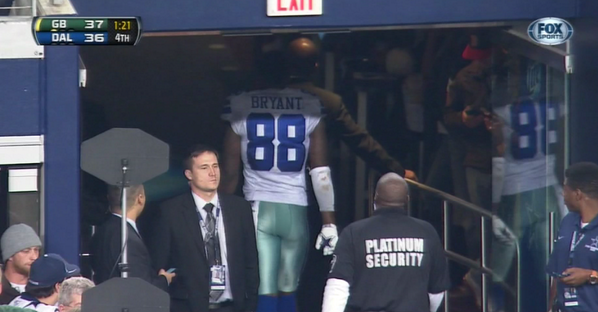
Ethics Dunce: Dallas Cowboys Wide Receiver Dez Bryant

Bryant quits

The NFL appears to be having a collective values breakdown. First the Miami Dolphins lose two players in an alleged bullying scandal, and last Sunday, star Cowboy wide receiver Dez Bryant walked off the field with more than a minute left to play in the game. After Dallas quarterback Tony Romo threw the last of his two second-half interceptions to virtually ensure a humiliating come-back defeat at the hands of the Green Bay Packers, cameras followed Bryant as he left his team for the locker room with 1:21 remaining on the clock. Later, he apologized and explained his actions by tweeting:

“I walked back to the locker room because I was emotional…it had nothing to do with my teammates we had it…We fought and didn’t finish”

Oh. What?

That’s no explanation. To reporters, he said that he didn’t want the cameras catching him crying. On the professionalism scale, this is minus 1000. He’s emotional? So what? Suck it up! He doesn’t like to lose? Who does? He couldn’t take it any more? Tough—he’s paid to take it, and damn well too. Continue reading