The Michel Martin Question I Didn’t Answer This Morning, and More On The Bill Cosby Scandal

On pointIn the segment on “Beverly Johnson And The Bill Cosby Scandal” I just completed for NPR’s “On Point” program, out of Boston with the magnificent Michel Martin hosting, I emulated the Sunday morning talk show guests I so revile for answering questions by making their own points that have little or no relevance to what was asked. Michel asked me, as the time left in the hour-long program was ticking down, what ethical obligations consumers—that is, the audience for his concerts, TV shows and albums—have regarding Cosby, in light of the rape allegations against him.

I was still stunned by the comments made by three callers, encompassing several ethically confused assertions that you know I would find annoying:

  • That the victims should not be coming forward so late;
  • That Cosby is “innocent until proven guilty” (GRRRRR…);
  • That it’s “easy” for women to make unsubstantiated allegations against celebrities, and
  • That there is a parallel between the allegations against Cosby and the Rolling Stone campus rape story.

That last one especially had my head threatening to explode, which would not be good for my relationship with NPR, so I think I can be forgiven for missing Michel’s query. Yes, the UVA rape allegation is exactly like the Cosby scandal, other than the fact that the accusers in Cosby’s case have come forward publicly while “Jackie” has not; that its two dozen (so far) alleged victims for Cosby and one in the UVA case; that one situation is a classic example of abuse of power, wealth and influence and the other is not; that Cosby settled one claim rather than air the allegations in a court of law; and that virtually every part of “Jackie” claim has failed to hold  up under scrutiny and investigation, whereas Cosby, the one individual who could offer evidence to counter the allegations against him, has done nothing but have spokesmen and lawyers issue blanket protests and denials.

Yup. Identical.

My answer to Michel should have been this:

“It’s up to Cosby fans, If they still can still laugh and cheer at Cosby’s nice guy schtick and “America’s Dad” persona knowing that he’s a serial rapist, fine: laughter is good, get it where you can. Personally, I can’t laugh at someone whom I know has engaged in horrific acts, hurt women who admired and trusted them, and by his own conduct left another cultural hero lying face-down in the mud. I can’t forgive it, I can’t get past it, and I’m certainly not going to keep laughing. this is no different from the NFL fans who keep wearing Ray Rice jerseys, or for that matter, Democratic women who continue to swoon over Bill Clinton. If they do, they either:

  • Can’t get over their cognitive dissonance, and at some level refuse to believe what cannot be rationally denied, or…
  • Don’t think the conduct involved—punching women, exploiting women, raping women—is worth getting upset about, or…
  • Buy the absurd personal/public dichotomy, and can still cheer wife-beatering athletes, star-struck intern-exploiting leaders, and raping comedians.

All of these are sad and impossible to justify, but they are common. Does the continued support of a Cosby ratify his conduct? Not in the eyes of his undeterred fans, but in the culture? Of course it does. If Bill Cosby’s career escapes relatively unscathed by this, and he is not held accountable by society, the verdict of the culture will be a particularly extreme version of The King’s Pass: if you are rich enough, powerful enough and seen as contributing enough to society, then you will be held to a lower standard, and can get away with, if not murder, serial rape.”

Continue reading

Scheduling Note: Cosby, Michel Martin, NPR, and Me

Beverly Johnson

Beverly Johnson

Beverly Johnson, the super-model whose Vanity Fair article about being drugged by Bill Cosby decades ago when she was summoned for an “audition,” will be a guest on the Boston NPR station, WBUR, as former “Tell Me More” host Michel Martin stands in. After Johnson, a panel will discuss various issues legal, ethical and cultural about the Cosby allegations, and I’m on it, along with Renee Graham, music and pop culture critic for NPR’s Here & Now. Op-ed contributor at the Boston Globe, and Debra Katz, partner at the law firm Katz, Marshall and Banks. You can catch up on some of the ethical implications of the Cosby mess here, and some more details about the show here. If you can get the show on the radio or web, you’ll hear it at 10 AM, E.S.T.,  this morning.
Continue reading

Comment of the Day: “Print the Legend Ethics: The War of the Worlds Panic”

war_worlds

Bravo and thanks to penn for a thoughtful and thought-provoking personal reminiscence that supports my recent post about the claim that the famous panic over Orson Welles’ famous 1938 “War of the Worlds” radio drama never happened. Here is his fascinating Comment of the Day on Print the Legend Ethics: The “War of the Worlds” Panic:

This story came up every Hallowe’en in my family as I was growing up. We had family living in Toms River and in Lakewood, NJ (about 35 miles from Grover’s Mill) at the time Orson did his thing. The different reactions to the broadcast by the people living in the two places resulted in a minor family schism which continues to this day in the attitudes of their descendants.

It was a city mouse/country mouse situation. The Lakewood adults were elementary school teachers — the sophisticates. They listened to that program as a matter of course and as they later reported, they declared this one silly from the very beginning. But then, all science fiction was silly to them (really! space ships and aleeums? pshaw!) — my father (it was his side of the family) always contended they had no imagination. My mother recalled, however, many years later (and after taking several psychology courses at the New School), that commercials or not, she was convinced they had been very disturbed, if not downright scared. Scared enough to sit through the whole “silly” program in the first place, and for the rest of their lives to focus an uncharacteristic rage on the writers … for using the name of a real location in the program. [I think this naming of Grover’s Mill may account for some of the anxiety, if not the panic — people were sooo trusting of the media in those days .. . .] Continue reading

Print The Legend Ethics: The “War of the Worlds” Panic

OrsonWellesDailyNews

One of the worst results of an untrustworthy news media is that it becomes difficult, as time passes, to determine with any certainty what the truth is.

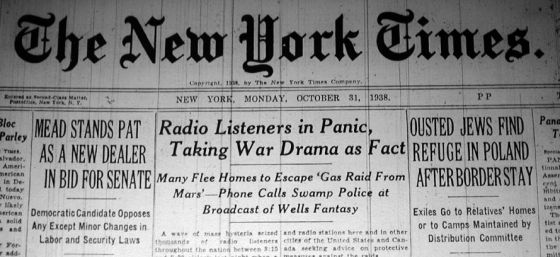
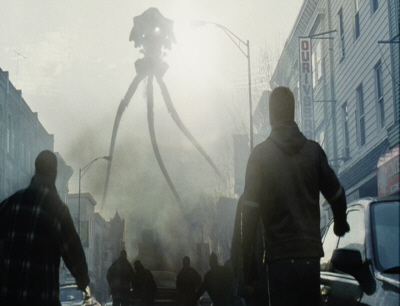
A classic example is on display today, in Slate, which celebrates the 75th anniversary of young, svelte, Orson Welles’ famous Halloween Eve broadcast of his radio adaptation of H.G. Wells’ “War of the Worlds,” with no Tom Cruise or Dakota Fanning but a nice conceit that involved telling the story through fake news flashes and eye-witness interviews. (One reporter is fried on the air by the Martian invasion vehicles.) An new NPR program and a PBS documentary both tell the familiar story of how the realistic-sounding radio play caused widespread panic among radio listeners who missed the opening credits, leading them to think that Earth was really under attack. Newspapers of the day headlined mass panic, and gave accounts of citizens running for cover, huddling in the basement, and cringing in terror.  The episode made Orson Welles a national celebrity, and launched him on his meteoric, long and strange career.

According to Slate authors Jefferson Pooley and Michael Socolow, it never happened. Declaring the story of the “War of the Worlds” panic a myth, the authors state without equivocation that the newspaper accounts, headlines, commentary and interviews, were fabricated:

“Radio had siphoned off advertising revenue from print during the Depression, badly damaging the newspaper industry. So the papers seized the opportunity presented by Welles’ program to discredit radio as a source of news. The newspaper industry sensationalized the panic to prove to advertisers, and regulators, that radio management was irresponsible and not to be trusted. In an editorial titled “Terror by Radio,” the New York Times reproached “radio officials” for approving the interweaving of “blood-curdling fiction” with news flashes “offered in exactly the manner that real news would have been given.” Warned Editor and Publisher, the newspaper industry’s trade journal, “The nation as a whole continues to face the danger of incomplete, misunderstood news over a medium which has yet to prove … that it is competent to perform the news job.” Continue reading

Ethical Self-Promotion Department

I was a guest over the weekend on The John McDonald Show on Newsradio WGAN 560 (Maine), thanks to the invitation of Arthur King, who was hosting the program. It went well, I thought, and the podcast can be found here.

Comment of the Day: “Ethics Dunce: Animal Planet”

Arthur in Maine contributes the Comment of the Day, expanding on the predictable comparison between Orson Welles’ Halloween radio broadcast of his adaptation of “War of the Worlds,” which many gullible listeners believed was a real invasion, with the misinformation broadcast by Animal Planet in its recent fake documentary claiming that mermaids may exist. I have a few comments afterwards; meanwhile, here is Arthur’s interesting perspective on the post, “Ethics Dunce: Animal Planet”:

“I’ll give Welles a pass here. Because of my work, I am a student of the media (contrary to the assumptions made by a kindhearted poster on another thread).

“Welles was not irresponsible. He was groundbreaking in his art, using a new form of media in a way it had never been used before. The program was announced as a radio play; it was interrupted by commercial breaks, it ended in an hour, nothing about the invasion was carried on other networks, and even more to the point: the panic ascribed to “The War of the Worlds” broadcast never happened. Continue reading

Ethical Standards, Not Laws or Regulations, Must Enforce Broadcast Civility

A federal appeals court just struck down controversial the Federal Communications Commission policy on indecency, ruling that regulations barring the use of “fleeting expletives” on radio and TV were too vague and could inhibit free speech….even if that free speech was smutty.

Good. Continue reading