
Stop means “stop,’ unless Randy decides it means “yield”—after all, he knows best.
Randy Cohen was the original author of the New York Times Magazine’s column “The Ethicist.” During his tenure he made a name for himself with lively and sometimes witty prose, and on Ethics Alarms, at least, a disturbing tendency to rationalize clearly unethical conduct when it suited his political agenda, which was unapologetically left of center. In one notorious example, he told a student whose wealthy and famous father was paying her college tuition that it would be ethical for her to cash a partial tuition refund check she received from the university to her mother and stepfather, who believed that the father had not paid his fair share of child support. Cash that check, advised Cohen….“You are entitled to this money not because he is successful while you struggle. Such rough justice would also encourage you to sneak into his house, swipe his sofa and sell it on some kind of furniture black market. That would be stealing; this is merely claiming what he owes you.” Of course, this is also stealing: cashing a check not intended for you because you believe it should be used to settle a disputed debt between the owner and someone else is not honest or fair, regardless of the merits of that belief. But Randy is a class warrior: as “The Ethicist,” he routinely took the position that it was “ethical” for people to use dubious means to get an edge on the evil rich, which in his world apparently means anyone richer than him.
I don’t know what Cohen has been doing since the Times sacked him; it isn’t practicing ethics, as he didn’t do this before his tenure, and confessed when he left the job that writing about ethics didn’t make him practice ethics while he was “The Ethicist” either, something I found and still find incomprehensible. Now, he tells us in a recent Times piece, the Ex-Ethicist is riding around New York City on his bicycle, running stop signs and red lights.
He tells us, moreover, that this is ethical, though it is certainly illegal. “I roll through a red light if and only if no pedestrian is in the crosswalk and no car is in the intersection — that is, if it will not endanger myself or anybody else, ” Cohen says. “To put it another way, I treat red lights and stop signs as if they were yield signs. A fundamental concern of ethics is the effect of our actions on others. My actions harm no one. This moral reasoning may not sway the police officer writing me a ticket, but it would pass the test of Kant’s categorical imperative: I think all cyclists could — and should — ride like me.”
This is arrogant, fatuous, reckless and wrong. But that’s Randy.
Even Coehn’s reading of Kant is wrong. The categorical imperative says that an action is ethical only if it could be the universal rule without harm, and this, despite Cohen’s rationalizations, could not. Who says the cyclist’s judgment of when it is safe to run a red light or stop sign is correct or reasonable in every instance? Why couldn’t motorists also use this same justification for running red lights at will? Continue reading →
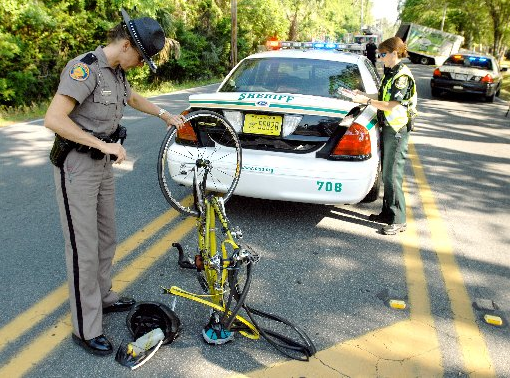 Reader Lance Jacobs, a New York bicycle instructor, was moved by last month’s Ethics Alarms Post “Randy Cohen’s Scofflaw Cycling: How Did THIS Guy Ever Get To Be Called ‘The Ethicist’?” to write the New York Times about their scofflaw, erstwhile “Ethicist,” who had proudly confessed in a an essay that he routinely broke the law while cycling, and believed that he was right to do so. The Times didn’t print Lance’s letter, an open letter to Randy, and sadly, this blog does not (Yet! Yet!) have the circulation of the Times, but it is an excellent rebuff to Cohen, and a most deserving “Comment of the Day.”
 Ethics Alarms