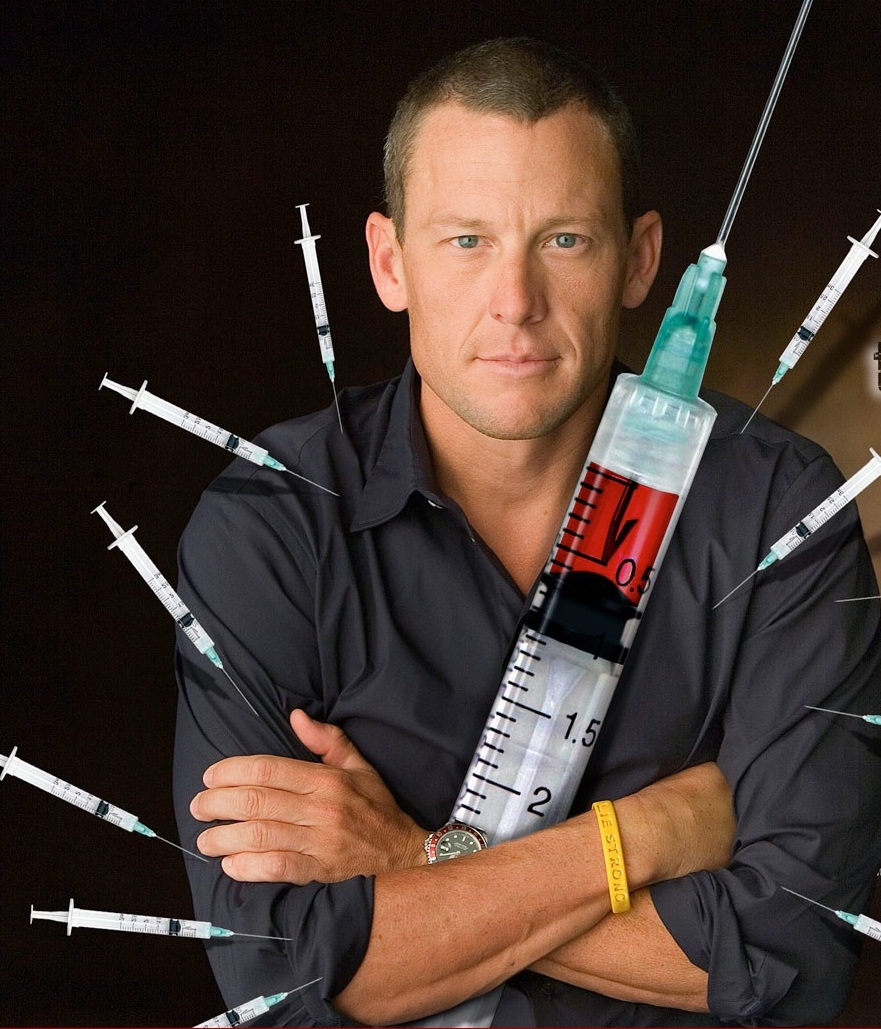
Unethical Quote of the Week: W.G. Hamm

“What I know about Lance Armstrong is that he inspired thousands of cancer victims and made their lives better. What I know about Mr. Armstrong is that when my wife and my son were both suffering from cancer, his story and his book helped them cope with their diseases. What I know about Mr. Armstrong is that the good that he did far outweighs the fact that he was trapped in a culture of drug use within the cycling fraternity. What I know about Mr. Armstrong is that he has been needlessly demonized by people who do not realize the balance between his good deeds and his bad deeds.”

—-W. G. Hamm, in his Letter to the Editor of the Washington Post. Hamm was praising a fatuous, rationalization-riddled  column by Post sportswriter Sally Jenkins in which she catalogued and endorsed every excuse and justification trotted out by Armstrong’s enablers and defenders.

would have loved Vlad.

W. G. would have loved Vlad.

I don’t know W.G. Hamm. I’m sure he’s the salt of the earth, and a part of me is queasy about picking on his letter praising Jenkins’ ridiculous column rather than tackling the truly ethically offensive and brain-dead column itself. One reason is that I have written extensively, frequently and recently about the arguments, if you can call them that, made by Jenkins. Her column really is spectacularly bad; here’s one passage that send me to the bathroom, for example:

“Maybe I’m not angry at Lance because for two decades now I’ve had serious questions about the wisdom and fairness of the “anti-doping” effort, which consists of criminalizing and demonizing athletes for what boils down to using medications without a prescription.”

No, it boils down to using medications without a prescription and using them to cheat in athletic contests for money and fame, while defrauding the public, you silly, dishonest woman. Continue reading

Of Course Barry Bonds Doesn’t Belong In The Hall Of Fame

Buy a ticket, Barry.

Buy a ticket, Barry.

A full complement of baseball’s steroid class is among the 37 players on the 2013 Hall of Fame ballot, so it was predictable that a new round of arguments would surface claiming that it is unfair, illogical, inconsistent or otherwise unseemly to exclude Barry Bonds and others from enshrinement. Predictable but frustrating: the arguments in favor of Bonds are arguments against maintaining ethical values, in baseball, sports, and American society.  It is also an annoying debate to engage in, and I have been engaging in it in various forms for many years, because Bonds’ defenders typically represent themselves as modern, reasonable, and realistic, while anyone making the quaint argument that cheating on a grand scale should earn shame rather than honors is mocked as judgmental, sanctimonious and naïve.  As ever, I am a glutton for punishment, and since otherwise wise and perceptive commentators like NBC Sports’ Craig Calcaterra choose to ally themselves with Bonds, I really am obligated to point out what a corrupt, illogical and unethical position it is.  If I and people like me don’t persist in this, we’ll have cheating approved as a cultural norm before we know what hit us.

Calcaterra has been supporting Bonds as a Hall of Fame candidate for a while now, but the title of his latest essay, “It’s Lunacy To Keep Barry Bonds and Roger Clemens Out of the Hall of Fame” is a gauntlet that begs to be picked up.  “Bonds and Clemens,” Craig writes, “ are two players who, in a just world, would be unanimous selections for induction…”  I find this an indefensible, even shocking, statement, both before and after the writer attempts to defend it. In a just world, a member of a profession who achieved his prominence in part by breaking the law and the rules, as well as lying about it, should be accorded the highest honor that profession has!  What an astounding point of view.

For simplicity’s sake, I’m going to leave Clemens out of this, in part because I can see a Hall of Fame voter credibly deciding that there isn’t enough evidence to conclude that The Rocket really did use performance enhancing drugs on the way to forging one of the top five pitching careers of all time, and in part because I suspect Craig of pairing Bonds and Clemens to make his various rationalizations more pallatable than they would be in defense of Bonds alone.  Belief in Roger’s steroid cheating rests entirely on the testimony of a proven liar and slime-ball, his former trainer. MLB’s Mitchell Report sided with the trainer, and I’m inclined to as well, but Clemens’ unfitness for the Hall of Fame, unlike Bonds (and Mark McGwire, Rafael Palmeiro, and some others), is not an open-and-shut case.

I give credit to Craig for not raising my least favorite of the Bonds defenses, that he has to be regarded as innocent because he has not been “proven guilty.” Calcaterra is a lawyer, and he understands the over-use and misuse of that cliché, as well as how it only applies when “guilty” means “you’re going to jail.” Indeed, he begins by conceding the obvious, that the evidence that Barry Bonds used steroids is overwhelming, which it is.

His first argument, however, is terrible. Under the ironic heading “Baseball Bonafides,” Calcaterra begins by reciting Bonds’ (and Clemens’) impressive list of achievements, which taken at face value show Barry Bonds to be one the best of the best, not just a qualified Hall of Fame baseball player, but an epitome of a Hall of Fame player along with such legends as Babe Ruth, Walter Johnson , Ted Williams and Willie Mays. “Put simply,” Craig says in conclusion, Bonds is an “immortal.” But he’s not-–not if he cheated, not if he achieved his historic status by corrupting his sport and lying to team mates and fans. And, as Calcaterra admits at the outset, this he did. As a result, the fact that Bonds won a record seven Most Valuable Player Awards is irrelevant. He cheated to win some of those awards. He gets no credit for them.  In Bonds’s case, “baseball bonafides” are not bona fide at all. Continue reading

The 8 Useful Ethics Tips From “The Tale of the Well-Meaning Kidnapper”

Luis Trinidad, safe but confused

Luis Trinidad, safe but confused

Ethics Tip #1: If you are this stupid and irresponsible, it’s unethical to have children

A Bristol, Connecticut man parked his car outside a store with the doors unlocked, the motor running, and his two-year-old son in the back seat.

Ethics Tip #2: When you witness child endangerment, make sure rescuing the child does not require breaking the law, unless there are no other options to save the child. Calling the police is usually another option.

Outraged by the father’s irresponsible conduct, a citizen who happened to pass by the car, 24-year-old Devon Mills, decided to take matters into his own hands.

Ethics Tip #3: When you hear yourself saying, “This guy needs to be taught a lesson,” stop and think things through: that may be true, but you may not be the appropriate deliverer of the lesson, and the statement is an invitation to overstep one’s authority.

Mills decided that it would serve the father of the child and owner of the car right if he got scared out of his wits. Continue reading

Presenting Rationalizations 28-31: The Altruistic Switcheroo, The Prospective Repeal, The Troublesome Luxury, and The Unethical Role Model

The Ethics Alarms list of rationalizations—the lies and fallacies we seduce ourselves with to make unethical conduct seem reasonable— continues to grow. Here are some worthy additions, bringing the current total to 31. I doubt that we have them all captured yet…not by a longshot.

28. The Altruistic Switcheroo: “It’s for his own good” – This rationalization is a pip, because it allows one to frame self-serving, unethical conduct as an act of good will and generosity. Cheating the young sprout will teach him to be more careful the next time, and it’s just a pleasant coincidence that you benefit from the deception. It is true that misfortune carries many life lessons, that what doesn’t kill us often makes us stronger, and that what hurts today may be the source of valuable wisdom and perspective later, but it really takes a lot of gall to cheat, lie to, steal from or otherwise harm someone else and claim it will be a good thing in the long term. Yet an amazingly large number of people possess this much gall, because the Altruistic Switcheroo is very popular, especially among parents who want to convince themselves that bad parenting is really the opposite. A marker for this rationalization is the statement, “You’ll thank me some day”—the specious theory of the sadistic parent who named his son “Sue” in the famous Shel Silverstein song made famous by Johnny Cash. No, he won’t. Continue reading

Ethics Train Wreck Watch: The Petraeus-Broadwell Affair

There is too much information awaiting disclosure to do a thorough ethical analysis at this point, but it is already clear beyond question that the David Petraeus-Paula Broadwell scandal is an ethics train wreck, with many more individuals and perhaps institutions involved than the direct participants. Today’s news reports that the adulterous affair prompting the much-respected CIA Director’s sudden resignation was triggered by Broadwell’s  threatening e-mails to another women she suspected of vying for the General’s affections clinches train wreck status. This thing is still rolling.

Other features of the wreck-in-progress: Continue reading

Ethics Hero: Golfer Blayne Barber

Aspiring professional golfers can’t just join the PGA tour. They have to qualify by completing and passing PGA school.  Blayne Barber is one such golfer, and his dreams of winning tournaments and cash prizes will have to wait at least another year, if they are realized at all. He washed out this year. The way he washed out, however, is remarkable, and shows that if he does make it into the PGA ranks, Barber will be a credit to his sport.

Indeed, most pro golfers are credits to their sport, because golf has managed to hold the line against the increasing cultural acceptance of poor sportsmanship better than any of our professional pastimes, with tennis a distant second, and third place too far away to see without binoculars. This is a sport where the honor system is mandatory. One reason the tradition of self-regulation has persisted in golf may be because cheating in contests is so easy, and because there are so many ways to do it. Players find their own balls, and write down their own scores. Anyone who has seen James Bond and Auric Goldfinger take turns cheating each other in the famous grudge match from the movie knows that amateur golf can be cutthroat and nasty. The pros have built a culture that requires exemplary conduct.

Few would be this exemplary, however. Continue reading

More Advice Column Malpractice: “Dear Prudence,” Elder Abuse and Voter Fraud

I have to wonder about the values, ethics and trustworthiness of any publication that employs an advice columnist as deeply incompetent and unethical as Emily Yoffe, a.k.a “Dear Prudence.” I’m sure that I would be compelled to correct her regularly if I read her responses with any frequency, which is one of the reasons I don’t read the column. 2011 Ethics Alarms Commenter of the Year tgt just flagged this horrific example of Emily’s craft, and correctly guessed my reaction, writing, “get ready to facepalm.”  Now that my visage is permanently concave, allow me to retort.

The query comes from a woman whose mother has filled in absentee ballots for her parents, voting her own preferences and not consulting them. Worse, the grandmother, who is suffering from Alzheimer’s, is a life-long partisan of the party her daughter voted against on her behalf.  The questioner asks “Prudence,” “Should I attempt to intervene in some way?” Continue reading

Lance Armstrong As The Status Quo: An Unethical Essay From An Ethics Expert

Don’t worry, Lance. Braden Allenby understands you. You were just ahead of your time, that’s all.

There are many things to learn from Prof. Braden Allenby’s Washington Post essay, “Lance Armstrong’s fall: A case for allowing performance enhancement,” none of which have anything to do with Lance Armstrong. Among the lessons:

  • “Everybody does it “really is the most seductive and sinister rationalization for unethical conduct.
  • Someone really shouldn’t write about sports ethics when they know nothing about sports.
  • If you only understand an author’s bias after reading the short biographical sketch at the end of the article, then he wasn’t responsibly correcting for his bias in his article.
  • When someone uses the worst of all rationalizations, the deplorable, “It’s not the worst thing,” neither their judgment nor their argument can be trusted.
  • Some ethics experts have appalling judgment in regarding ethics.

Allenby’s essay takes the position that all sports should allow athletes to take whatever performance enhancing drugs that become available, beginning with the tragedy of Lance Armstrong’s final disgrace as a cheater and corrupter of his sport. Seldom do you see an argument clothesline itself so quickly: here is Allenby’s opening sally:

“In the past month, cyclist Lance Armstrong has been stripped of his seven Tour de France titles. His commercial sponsors, including Nike, have fled. He has resigned as chairman of Livestrong, the anti-cancer charity he founded. Why? Because the U.S. Anti-Doping Agency and the International Cycling Union say he artificially enhanced his performance in ways not approved by his sport and helped others on his team do the same. This may seem like justice, but that’s an illusion. Whether Armstrong cheated is not the core consideration. Rather, his case shows that enhancement is here to stay. If everyone’s enhancing, it’s a reality that we should embrace.” Continue reading

A Choice, A Doubt, and One of a Million Moments

In the end, a life is made up of more than a million choices, large and small, that we make according to a witch’s brew of factors. There is timing, and how we are feeling at the moment, and there are random factors, our emotions, past experiences and needs, and, just maybe, some ethical analysis involving altruism, the Golden Rule, a careful balancing of outcomes, and solid principles of right and wrong. We hope to make good choices, and yet even a good one can have disastrous effects, leaving us illogically hesitant to make the same choice the next time. We hope, if we strive to be ethical and learn from our mistakes while not learning the wrong lessons—cowardice, fecklessness, self-obsession, fear of responsibility and risk, procrastination—from our failures, to reach the finish line having made existence better for more of our fellow human beings than we made miserable, and having been a net benefit to civilization while we were part of it.

Yet there really are a million or more such choices,  many of them present themselves without any warning, and the results of the choice are often unknown. The only one keeping score is you, most of the time. I was presented with such a choice tonight, and I fear that I chose badly. Continue reading

Romney’s “Worst Weeks” and the 27th Rationalization

Yeah, yeah, but did you hear what Mitt said to raise money?

Normally I would consider the surreptitious taping and then publicizing of a quasi-private meeting unethical, writes a lawyer colleague, “but these are not normal times.”

I thanked him profusely for alerting me that I had inexplicably allowed a hoary, classic rationalization for unethical conduct with a distinguished pedigree to escape the Ethics Alarms list, though this was not, I gather, his original intent. I just remedied the embarrassing omission, dubbing this The Revolutionary’s Excuse.” Here is the entry:

27. The Revolutionary’s Excuse:

“These are not ordinary times.” Continue reading