Cruelty and the Comers: At a Certain Point, Being Nice Just Makes It Worse

Meet the Comers

The nauseating news story of the week comes from L.A., where 18-year-old Mitch Comer was seen looking emaciated and confused in a downtown Greyhound bus station. A hundred pounds and 5’3″ tall, the boy seemed lost, and a security guard questioned him. Comer explained that he had just arrived from Georgia, where he had been imprisoned in his parents’ basement since his father pulled him out of an 8th grade class four years ago. Then, on his 18th birthday, they released the boy, and his stepfather took Mitch to the bus station, where they had a touching goodbye

“The story we got was that the stepfather took the kid to the bus depot, said ‘Here’s $200, here’s a list of the homeless shelters in Los Angeles, you’re a man now and don’t come back,'” said LAPD Commander Andrew Smith. This won Paul and Sheila Comer, who live in an affluent Georgia suburb, child abuse and false imprisonment charges as well as a nomination as 2012’s Monstrous Parents of the Year. Continue reading

Writers Writing About Ethics, Without Any

Sorry, can’t use you.

Writer Joe Konrath has written one of those blog posts about ethics that makes me want to defenestrate myself, a post that expounds on rationalizations as a substitute for ethical analysis because he is incapable of the latter, arriving at fatuous and misleading conclusions. Naturally his post was picked up and expounded upon by another blogger, Ben Galley, who has even launched an ethics-challenged website called Ethiks to promote similar ethics rot.

Both writers are holding forth about recent scandals in the publishing world, involving so-called “sock puppetry,” where a writer anonymously praises his own books on-line or trashes the work of competitors, and writers paying for positive reviews. Both are also laboring under juvenile ethical delusions, and obnoxiously so, among them:  that “everybody does it” is a valid excuse for cheating, that the fact that a critic of unethical behavior might engage in such behavior himself under certain conditions invalidates the ethical criticism, and that unethical people insisting that unethical conduct isn’t puts such conduct in a “grey area.” None of these is true; none of these is remotely true.

The ethically-clueless tenor of both posts can be gleaned from this section, by Galley:

“Ethics in life are a grey area. No less in the book industry. To borrow JA’s analogy, the claim of “I would never kill” goes out of the window pretty quickly when protecting your family against a murderous intruder. The line of ethics is never a straight one, often zig-zagging through a charcoal no-man’s land of right and wrong. The question is this: Where does the line lie for you? It’s nothing less than personal. Some people simply shrug at the thought of sock-puppetry. Others go a shade of red and grit their teeth. Sadly, we can write all the codes and edicts we like, the point is that not everyone will a) agree, nor b) abide.”

Let me see: wrong, wrong, irrelevant, wrong, not necessarily, no it isn’t, NO, it REALLY ISN’T, and so what?

Most ethical questions are not gray at all: these definitely aren’t. They are clear as clear can be. “Sock puppetry” is dishonest and unfair. An author paying for positive reviews, and a critic accepting payment from an author to review his work, is blatantly dishonest and a conflict of interest. There is no “gray” about it; they are just wrong. Anyone who draws the “line” anywhere else is wrong too. It doesn’t matter whether everyone agrees: those who don’t agree are unethical. So are those who can’t “abide.” Their unethical conduct doesn’t alter right and wrong.

Konrath’s piece wastes our time with a long argument claiming that unless one is as pure as the driven snow, not only can’t you call unethical conduct what it is,  the fact that you can’t calls into question whether the unethical conduct is really unethical at all. Here’s his “quiz,” which Konrath presents triumphantly as if it is a real brain-buster, when anyone with a modicum of honesty, decency and common sense should be able to score 100% without straining a neuron.

Here it is, with my answers in bold: Continue reading

Comment of the Day: “Randy Cohen’s Scofflaw Cycling: How Did THIS Guy Ever Get To Be Called ‘The Ethicist’?”

Reader Lance Jacobs, a New York bicycle instructor, was moved by last month’s Ethics Alarms Post “Randy Cohen’s Scofflaw Cycling: How Did THIS Guy Ever Get To Be Called ‘The Ethicist’?” to write the New York Times about their scofflaw, erstwhile “Ethicist,” who had proudly confessed in a an essay that he routinely broke the law while cycling, and believed that he was right to do so. The Times didn’t print Lance’s letter, an open letter to Randy, and sadly, this blog does not (Yet! Yet!) have the circulation of the Times, but it is an excellent rebuff to Cohen, and a most deserving “Comment of the Day.”

Here it is:

“Dear Mr Cohen, Continue reading

The Ethics Corrupter-In-Chief

I wanted to stay far, far away from commenting on the Democratic National Convention in Charlotte, because I knew that the double standard of media scrutiny of the deceit and dishonesty there ( in contrast to the media’s adversary stance during the Republican convention) would drive me to drink if I thought about it long enough to write coherently. And so I shall stay away, except for this one infuriating topic, which is broader and more significant than the convention itself.

No political party that cares sufficiently about the ethical values of integrity and honesty, as well as responsible leadership, would feature Bill Clinton as its “rock star” speaker. That the Democrats did, and that the media and the public generally gave them a pass for doing so, confirms that Clinton’s corrupting influence on the American culture continues. Recent polls indicate that he is the most popular political figure in the country today, and Democrats will no doubt cite that as justification for inviting him to speak. To the contrary, it shows the damage that he has done to the values of the nation, and how wrong the Democratic party has been to aid and abet that damage.

Bill gave a good speech, as he usually does. There is no way to know how much of it he believes or meant, for Clinton is a recreational liar: he likes lying. He’s good at it, and he does it at every opportunity. In 2008, on The Ethics Scoreboard, the slower and more formal predecessor to this blog, I made Clinton the first (and as it turned out, sole) admittee to the David Manning Liar of the Month Hall of Fame, writing in part that… Continue reading

Buzz Bissinger’s Primer on Unethical Reasoning

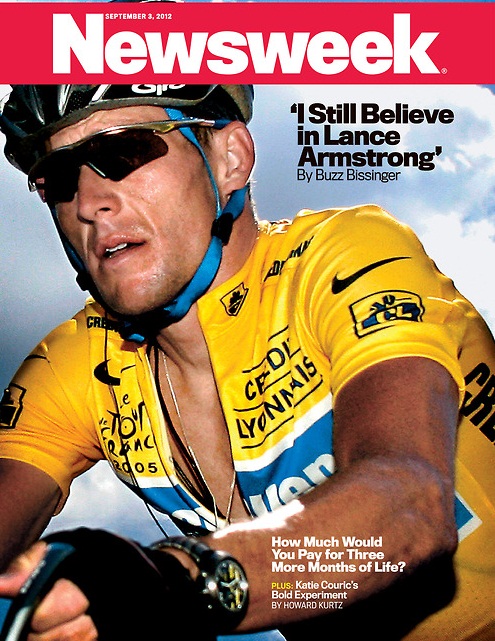
Sportswriter Buzz Bissinger, already an Ethics Dunce in good standing, has contributed something immensely valuable to the world of ethics: a cover story for Newsweek that can serve as a teaching aid in college ethics classes.

Titled “I Still Believe in Lance Armstrong,” Bissinger lurches from one rationalization to another, contradicting himself repeatedly along the way. This is a professional journalist, writing in his field, for what once was a respected news commentary magazine. Why is so much of the public unable to tell right from wrong? Because they spend a lifetime reading junk like this: Bissinger’s essay could be Exhibit A.

Bissinger begins by talking about the reactions of his son, a cycling enthusiast who worshiped Armstrong, to the recent news that the tarnished athlete would no longer challenge the U.S. Anti-Doping Agency’s efforts to strip him of his titles:

“Caleb is not blind. He said it was hard not to read the statement and conclude that when Armstrong said, ‘There comes a point in every man’s life when he has to say ‘Enough is enough’ ” and that he was finished fighting the United States Anti-Doping Agency’s fanatical attempt to strip him of his victories, what lay below the outrage was an admission that he may well have cheated with performance enhancers in order to win. That bothers my son. It is why he called the stunning announcement a ‘sad day.’ But it is also why he called it a ‘weird day’ emotionally because of the constant effort to make Armstrong into a villain.” Continue reading

The Last of Lance

The Lance Armstrong Fan Club writes to the US Anti-Doping Agency to protest its witch hunt.

Lance Armstrong has announced that he will no longer fight doping allegations, meaning that the Anti-US Doping Agency will effectively ban him from cycling and strip him of his titles. “If I thought for one moment that by participating in USADA’s process, I could confront these allegations in a fair setting and — once and for all — put these charges to rest, I would jump at the chance,” Armstrong said in a statement. “But I refuse to participate in a process that is so one-sided and unfair.”

It’s a shrewd move. Now Armstrong fans and admirers who refuse to acknowledge what is overwhelmingly likely bordering on certain—that he is a cheat, a liar and a fraud—can argue that poor Lance is a victim, and never was “proven guilty.” Of course, poor Lance has made millions of dollars and lived the life of a celebrity and hero for more than a decade, and he not going to forfeit any of that, or his freedom, no matter what rational people think of him. Like Barry Bonds, baseball’s most successful steroid cheat, he pulled it off, exploiting his sport, deceiving the public and taking advantage of a “look the other way” culture that corrupted bicycle racing even more thoroughly than steroids corrupted baseball. Continue reading

Randy Cohen’s Scofflaw Cycling: How Did THIS Guy Ever Get To Be Called “The Ethicist”?

Stop means “stop,’ unless Randy decides it means “yield”—after all, he knows best.

Randy Cohen was the original author of the New York Times Magazine’s column “The Ethicist.” During his tenure he made a name for himself with lively and sometimes witty prose, and on Ethics Alarms, at least, a disturbing tendency to rationalize clearly unethical conduct when it suited his political agenda, which was unapologetically left of center. In one notorious example, he told a student whose wealthy and famous father was paying her college tuition that it would be ethical for her to cash a partial tuition refund check she received from the university to her mother and stepfather, who believed that the father had not paid his fair share of child support. Cash that check, advised Cohen….“You are entitled to this money not because he is successful while you struggle. Such rough justice would also encourage you to sneak into his house, swipe his sofa and sell it on some kind of furniture black market. That would be stealing; this is merely claiming what he owes you.”  Of course, this is also stealing: cashing a check not intended for you because you believe it should be used to settle a disputed debt between the owner and someone else is not honest or fair, regardless of the merits of that belief. But Randy is a class warrior: as “The Ethicist,” he routinely took the position that it was “ethical” for people to use dubious means to get an edge on the evil rich, which in his world apparently means anyone richer than him.

I don’t know what Cohen has been doing since the Times sacked him; it isn’t practicing ethics, as he didn’t do this before his tenure, and confessed when he left the job that writing about ethics didn’t make him practice ethics while he was “The Ethicist” either, something I found and still find incomprehensible. Now, he tells us in a recent Times piece, the Ex-Ethicist is riding around New York City on his bicycle, running stop signs and red lights.

He tells us, moreover, that this is ethical, though it is certainly illegal. “I roll through a red light if and only if no pedestrian is in the crosswalk and no car is in the intersection — that is, if it will not endanger myself or anybody else, ” Cohen says. “To put it another way, I treat red lights and stop signs as if they were yield signs. A fundamental concern of ethics is the effect of our actions on others. My actions harm no one. This moral reasoning may not sway the police officer writing me a ticket, but it would pass the test of Kant’s categorical imperative: I think all cyclists could — and should — ride like me.”

This is arrogant, fatuous, reckless and wrong. But that’s Randy.

Even Coehn’s reading of Kant is wrong. The categorical imperative says that an action is ethical only if it could be the universal rule without harm, and this, despite Cohen’s rationalizations, could not. Who says the cyclist’s judgment of when it is safe to run a red light or stop sign is correct or reasonable in every instance? Why couldn’t motorists also use this same justification for running red lights at will? Continue reading

Bob Nightengale’s Rationalization Orgy

“OK, he got caught, but it doesn’t mean he isn’t still the BEST at Rubik’s Cube…”

I was interviewed on a radio news show early this morning, and one of the questions I was asked was whether what the host called “the decline of ethics in the country” could be reversed. I’m not convinced there has been such a decline, but if there is, it sure doesn’t help to have so many  journalists with big microphones displaying infantile analysis of ethics-related issues on a regular basis.

Today’s case was USA Today sportswriter Bob Nightengale, who took the occasion of the annual induction of new members into baseball’s Hall of Fame in Cooperstown this weekend to trot out nearly every rationalization and ethical invalid argument imaginable to explain why he would be voting for all the proven or suspected steroid cheats  for the Hall when their time comes:

“There, I said it. I will vote for Bonds. And Clemens. And Sosa. And Piazza. I’ll think about Bagwell. And will continue voting for Rafael Palmeiro, who tested positive in his final season when he reached 3,000 hits.”

And then come the rationalizations:

  • “Hey, it’s OK to admit racists, criminals, drunks and recreational drug abusers, but let’s not tarnish the sacredness of the Hall of Fame.” This is essentially a “there are worse things” argument with an overlay of ignorance and stupidity. This is a baseball Hall of Fame with very clear character requirements: “Voting shall be based upon the player’s record, playing ability, integrity, sportsmanship, character, and contributions to the team(s) on which the player played.” No other sports Hall of Fame has such standards: just wait for the fight over admitting Joe Paterno into the College Football Hall of Fame (O.J. is a member in good standing.). Continue reading

Obama Resorts To Swiftboating

“It was despicable what they did to John Kerry. Hey! Maybe it will work on Romney!”

I didn’t see this coming from the Obama campaign, and I suppose I should have. The President has shown a willingness to abandon virtually every one of the principles his piously stood for during his “transformational” 2008 campaign; the unifying, bi-partisan, President-of -all-Americans has meticulously worked to seed distrust and enmity between black and white, Anglo and Hispanic, business owners and labor, rich and poor, non-Catholic and Catholic, young and old, men and women, and, of course, Republicans and Democrats, as a desperate and cynical strategy to stay in power, disregarding the inevitable harm such a scorched earth strategy will do to the nation. If anyone can recall in our history such a total breach of integrity by a major American political figure, please enlighten me. The closest I can find is President Obama’s 2008 opponent, John McCain, who thoroughly disgraced himself to fend off a tea party challenger in his 2010 Senate bid in Arizona….and it really isn’t close.

Still, I didn’t expect the President to resort to Swiftboating, the political tactic that derives its name from the attacks on John Kerry’s military heroics from some of his fellow Vietnam swift boat commanders (“Swift Boat Veterans for Truth”) who financed a devastating series of negative campaign ads alleging that Kerry’s decorations for valor were based on fraud. Though the ads were based on rumor, hearsay and animus, they put Kerry on the defensive in his 2004 campaign against President Bush. I doubt that the smear really lost Kerry the election—he was a terrible candidate—but Democrats have continued to cite the Swiftboat ads as proof of conservative perfidy and ruthlessness. They, of course, would never stoop so low. Continue reading

Ethical and Unethical Adultery Advice: There is Carolyn Hax, and Then There Is Emily Yoffe

Sometimes, you just have to tell your slimy boss “No.”

Emily Yoffe is Slate’s advice columnist, in its “Dear Prudence” feature. She specializes in extreme situations: a recent column involved a teenager who realized that his mother had breast-fed him far too long because she was sexually aroused by it, and then had him fondle her breasts for years after he stopped be willing to suck on them. He asked what he should do now that his mother was subjecting his younger sister to the same treatment. (Emily did get that one right: she told him to call child services on his mother, and to seek professional help for himself.)

Last week I congratulated Carolyn Hax for her advice to a woman torn between the adulterous relationship of one friend with another friend’s husband. Notwithstanding the persistent argument of one crusading commenter who felt that I should have stood for universal adultery whistleblowing on friends and strangers alike, Hax gave, as usual, practical, ethical and measured advice.  She suggested that the inquirer tell the cheating husband that his secret was out, and that she would not lie to protect his illicit affair.  I believe that’s the right ethical balance. Hax’s advice to the woman was to be proactive in both extracting herself from the split loyalties and to be a catalyst for either disclosure or ending the affair. I also noted that the ethical duty on the questioner may be different when the betrayed spouse is an especially close friend, or a family member. Then loyalty and trust could require disclosure.

That same week, Yoffe got an inquiry from a “well-paid assistant of a successful business mogul.” Among her duties, she told “Prudence,” is to facilitate her boss’s extra-marital affair: lying about his whereabouts to business associates, deceiving his wife when she calls, and even buying gifts for the illicit lover. “Next month he’s going on a weeklong business trip,” she wrote. “He only needs to be gone for two days, but he’s taking his girlfriend with him and staying longer. I know I’m doing wrong by his wife. But I love my job, and I’m not sure what I could or should do to behave honorably in this situation.” Continue reading