The Threatening Banana

First, the story:

In Mesa County, Colorado, Nathen Rolf Channing, 27, was arrested after he pointed a banana at police officers as if it were a gun.  He explained that he doing a “trial run” for YouTube video as a “funny joke.”

The two officers initially thought the banana was a gun after Nathan “drew the object in the same manner someone would draw a standard handgun from a concealed holster.”  According to the arrest affidavit, Mesa County deputies Joshua Bunch and Donald Love  feared for their lives after Nathan pointed “what appeared to be a yellow tube with a black center” at them. Both stated that they thought the fruit was a gun, and Love was preparing to fire when Nathan shouted “It’s a banana!”

A conviction could get Nathan three years in prison and a fine of up to $100,000.

Now some observations:

1. Nathan is an idiot, and should be convicted. Just because an assault is silly doesn’t mean its not an assault. Police officers shouldn’t have to put up with gag threats on their lives. Continue reading

Ethics Dunce: ESPN Blogger David Schoenfield

...reason is emotion, and emotion is reason...

…reason is emotion, and emotion is reason…

Every year about this time, a large group of baseball writers, not to mention fans, expose their ethics and analytical deficiencies by making terrible arguments for admitting steroid-using stars of note into baseball’s Hall of Fame. The voting for the Hall is going on now, you see, and this year a bumper crop of candidates were either proven steroid users or reasonably suspected of being so.

Also every year at this time, I pick one of those ethically-challenged writers as an Ethics Dunce. This year, the winner is ESPN’s David Schoenfield, by virtue of a sentence near the end of a recent post in support of Frank Thomas and Edgar Martinez, neither of whom are on the Performance Enhancing Drug suspicion list, as Hall of Fame candidates. Schoenfield wrote,

“The PED disagreements are all about emotion (“Cheaters!”) versus reason (“It was part of the game in that era, we don’t know who did what, etc.”).

Talk about a big, fat, hanging curveball over the heart of the plate! Continue reading

J.J. And The Chickens: When Compassion Should Trump Principle

J.J. and friend.

J.J. and friend.

This strange and infuriating news story about the autistic child who is about to lose his “therapy chickens” is yet another example of how even the best ethics practices not only have exceptions, but obvious ones. Obvious, that is, except for the muddled thinkers on the DeBary (Florida) City Council, who have decided to harm a young and vulnerable child while turning his family’s life inside out because the needs of one citizen shouldn’t be enough to justify an otherwise unwise public policy. That governing principle is undeniably true…except in this case. And since it is so screamingly obvious that the otherwise sound principle is cruel to apply in this case, it is the perfect, obvious, compassionate instance when making an exception to a rule that works 99.9999% of the time is not only reasonable, but the right thing to do. The city council in question doesn’t comprehend this. Dead-eyed petty bureaucrats seldom do. Continue reading

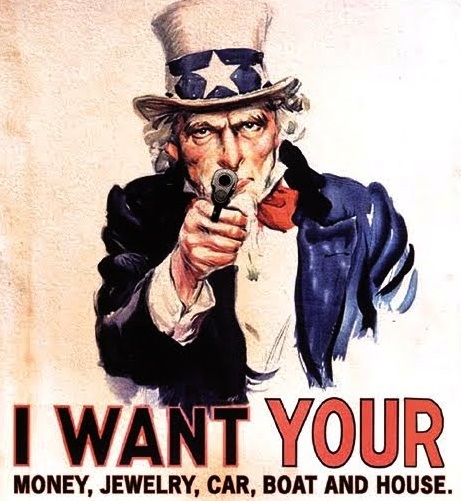
The Civil Forfeiture Outrage: American Government At Its Worst, So Naturally We Ignore It

Do progressives and conservatives have the courage to confront the illusion-shattering outrage of civil asset forfeiture in America? Not so far they haven’t. That shouldn’t be too surprising.

There are some things our governments do that are so frightening, wrong and un-American that we tend to look right by them—ignore them, pretend they aren’t happening, focus on other things—because their implications are too confounding to deal with. For fans of big government, who look to central authority to micro-manage our economy, distribute our resources, protect us from every threat and isolate us from the consequences (and often the benefits) of human nature, the fact that government power corrupts as surely as any power is an inconvenient (and undeniable) truth that threatens the foundation of their ideology. How irrational is it to place more responsibility on the government if we can’t trust the government, because we can’t trust the inevitably flawed and conflicted individuals who run it?

The willful blindness is no less insidious with conservatives, whose core belief is the inherent goodness of the American system and way of life, as defined by our founding documents. Accepting that the largest and oldest democracy on earth sometimes targets and plots against law-abiding citizens means accepting the possibility that the system itself doesn’t work, and that its supposedly sacred ideals—life, liberty, and the pursuit of happiness—are a cynical lie. Aiding and abetting the blindness is the traditional media, which is substantially populated by self-important, inadequately-educated, ethically-shaky pseudo-professionals who believe their duty to objectively tell the public what it needs to know should be tempered by what they believe will persuade members of the public to adopt the “right” views, and, of course, by what will pull their attention away from the competition. Better to have features about Michelle Obama’s healthy eating crusade than to tell Americans about government wrong-doing, especially when the journalists support the party in power.

As a result of this toxic mix of bias, self-interest, self-delusion and incompetence, many of the most illuminating examples of how far America can go wrong can take a long, long time to enter into public consciousness. A recent example is insider trading by members of Congress, which had been well-documented for a decade before a “60 Minutes” report combined with the Occupy protest visibility and the widespread distrust of Wall Street suddenly made it a significant public concern. But other equally important issues, like the abuse of U.S. convicts, including the tolerance of prison rape, haven’t broken through the willful blindness yet.

Neither has civil asset forfeiture, despite the efforts of libertarian activists, publications like Reason, websites like Popehat, and organizations like ACLU and  The Institute for Justice, a libertarian, human rights public interest law firm that I have been negligent in not plugging earlier. (I apologize.) Right now, the Institute is going to court in a Massachusetts civil forfeiture case, United States v. 434 Main Street, Tewksbury, Mass, that serves as an excellent introduction to the sinister nature of this institutionalized abuse of power. Here’s the story, from the Institute’s website: Continue reading

The Tragedy of the Poles

This week Gallup announced that the United States public is historically polarized in its ideological views. This is tragic news for the United States, and anyone who wants to know why merely needs to understand the significance of recent emissions from the Stygian depths of the Republican Party and the conservative movement.

Today is the Florida primary, and if rationality reigned supreme, Newt Gingrich would receive as many votes as the write-in total for Pee Wee Herman. Once he was unable to thrill the easily thrillable by making grandstanding declarations against the bias of the media—the equivalent of shooting fish in a barrel—Newt, as always, revealed himself as temperamentally, ethically and rationally unqualified to lead the nation, or, quite probably, a plumbing crew. He made irresponsibly grandiose proposals, like colonizing the moon at a time when the nation can’t afford PBS. He attacked President Obama while simultaneously using Obama’s class warfare tactics to denigrate his fellow millionaire, Mitt Romney. Once a pious advocate of Ronald Reagan’s “11th Commandment” that Republicans should not attack each other, he called Romney a liar, a liberal (which, of course, is much worse than a liar at the Right Pole). He heralded an obscure out-of-date robo-poll as showing that he was running neck-and-neck with the former Massachusetts governor in Florida, when he knows that he has lost ground in the race, as every legitimate poll now shows. He made dark hints that Romney—pssst! He’s a Mormon! Be afraid!—-was biased against “our religions.” He threatened, claiming that he would reject any debate with President Obama that had a moderator from the evil, biased media, an especially ridiculous pledge since the main argument ( facile myth, by the by)  for Newt’s candidacy has been that he would thrive in Presidential debates. And, of course, he whined, claiming that his precipitous fall was the fault of liars, the press, the establishment—anybody but Newt. If there is an ethical value he hasn’t breached lately—let’s see: responsibility, accountability, respect, fairness, prudence, honesty, caring, kindness, process, integrity, loyalty—just wait a while.

In short, Gingrich has behaved as he has always behaved under stress, as the mean-spirited, irresponsible, Machiavellian, untrustworthy, self-centered and destructive man that he is. He was waving a huge phosphorous orange flag reading, “I have no business being President!” for all to see. Thanks, Newt!

But a mind-boggling number of ideologues on the right can’t see it. They refuse to see it, because when you are stuck at an ideological pole, reality no longer matters. What matters is that Gingrich is a conservative, closer to their pole than the ideologically flexible Romney, and any references to Newt’s character are “the politics of personal destruction, ” because, you see, character is irrelevant at the poles. How could it not be? After all, the other pole has people of good character, and they are still wrong. “Annoy a liberal, ” Sarah Palin said on Fox. “Vote for Newt!” Yes, that’s a good reason to vote for presidential candidate—to annoy people you don’t like.

When you occupy an ideological pole, you become incapable of open-mindedness, reason, self-improvement or change. You can’t learn, you can’t absorb new data objectively. Everything is automatically squeezed and distorted to fit a pre-determined construct, or is ignored entirely. Lock-step masquerades as integrity. Reason, consideration, compromise, practicality, prudence—not to mention respect, civility, fairness, honesty and kindness—become impossible. The pole is everything. And lest anyone think that by using Newt-blindness as an example, I am rating one pole as superior to the other, I am not. Watch MSNBC for about five minutes to see what I mean.

Rush Limbaugh has a rant that he trots out regularly about the uselessness of moderates. It is a deceitful rant, because he is evoking images of moderates as people who refuse to fully engage in difficult issues, and whose answer to ever problem is “it depends,” meaning, in most cases, “it depends which opinion I heard last.” He is right that such people are useless in a democracy, except to be manipulated by those with more energy, passion, credentials, visibility, fame or certitude. Those are not really moderates, however, but just pliantly ignorant. They have no idea how to examine an issue, so they don’t—in their case, “open mind” means “empty mind.” True moderates, however, are those fair and rational enough to know that there are no ideological templates that work equally well with every problem. They may generally agree with more conservative or liberal positions, but they know that complex problems involve complex solutions, and artificial rules about what must or must never be done just makes some problems unsolvable. They know that people of differing philosophies and points of view are enlightening, not stupid; essential, not evil. The poles, on the other hand, are great places for the empty minds to hang out..,..there, or at Occupy D.C. The poles provide substitutes for thought. They make it easy. Conservative–GOOD! Liberal—BAD!

Or vice-versa.

Polarization is the antithesis of ethics. It divides populations into warring camps whose objective is to win, not to do good, because the poles preclude objective analysis of what good is. Ethics, on the other hand, presupposes that we are all on the same team, and that doing the right thing requires cooperation, not combat.

The nation desperately needs a transformative leader who rejects the poles…as Peter Wehner describes him in Commentary, a leader who  would “turn the page” on the “old politics” of division and anger; who would call for an end of  a politics that “breeds division and conflict and cynicism.” Such a leader would pledge to help the country “rediscover our bonds to each other”  and to “get out of this constant petty bickering that’s come to characterize our politics.” He would “cast off the worn-out ideas and politics of the past.” We need leader who will proclaim an approach to discourse that is alien to the poles, who will say, and mean it, “I will listen to you, especially when we disagree.”

A man claimed to be that leader; his name was Barack Obama.  He told us that the nation had “chosen hope over fear, unity of purpose over conflict and discord”by electing him.  In his inaugural address, he declared “an end to the petty grievances and false promises, the recriminations and worn-out dogmas that for far too long have strangled our politics.”

And then, without the leadership skills to deliver on his soaring promises and unable to handle the intractable opposition of one pole, he retreated to the other.

But there are no ethics at the poles.

Only doctrine, intolerance, arrogance, hate, blindness…

…and failure.

Outrageous Prosecution: The Eric Rinehart Story

Asst. U.S. Attorney DeBrotas predecessors

Eric Rinehart, a 34-year-old police officer in  Middletown, Indiana, began consensual sexual relationships with two young women, ages 16 and 17. Rinehart was going through a divorce at the time, and in Indiana, he was doing nothing illegal, for 16 is the age of consent in the Hoosier state? Unethical? I tend to think so, but that isn’t part of the story.

One of the girls told Rinehart that she had posed for erotic photos for an earlier, presumably younger boyfriend, and suggested that she do the same for him. So Rinehart gave her his camera, with which she took the lascivious photos. This inspired Rinehart to take some more sexy photos and at least one video of both girls, which he downloaded to his computer.

For this, Rinehart was convicted on two federal charges of producing child pornography. Continue reading

Obama’s Quality of Mercy: Strained

President Obama finally pardoned somebody who wasn’t a turkey last week, but not before he became slowest Democratic president in U.S. history to use Article II of the Constitution to right a judicial wrong or just exercise his power to demonstrate  the ethical virtue of mercy. His choices for pardons could not have been more tepid, however, prompting a withering blog post by Prof. P.S. Ruckman, who champions the pardon power, and keeps meticulous score.

Ruckman had predicted that Obama would end the pardon drought as soon as December hit, noting that recent presidents used the Christmas holidays as a convenient pardon prop. But he is outraged at the small number of pardons, writing,

“Can President Obama say “no?” Yes, he can! Continue reading

Handshake Ethics, Professionalism, and Rand Paul

Democrat Jack Conway, attempting to take down his opponent for the U.S. Senate seat in Kentucky, Rand Paul, decided to go low. He employed a number of personal attacks including questions about Paul’s participation in a harmless, if bizarre college prank that had been the subject of a blatantly unfair article in Gentleman’s Quarterly. It was a desperate, mean, and unprofessional performance by Conway. Paul was obviously and understandably furious.

At the end of the debate, Paul rushed by Conway, ignoring his outstretched hand. I sympathize with him. I empathize with him. In the heat of the moment, having just had my opponent smear me on television with tales out of school—literally—I might have even done the same thing, though I hope not. Nevertheless, Paul rejected a vital ritual as well as a cardinal rule of civility in the political arena, where, as in the sporting arena, the handshake after the contest sends a symbolic message of reconciliation, forgiveness, respect, and most of all, professionalism. Continue reading

President Obama’s Perfect Lie

What is a perfect lie in politics? It is a lie that gives strength to one’s defenders, cast’s blame on one’s enemies, and yet the victims of the lie would rather let people believe it is true than correct it, because the truth will hurt even worse. These lies are rare, but when you have one, it is a wonderful thing to behold. There is only one problem with perfect lies.

They are still lies.

As Reason’s Matt Welch points out in devastating fashion, President Obama has found such a lie, and repeats it often, though it has no basis in fact whatsoever, and Obama has to know it has no basis in fact whatsoever. Here is the latest version, from a speech this week: Continue reading

Perry v. Schwarzenegger: Choosing Ethics Over Morality

Predictably, Judge Walker’s decision in Perry v. Schwarzenegger striking down California’s voter approved Proposition 8 has infuriated foes of gay marriage, who have condemned his opinion as judicial activism, a rejection of democratic process, and an agenda-driven farce. Walker himself is being attacked for having a conflict of interest, because he is widely believed to be gay himself. (The belief that a gay judge cannot rule objectively on the issue of gay marriage while a straight judge can is itself an expression of bias.) This is not surprising. What is surprising, at least to me, is that the only substantial argument critics of the opinion can articulate is based on the exact proposition Walker rejected in his opinion: that laws should be able to prohibit conduct based on morality and tradition alone, without quantifiable and verifiable reasons relating to the best interests of society. By insisting that a California law that would withhold a fundamental right—marriage—from a class of Americans must justify itself with reason rather than tradition, Judge Walker ruled that it is ethics, not morality, that should govern American law and justice. Continue reading