Lang Lang, the Chinese pianist who played for guests the White House State dinner on Jan. 19 honoring Chairman Hu Jintao, apparently regaled the crowd with an unfamiliar melody (to the Americans) that was really a famous anti-American propaganda song from the Korean War, the theme to the movie “Battle on Shangganling Mountain.” Continue reading
respect
To Edit, or Not to Edit: A Blogging Ethical Dilemma
I was just simultaneously reading an excellent, if not particularly revolutionary, article about blogging ethics and checking out the latest comments on the Immortal Tide (with Acti-lift!) Debate. Suddenly I found myself wishing that the author, whose essay concentrated on editing blog posts, had also addressed the issue of editing blog comments.
Unlike some blog platforms, WordPress does not have a feature that allows commenters to review or spell-check their own posts. Despite this, many of the regular commenters here have a better record of avoiding typos than I do, and I have preview and spellcheck features. When they make a spelling or grammatical error (and I notice it), I will fix it for them: WordPress allows me to edit comments. Sometimes a commenter will e-mail me personally and request an edit, and I am happy to oblige.
A while ago, one new commenter whose post was riddled with spelling and grammatical errors accused me of letting her errors stand to make her look unintelligent because she had disagreed with my original post, while I continued to edit comments that were more friendly. In her case, I actually hadn’t read the previous typo-infested comment that she was referring to, and treated her complaint as a request to edit it, which I did. But it was a mess, and I wondered then if it made sense, or was even fair, to turn an inarticulate, careless comment into a clear and persuasive one.
Today I have read several posts on the endless Tide commercial thread from a 15-year-old girl. The post is in text-speak, essentially, without capitals, punctuation or any attention to style. It is a clear comment, however,even if it is obviously the expression of a 21st Century teen. Should I edit her comment to give it more credibility, by punctuating it, for example?
What is an ethical editing policy regarding comments on an ethics blog? The options, as I see them, with their ethical pros and cons: Continue reading
Keith Olbermann: An Ethics Cautionary Tale
 At the risk of being accused of proving the old proverb that when all you have is a hammer, every problem looks like a nail, let me offer the observation that the apparently acrimonious departure of Keith Olbermann from MSNBC, despite being the cable channel’s biggest star, is a cautionary tale about ethics.
The lesson: the absence of respect for the opinions of others, accompanied by a lack of humility and a surplus of contempt for fairness and civility, will doom even intelligent, talented and hard-working individuals to inevitable failure, because they cannot be trusted, not by employers, not by colleagues, not by friends.
This is why ethical values are valued: they are essential to individual success, because they contribute to societal and social success. This is, I believe, the fourth time an Olbermann show has ended like this, and like Bill Murray in “Groundhog Day,” he is doomed to repeat the pattern until he learns how to be a more caring, more trustworthy human being.
I hope he makes it. Keith Olbermann has the ability to help make this a better country, instead of a nastier, meaner, more divided one. I hope he gets another chance, and that this time, he figures out how to use his abundant talents to do it.
Comment of the Day: “Facebook Wars: Parental Abdication, School Abuse of Power”
The Comment of the Day is from Joshua, from the lively thread on the post “Facebook Wars: Parental Abdication, School Abuse of Power.” Continue reading
Facebook Wars: Parental Abdication, School Abuse of Power
Student Facebook pages were much in the news yesterday. One student was suspended from an Illinois school for posting a list of girls at his high school ranked by appearance and sexual proclivities, while another school, Uniondale High, contacted authorities in Nassau County who prevailed upon Facebook to take down a similar page posting provocative comments about high school girls in various area high schools. Uniondale says it has a “no tolerance” policy toward cyber-bullying.
When did schools suddenly acquire disciplinary control over what students do when they aren’t at school? Continue reading
“Finishing the Hat”: Sondheim, W.S. Gilbert, and Expert Malpractice
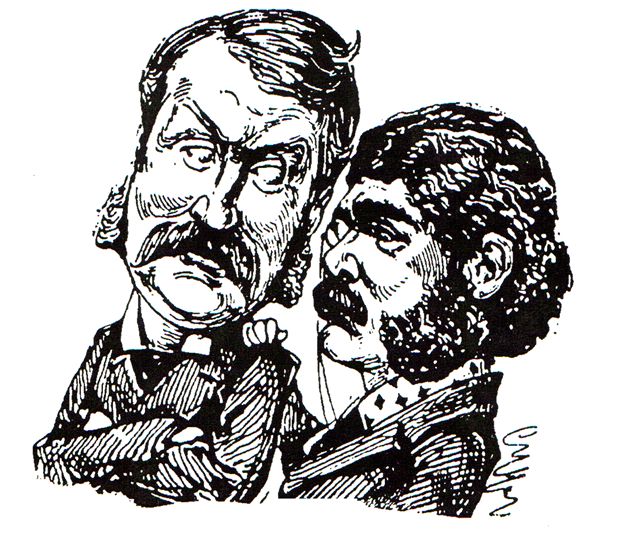
Stephen Sondheim’s “Finishing the Hat” is a fascinating reflection on a remarkable career and the craft of making musicals by the greatest living master of the form. In the course of recounting his formative years, triumphs, failures, and duels with producers, authors and composers, Sondheim also critiques the lyrics of his predecessors, contemporaries and role models—as long as they are dead. In a nod to gentility or cowardice, the only living lyricist he subjects to his expert critiques is himself.
Sondheim is a tough judge, as one might expect from a composer/lyricist who meticulously measures each vowel sound and stressed syllable for maximum effect. He is also, by virtue of both his reputation and technical expertise, an influential one. The lyricists he grades highly in the book, such as Frank Loesser, Cole Porter and Dorothy Fields, are likely to have their reputations burnished by his praise, and those he slams, like Lorenz Hart and Noel Coward, will suffer by comparison. Because of this, Sondheim had an obligation, as a respected expert in his field, to make each case carefully and fairly. To his credit, Sondheim seems to recognize this, and all of his critical discussions of an individual lyricist’s style and quirks include specific examples and careful analysis. We may disagree with Sondheim as a matter of personal taste, but it is difficult to argue with his specific points, because they are backed up by examples, technical theory, and the weight of his authority.
It is therefore surprising and disappointing to see Stephen Sondheim slide into expert malpractice when he undertakes, clearly half-heartedly, a critique of the lyrics of W.S. Gilbert, of Gilbert and Sullivan fame. Continue reading
Speaker Boehner’s Sensitive/Cowardly Removal of Harmless/Violent Wording in Response to a Trumped-up/Genuine Problem
One of the characteristics of a true Ethics Train Wreck (or ETW for short) is that it eventually reaches the point where unethical and ethical responses to it are indistinguishable. The Tucson shooting ETW officially reached that point today, when Speaker of the House John Boehner apparently yielded to the complaint that referring to the health care reform law as “job killing” was inappropriate in light of Jared Loughner’s near-murder of Rep. Giffords along with killing or wounding 19 other victims.
In a post on his official blog, Boehner referred to the law as “job destroying” and “job crushing,” an apparent concession to critics like Democratic Rep. Chellie Pingree, who argued that the House bill called the “Repeal the Job Killing Health Care Law Act” should be renamed something without “killing” in it, “for Gabby’s sake.” By doing so, the Speaker of the House gave credibility to an argument that… Continue reading
Golden Globe Ethics: Ricky Gervais’s Hosting Dilemma
Hollywood is buzzing and griping about the manner in which Ricky Gervais chose to host the Golden Globe Awards last night. The L.A. Times pronounced him “too nasty,” and it was clear as the night went on that his pointed and often personal jibes at the film and television egomaniacs filling the ballroom at the Beverly Hilton were often infuriating or embarrassing his targets. There was even speculation during the show (via Twitter) that he had been fired mid-ceremony. Continue reading
Becoming a Society Without Empathy
Attorney, blogger and legal ethicist Franco Tarulli has a thoughtful post on The Ethical Lawyer about the results of a recent study I had missed, and now that I know about it, I almost wish I was still missing it. The findings are ominous. Continue reading
Unethical Web Post of the Month: William Rivers Pitt
I had been unaware of the existence of a writer named William Rivers Pitt before yesterday, and I now I will look back on those days of naive and blissful ignorance with nostalgia and deep mourning for innocence lost. The face of unreasoning hate and bigotry is always ugly, but one seldom encounters such purple-complexioned, vein-popping, spittle-spewing fury on the web, especially from a published author with a vocabulary exceeding “Deliverance” levels. I had been aware of the website Truth-Out, a hard Left commentary site that I now know exercises no editorial discretion whatsoever.
Mr. Pitt’s rant is entitled “The Wrath of Fools: An Open Letter to the Far Right,” which, if it were written by anyone with a history of the relative moderation of, say, Richard Cohen, Nancy Pelosi or Bill Maher, I would assume was satire. Continue reading
 Ethics Alarms