Uno’s, Doing Its Small Part To Keep Americans Ignorant

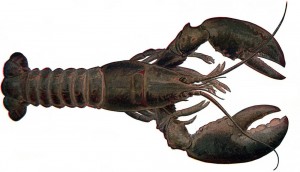
A live, non-talking lobster

Uno’s is a pizza chain that for some reasonadded seafood to its repertoire. For a couple years now it has been peddling lobster dishes on its menu, and the TV commercials feature a black humor ad featuring clueless lobsters chatting by a boiling lobster pot, not suspect that they’re next.

The problem facing Uno’s ad agency was that most Americans, not being from lobster country (as I am), think lobsters are red. They are not red until they are cooked, however; when they are alive and talking, lobsters are a dark, menacing, blackish green. In fact, live lobsters look like big bugs, and if you’re expecting bright red creatures, that what you might think the crustaceans are. So, faced with wanting talking lobsters that are also appetizing, what did Uno do? They made their live lobsters red, even though that will perpetuate the crustacean ignorance of the vast number of mal-educated citizens.

Sorry; it’s a small ethics foul, but a foul nonetheless. A lot of Americans think the Civil War was fought in the 20th Century, but that wouldn’t excuse a commercial showing the battle of Gettysburg including aircraft. Ignorance of any kind is to be avoided, and those who know the truth have an obligation to illuminate, not to keep people dumb and happy by feeding their confusions. Live lobsters aren’t red, and it’s wrong to keep badly educated non-New Englanders  thinking otherwise.

And they don’t talk, either.

Unethical Lawsuit Files: The Golfer and the Diner

The tort system  evolved to ensure that those injured by the recklessness, maliciousness or negligence of others can enlist the courts and juries to help them be made whole. It presumes, but, sadly, does not require, a measure of fairness, proportion, personal responsibility, forbearance, prudence, empathy, and common sense, as well as a lack of greed.

Two recent lawsuits, involving a golfer and a diner, illustrate how an otherwise good system can be used unethically.

First, the Diner: Continue reading

Food Preparation and the Right to Have Unethical Views

Ethicist Chris McDonald, who holds forth on his  Business Ethics Blog, has a provocative post on the right to know what you’re eating on another of his blogs, the Food Ethics Blog. I have no quarrel with the main point of his post, which I recommend that you read it here.

A related point in the article, however, not involving ingredients but food preparation, caused me to stop and ponder. Dr. McDonald writes…

“… imagine again that you’re a waiter or waitress. As you set a plate of food down in front of a customer, the customer asks: “Were any ‘minorities’ involved in the production of this food? Do you have any foreigners working in the kitchen?” Appalled, you stammer: “Excuse me?!” The customer continues, “I don’t like immigrants, and I don’t like the idea of them touching my food. I have the right to know what I’m eating!” Does this customer have the right to that information? Most of us, I think, would say no, of course not. She might see that information as really important — important to letting her live her life the way she wants to — but few of us would agree that anyone else is obligated to help her live out her racist values.”

I think the customer’s request for information regarding who is preparing one’s food is a valid one. Continue reading

Are Restaurants That Hire Illegal Immigrants Ethical?

No.

Next question.

Okay, let’s not be hasty. The New York Times Diner’s Journal asks the question, invoking the images of the 2004 film “A Day Without a Mexican,” in which all of California’s Mexicans suddenly disappear and the state is thrust into a world with far fewer gardeners, nannies, fruit-pickers, maids, cooks, and dishwashers. The film is the high-water mark of the essentially unethical rationalization for illegal immigration that is one of the main culprits for America’s unconscionable tolerance of it—that without illegals, the economy and quality of life of Americans would break down.

That the argument makes any sense at all is really a strong reason to stop illegal immigration, because it shows what happens when illegal and unethical practices becomes so entrenched that they warp the institutions, systems and cultural norms they affect, and corrupt the citizens who take advantage of them.  Continue reading

On Unethical Tipping

I had an enlightening, even shocking, discussion last night with a young woman who waitresses as a second job. I asked her about her observations regarding customer tips during the recession and generally. From what she says, there are a lot of unethical diners out there. Continue reading

Unethical Website of the Month: Eater.com

I would not have been able to resist giving the the Unethical Website title to Gizmodo [see previous post] unless there was a more typical candidate (as in “not criminal”) available. Thanks to a tip from Ethics Alarms quote-maven Tom Fuller, I give you Eater.com. It hasn’t stolen anything. It just sold out the interest of its own readers—lovers of fine foods and patrons of excellent restaurants—for a splashy feature destined to attract a flood of traffic, and to stick a knife in the backs of its competition. Continue reading