Comment(s) Of The Day: “Not This Issue Again! Arrest These Parents For Child Endangerment, Please…”

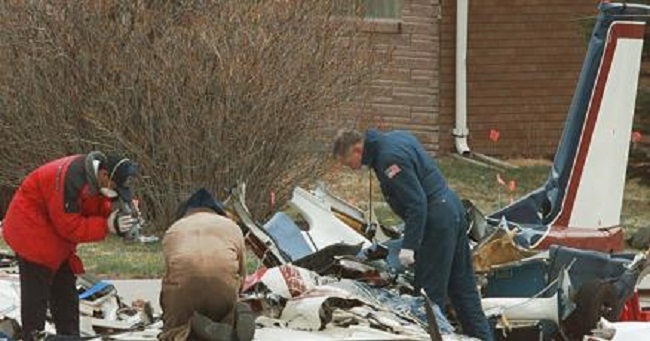
My position on parents endangering young children by seeking “all-time youngest” records for them and forcing them into unnecessarily dangerous recreational activities the kids can’t possibly understand or consent to is, I fear, unalterable. (Above is the 1996 wreck of the plane piloted by 7-year-old Jessica Dubroff, whose parents had her attempting to become the youngest trainee pilot to fly a light aircraft across the United States. Local, national, and international news media cheered on Dubroff’s story until she, her training pilot and her father died in the crash. )

However outdoors enthusiast Sarah B. mounted as strong a case against my position as I can imagine, in two successive comments combined here as Sarah B.’s Comment of the Day on the post, “Not This Issue Again! Arrest These Parents For Child Endangerment, Please…”:

***

I think there may be a misunderstanding on how Wyoming papers handle kid stories which I think changes a few things.

In small towns like most of Wyoming (not the urban hell that is Casper, Cheyenne, or Laramie), a story with a kid gets written long before a story about Bud Light and Dylan Mulvaney. I made the front page of our local paper at least a half dozen times as a kid, and made the paper dozens of times. Every year, the middle school and high school band/choir concerts would make the front page the day after they were held. If you consider that we did three concerts a semester for each of band and choir in high school, and two concerts a semester for each of middle school band and choir, that is ten days where the kids make the front page each school year. The high school homecoming royalty would make the front page on Thursday after the Wednesday reveal, the parade would always make front page on Friday, the game on Saturday, with the dance making page two. Prom was front page material. When four kids from our school got the best scholarship to the University of Wyoming one year, we made the front page. Every semester honor roll for every level of school made about third page. Placing in a math competition, debate competition, etc would always get a name in the paper, usually a picture too, and often on the front page. High school sports covered the front page every week.

I say this to emphasize my belief that this shouldn’t be considered as bad as you think. Newspapers gush over “youngest” this and “oldest” that. It makes people read the paper. National news is a page six or eight item and international news, like a war between Ukraine and Russia, is usually found below the fold on the comics page, under the Sudoku and Dear Abby.

People want the stories with the kids. Front page news is preferred to have a picture of a kid. A kid doing something good, like winning the coupon for a free pizza at the drawing at the library book fair, is a great front page story. Getting to the top of Devil’s Tower is just as good, and should be considered with the same gravity.

This is just standard newspaper fodder, nothing to get so excited about.

Continue reading

Self-Driving Cars And The Hindenburg Phenomenon

In Tempe, Arizona, a homeless woman was pushing a bicycle carrying plastic shopping bags and walked from a center median into a lane of traffic. She was immediately  struck by a self-driving Uber car operating in autonomous mode.

The car was traveling 38 mph in a 35 mph zone, and never braked. Police say the tragedy wasn’t the car’s fault, but it doesn’t matter. Uber has suspended use of the self-driving cars, and history tells us that the devices may be on a road to oblivion due to an unavoidable collapse of public trust.

I’ve been expecting this. To be precise, I’ve been expecting the first fatality inside a self-driving car, and that will happen soon enough. When it does, I think it is a close call whether self-driving cars ever recover, especially if the fatal accident is especially gory, or involves children.

All it took, remember, to end airship travel forever was one spectacular accident, when the Hindenburg burst into flames and was captured in photographs and newsreels. Before that, airships had a good safety record. Another vivid example was the 1933 Dymaxion, a streamlined car on three wheels created by visionary Buckminster Fuller. All three wheels turned, giving  the Dymaxion the ability to pull into parking spaces in one move. But the design was unstable. Three were built, hailed by investors, the media and celebrities as a break-through, and then one crashed, killing the driver. And that was the end of the Dymaxion. It sure was cool, though… Continue reading

Law vs. Ethics: The Infuriating Big Branch Mine Disaster Sentence

UBBMemorial

We really have to change sentencing guidelines so that white-collar criminals get the sentences they deserve.

Twenty nine men were killed in West Virginia’s Upper Big Branch coal mine explosion six years ago, and former Massey Energy CEO Don Blankenship, who was  found guilty of conspiring to avoid safety regulations that could have prevented those deaths, received only a one-year prison sentence and a fine.

A federal jury convicted Blankenship last year of a misdemeanor conspiracy to violate mine safety standards at Upper Big Branch. The jury acquitted him of felonies that could have put him in jail for 30 years. The judge handed down the stiffest sentence allowed for his misdemeanor conviction, but U.S. Labor Secretary Thomas Perez, prosecutors and the family members said later that the punishment was far too lenient for the nature of the crime.

Indeed it was. Corporations play the odds in a risk-reward game. If violating rules, regulations and laws can save or make millions and the eventual penalty when and if the company is prosecuted is only a fine, many companies and executives think it’s a risk worth taking. . If the risk also includes significant prison sentences for decision-makers, the risk-reward ratio changes significantly.

Blankenship was CEO of a company that intentionally risked the lives of its employees, and 29 men died. One year in jail looks like a rap on the wrist. Forget about the “Affluenza” kid: this sentence is far more disturbing.

“This man has no remorse at all!” a family member of one of the victims said. “He never approached none of us [after the mine disaster], he never told us he was sorry for what happened, and he knows he could have done the right thing.”

“I miss my family. (Blankenship) hugged his,”  he continued. “And all he gets is a year. The judge has done great; she gave him what she can give him. But there need to be stricter, more harsh penalties for people like that who put greed and money over human life.”

Yes.

Jenrry Mejia, The Inexplicable Ethics Mega-Dunce

mejia

What is the explanation for this?

Jenrry Mejia is a young New York Mets relief pitcher who until recently had a bright future as a star closer and a guaranteed multi-millionaire.  Now, entirely on his own initiative, he has become the first player ever banned from baseball for using steroids .

This is not easy, though Mejia did it with ease…and speed.  After recovering from Tommy John surgery, Mejia was establishing himself as the Mets closer by the end of the 2014 season. But he began the 2015 season with an 80-game suspension for testing positive for a common PED (Performance Enhancing Drug), then, even before completing that punishment,  flunked another urine test and earned himself a 162-game suspension a few months later.

Knowing full well that a third positive test would end his career, Mejia tried a different banned steroid, was caught again, and that third strike triggered a lifetime expulsion from major league baseball under the sport’s rules. Nobody has been that reckless and stupid, not even Manny Ramirez (who was caught twice), and Manny’s picture is in the dictionary under “reckless and stupid.” Continue reading

Ethics Dunce: The Washington Post

Better yet, just THINK...

Better yet, just THINK…

Here is another reason Why Our Children Will Grow Up To Be Cheats And Liars: ethically obtuse thinking like that expressed by the Washington Post editors this morning.

The Jackie Robinson West Little League team was stripped of its national title for a very good reason: it had an unfair advantage over its competition, so its victory was corrupt. Its coach and administrators cheated, manipulating league boundaries to assemble a team fortified by “ringers.” The victory didn’t count because the victory was a sham. The team wasn’t playing by the rules. This is not a difficult concept, or shouldn’t be.

Yet the Post’s editors are aghast, writing, “The fact is they punished a group of children who did everything right, on and off the field — punished them for the sins of adults who did wrong and an organization that was willfully oblivious.”

Yup. That’s the way life works. That’s the way it has to work and has always worked, and the sooner children learn that lesson, the less likely they are to grow up as ethically muddled as the adults who write Post editorials. Continue reading