New Passengers on the Roger Clemens Ethics Train Wreck

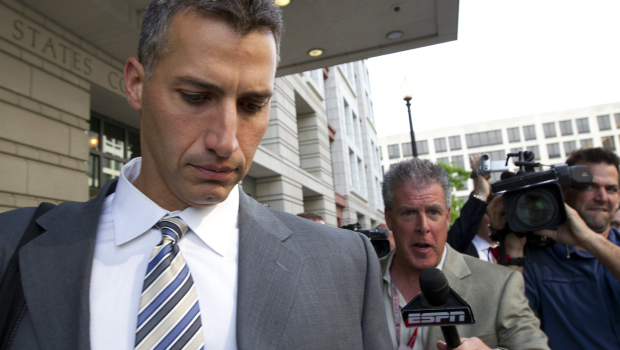
Hey Andy! Listen to that guy behind you…you won’t believe what he’s saying about you!

First, an Ethics Train Wreck recap, before we get to yesterday’s developments:

The Roger Clemens ethics train wreck officially started rumbling down the tracks in 2008, when Major League Baseball’s Mitchell Report, itself something of a train wreck to begin with, revealed that Roger Clemens’ trainer, a rather shady character named Brian McNamee,  had told the investigative commission that he had injected the pitching great with banned performance-enhancing drugs, or PED’s. In rapid succession there was ethics carnage everywhere. Clemens, under the pretense of inquiring about the health of his former trainer’s child, who was gravely ill, tried to get the trainer to admit he was lying. Congress, absurdly, called a special hearing on the matter. Clemens visited select Congressional offices beforehand, which tainted the objectivity of questioning. The Congressional committee, rather than seeking to illuminate the Clemens dispute or the status of PED’s in baseball, instead decided to take sides, with Republicans defending Clemens (a Bush-supporting Texan) and the Democrats seeking his scalp—facts had nothing to do with it. Clemens, meanwhile, made several dubious statements, and showed his class by telling the world that his wife, not he, was the PED-user in the family. A few months before, Clemens prevailed upon his friend Mike Wallace, then in his late 80’s and semi-retired, to tarnish his reputation as a tough and objective truth-seeker by tossing soft-ball questions to Clemens on CBS, so the pitcher could deny his drug use to a famously skeptical interviewer who was, in fact, thoroughly conflicted. Continue reading

Ethics Hero: Derek Jeter

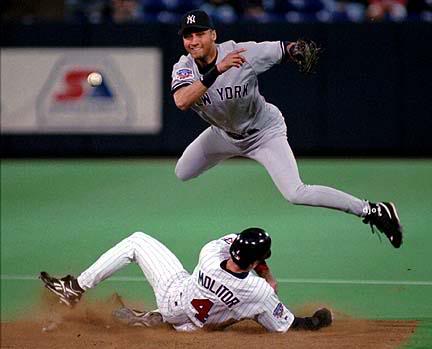
Roger Clemens is now on trial facing perjury charges. Barry Bonds has been convicted of obstruction of justice. Pacman Jones has just been arrested again; Tiger Woods hasn’t won a golf tournament since he was exposed as a serial adulterer. Through the travails and embarrassments of all of these and many more tarnished athletes who were once looked upon as cultural heroes, Yankee shortstop Derek Jeter has remained a constant— a team player, a clutch player, and an undeniably great player who has maintained his integrity and high values of competition and sportsmanship, never betraying the trust of his fans, his city, his team, or his game.

Yesterday Jeter reached 3000 hits, the watermark of the greatest of the greats, becoming the only lifetime New York Yankee to do so. He achieved the magic number with the flair only special players can muster, rising to a grand occasion like Ted Williams, hitting a home run in his final at bat, or Cal Ripken, marking  his passing of Lou Gehrig’s “iron man” record for consecutive games with a homer. Yesterday, Jeter passed 3000 in a rush, going 5 for 5 with the hit # 3000 being, yes, a round-tripper. Continue reading

Ethics Dunce: Buzz Bissinger

It took about an hour after the  Barry Bonds verdict for the first ethics-challenged national sports writer to write something outrageous about it. Not surprisingly, it was Buzz Bissinger, a the member in good standing of the Daily Beast’s stable of annoyingly hypocritical, biased or appallingly cynical writers, Bissinger belonging to the last category.

His post, which pronounced the Barry Bonds conviction “a travesty” in the title, contained one ethics howler after another, any of one of which would have justified an Ethics Dunce prize.

Here they are:

“It is true that the case of Barry Bonds does hit a new low, a new low in the waste of millions of dollars of taxpayers’ money, a new low in the witch hunt of a player who, because he was considered surly and arrogant and unlikable, is now having intimate details of his life revealed (such as testicle shrinkage), a new low in outrageous abuse of government power.” Continue reading

Hall of Fame Ethics: The Jeff Bagwell Dilemma

Members of the Baseball Writers Association of America have been turning in their ballots for the Hall of Fame, their collective totals eventually determining which retired major league baseball stars will have plaques in Cooperstown. If you follow baseball closely, you are aware of the big debates this year: Is Tim Raines worthy? Will Bert Blyleven finally make it? Has Alan Trammel been unfairly neglected? What about Jack Morris and Roberto Alomar? If you don’t follow baseball, you couldn’t care less, and I pity you. One controversy this year, however, should be of interest to non-fans as well as fans, because it involves the proper application of the ethical principles of fairness and equity in an environment of doubt. It is the Jeff Bagwell dilemma. Continue reading

Thomas Boswell’s Outrageous Ethical Breach

In the first installment of Ken Burns’ latest addendum to his epic documentary “Baseball”, there is a considerable discussion of baseball’s steroid problem, and its effect on the game, its image, and integrity.  Washington Post sportswriter Thomas Boswell is one of those interviewed, and caused quite a few PBS watchers, including me, to drop their jaws when he volunteered this:

“There was another player now in the Hall of Fame who literally stood with me and mixed something and I said ‘What’s that?’ and he said ‘it’s a Jose Canseco milkshake.’ [ Note: Star outfielder Jose Canseco was widely believed to be a steroid user from early in his career, and he finally admitted it after retiring.] And that year that Hall of Famer hit more home runs than ever hit any other year. So it wasn’t just Canseco, and so one of the reasons that I thought that it was an important subject was that it was spreading. It was already spreading by 1988.”

Boswell, who knew exactly what the player meant by “Jose Canseco milkshake,” never reported the apparent use of steroids—illegal in 1988, as it is now— to the team, Major League Baseball, or the public. Continue reading

“The Ethicist” and His Definition of “Unethical”

Eureka! Bingo! At last!

While explaining in this week’s column why he hesitates to label a manifestly unethical practice unethical, The New York Times Magazine’s ethicist, Randy Cohen, clarified a couple of questions that have been bothering me for quite a while. Why do so many people react so violently to my conclusion that they have done something unethical? And why does Randy Cohen, a.k.a. “The Ethicist” so frequently endorse unethical conduct, especially dishonesty, when he believes it is motivated by virtuous motives? Continue reading

Ethics Dunces: Charlie Rangel’s Birthday Celebrants

From “The Hill”:

“Democratic leaders and major party donors plan to hold a lavish 80th birthday gala for Rep. Charles Rangel (D-N.Y.) at The Plaza Hotel in Manhattan next month, despite 13 ethics charges pending against the veteran lawmaker.”

Apparently New York’s U.S. Senators Charles Schumer and Kirsten Gillibrand plan to attend, as well as New York Gov. David Paterson and gubernatorial candidate Andrew Cuomo—Democrats all.

Here is the ethical problem—and it is hardly rocket science. When a public figure’s misdeeds are more prominent in the public’s view than his or her lifetime accomplishments, it is impossible to celebrate the latter without appearing to endorse, support, or other wise fail to show sufficient disapproval of the latter. Continue reading

Mark McGwire’s Steroid Confession, Part 1

Former slugging first baseman Mark McGwire finally admitted yesterday that he indeed was a steroid-user while playing.  Telling the truth, even, as in McGwire’s case, when it is done too late and in a self-serving manner, is a good thing.  Nevertheless, his admission should have no bearing at all on the judgment of him as unworthy of  post-career honors. McGwire cheated, and his use of steroids damaged his fellow players and the game.  Nothing he said changes any of that. Continue reading

The Ethics of Ignorance and Apathy: Gore’s Million Degree Gaffe

I didn’t watch Al Gore when he appeared on the Tonight Show a couple weeks ago. What he said then while hobnobbing with Conan should be old news, but in fact it was no news at all, because virtually no news media gave it more than a passing mention. Then, by purest accident, I heard a talk-radio host ranting about a shocking statement Gore had made on the show, and I checked to see if he could possibly be quoting the former Vice-President correctly.

He was. Here is the exchange: Continue reading