Baseball, Ted Williams and Ethics Zugzwang

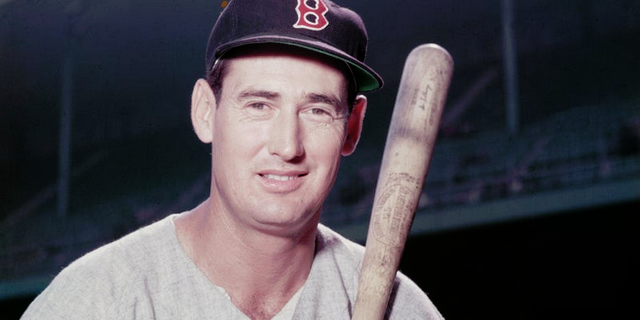
Baseball has an potential ethics problem involving baseball legend (and Red Sox icon)Ted Williams that I don’t think can be resolved.

Williams, or “Teddy Ballgame” as he liked to call himself (He also called himself “Ted Fucking Williams the Greatest Fucking Hitter Who Ever Lived”) is renowned as the Last of the Four-Hundred Hitters, Batting .406 in 1941. (He also lost the MVP vote that year to Joe DiMaggio because Joltin’ Joe hit in 56 straight games, a statistical anomaly.) That .406 average looks especially impressive in 2025, when only one player in the National League, Trea Turner, even managed to hit .300.

But just for fun, let’s imagine that Turner hit exactly .400. Ted Williams would no longer be the last of the .400 hitters, right? But there is a problem. When Ted hit .406, baseball counted sacrifice flies—when a batter makes an out with a fly ball that is deep enough that a runner on third base can tag up after the catch and score—like any other out. They counted against a player’s average. In 1953, though, baseball changed the rule so a “sac fly” didn’t count as an out. If Williams’ sac flies had been hit under the new (and current) rules, his average (he had 8 that year), would have been .413. If Turner were playing under the 1941 rules—-he hit 2 sac flies this season—those two outs would drop him below the .400 mark.

Continue reading

The “Immaculate Inning” Conundrum: A Fairness And Integrity Challenge

Yes, this perplexing ethics issue arises in baseball, but the principles it involves are applicable in other contexts. Attention should be paid.

Although there is no official definition, an immaculate inning in baseball occurs in baseball when a pitcher strikes out all three batters he faces in one inning throwing only nine pitches. This has only happened 114 times in Major League history, and been done by just 104 pitchers. The first immaculate inning was thrown by John Clarkson of the Boston Beaneaters against the Philadelphia Quakers on June 4, 1889. No-hitters, which automatically get a pitcher’s name in the Major League Baseball Hall of Fame in Cooperstown, are three times more common that immaculate innings. Throwing an immaculate inning is a career landmark for any pitcher.

A week ago, Tampa Bay Rays reliever Robert Stephenson threw nine pitches to three Cleveland Indi—I’m sorry, Guardians batters and struck them all out on three pitches each. But whether or not this constituted an immaculate inning is still being debated. Within the controversy is a welter of ethics lessons and problems.

Continue reading

Fairness, Justice, And Baseball No-Hitters

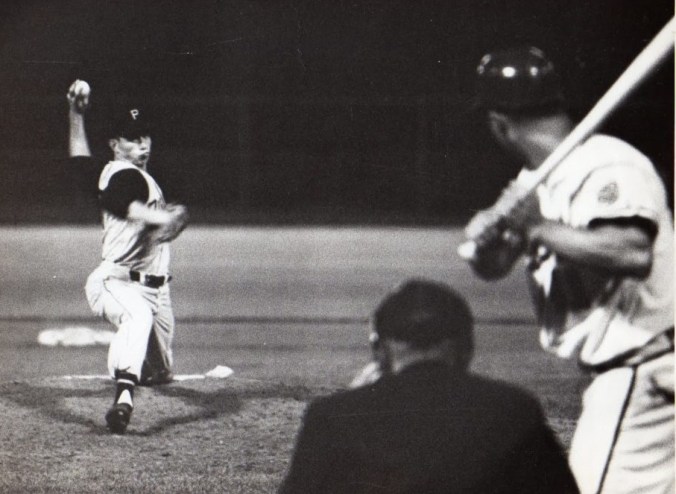
That’s Harvey Haddix about to throw a pitch above. The photo is from one of the most famous baseball games ever played: on May 26, 1959, Haddix, then a starting pitcher for the Pittsburgh Pirates pitched a perfect game—that’s no runs, hits, walks or errors, with nobody on the other team reaching base) for 12 innings against the Milwaukee Braves. It was the greatest pitching performance of all time, but because the Pirates didn’t score a run either, Haddix had to keep pitching into the 13th inning, where he lost the perfect game, the shutout and the game itself. As a result, he wasn’t even given credit for a no-hitter, which is normally when a pitcher throws nine-innings of hitless ball. That really bothered me as a kid; it made no sense.

In baseball, a no-hitter, with a perfect game being the ultimate no-hitter, has always been considered one of pinnacles of single game performance by a baseball player. A pitcher who throws one gets his name in the Hall of Fame; it’s a distinction that accents an entire career. Only the greatest pitchers throw more than one in a career; some of the very greatest, like Lefty Grove, Grover Cleveland Alexander, and Roger Clemens, never get one. (Cy Young, Nolan Ryan and Sandy Koufax, however, tossed three or more each. Johnny Vander Meer tossed two no-hitter in consecutive starts!) So being credited with a no-hitter is important; it matters.

Imagine then what it would feel like to be credited with pitching a major league no-hitter (or have your father or grandfather credited with one) and have it taken away. That’s what happened in 1991. Up until then, there had been no specific definition of no-hitter except the obvious, common sense one used by sportswriters, players, fans and baseball historians: a no-hitter was a baseball game that ended with one team having failed to get a hit. One of my favorite Commissioners of Baseball, however, Fay Vincent, the last one who wasn’t a toady for the baseball team owners (Vincent was fired for being independent, which up until then was the definition of his job), decided that the definition of no-hitter was too loose, among some other statistical anomalies. He put together a commission, and, with his influence, they redefined a no -hitter as a game that ended with one team getting no hits in at least nine innings.

Continue reading

From The Ethics Alarms Incompetence Files, Baseball Section, Unanticipated Consequences Tab

Oh yeah, this is going to turn out well…

In the Boston Red Sox’s first Spring Training game, played with the new pitch-clock rules that will be followed this season, home plate umpire John Libka ruled that Atlanta Braves prospect Cal Conley was not in the batters box and “alert” to Sox pitcher Robert Kwiatkowski at the required eight-second mark. This mandated that an automatic strike be called. The automatic strike came at a 3-2 count with the bases loaded and two outs in the bottom of the ninth, with the score tied 6-6.

That ended the inning, and, since there are no extra innings in spring exhibition games, the game. The final score was 6-6.Neither Conley, nor the fans watching, nor the Red Sox, nor either team’s broadcasters had a clue what had happened.

How exciting!

The new pitch timer rule requires pitchers to take no more than 15 seconds to begin their delivery with the bases empty and 20 seconds with runners on base. The batter must also be in the batter’s box and “alert” to the pitcher—meaning ready to swing— at the eight-second mark. Thus the pitcher clock is also a hitter clock.

Morgan Sword, MLB’s executive vice president of baseball operations, recently called the pitch clock “probably the biggest change that’s been made in baseball in most of our lifetimes.” If it decides many games by cutting off rallies with the bases loaded, I suspect fans might be calling it something else.

Making material changes to the rules of a successful enterprise after many decades is something that should not be undertaken precipitously or with a “well, let’s see how it works out!” attitude. Such changes, if made, must also be communicated clearly and widely to the public, which MLB has not done in this case.

I see strong analogies to, for example, the 2020 mail-in ballot rules, among other public policy innovations.

Baseball, after all, is Life.

Baseball Ethics: MLB Changes The Rules Because Its Players Can’t Compete Under The Old Ones

I feel like I can’t let baseball off the hook while I’m being hard on the NFL today.

Of course, football’s ethical problem (well, one of the many) is that it allows too many players on the field who are killers, rapists and thugs, while baseball’s ethical problem is that it habitually changes the rules of the game rather than make the players accept the consequences of their own flaws.

You know, like Democrats…

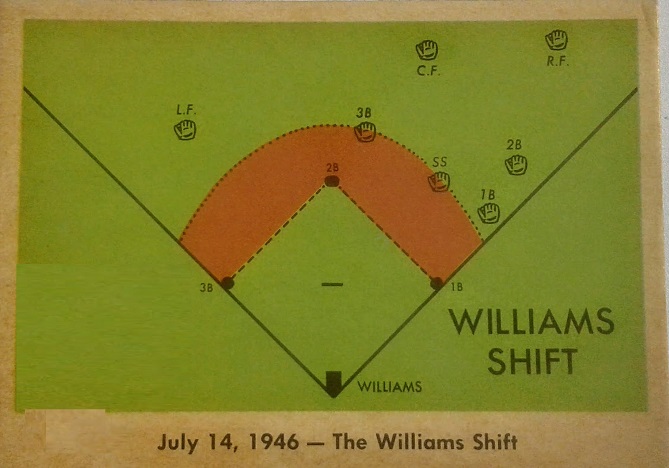
Beginning in 2023, Major League Baseball will enforce a set of restrictions it claims “will return the game to a more traditional aesthetic” by outlawing extreme defensive shifts. The goal is to encourage batters to put more balls in play rather than swing for the fences, a trend that has led to record numbers of strikeouts. The theory is that once they feel they have a better chance of getting a hit without knocking the ball out of the park, batter will try to make contact and thus hit more ground balls and line-drives,  giving players in the field more opportunities to showcase their athleticism. The changes are: Continue reading

Baseball Has A Cheating Problem That Is Old, Was Supposedly Addressed Decades Ago, And Is Strangling The Game. It Is Relevant To More Than Baseball (Part 1: Introduction)

Baseball sticky

Since about four other readers pay any attention to my baseball ethics posts, let me say right up front why this a mistake. Baseball’s current pitchers using foreign substances on the ball problem is, ethically, exactly the same as our nation’s election cheating scandal, or the illegal immigration crisis. It arises from the same dead-headed rationalizations, intellectual laziness, and self-serving deception. We can and should learn from it. But we won’t.

If you want to ignore the latest baseball ethics scandal as a niche problem unrelated to greater ethics principles, be my guest. You will be missing an important and still developing lesson.

Baseball’s hitting is way down this year, and pitching is more dominant than it has been since the mid-1960s. There is a reason: almost every pitcher is using some kind of sticky substance on the ball. This increases “spin rate,” which before computers and other technology was impossible to see, much less measure. The faster a pitcher can make a ball spin, the more it moves, curves and dives at higher speeds. Sticky substances allow a pitcher to do that. Using them is against the rules; it’s cheating. But for years now, the same kind of ethics-addled fools who allowed Barry Bonds and other cheats to use illegal steroids and wreck the game’s home run records as long as they lied about it have let pitchers illegally doctor the ball.

This week, the whole, completely avoidable ethics train wreck became an engine of destruction for the National Pastime.

Unfortunately, one has to understand the context to comprehend what is going on now, and that means looking backwards, in this case, to 2014. Here, with some edits, are two Ethics Alarms essays that provide the context. The first was titled “The Abysmal Quality of Ethical Reasoning in Baseball: A Depressing Case Study.” The second, Pineda-Pine Tar, Part II: Baseball Clarifies Its Bizarro Ethics Culture, appeared 13 days later. Yes, what is happening now was foretold by conditions that were evident seven years ago. The remaining parts of this series will bring you, and the train wreck, up to date.

***

What happened was this: During last night’s Red Sox-Yankee game in Yankee Stadium, the Boston broadcasting team of Don Orsillo and Jerry Remy noticed a glossy brown substance on New York starting pitcher Michael Pineda’s pitching hand. It was very obvious, especially once the NESN cameras started zooming in on it.   “There’s that substance, that absolutely looks like pine tar,” play-by-play man Don Orsillo said. “Yeah, that’s not legal,” color commentator and former player Jerry Remy replied.

Indeed it isn’t.  According to rule 8.02(a)(2), (4) and (5), the pitcher shall not expectorate on the ball, either hand or his glove; apply a foreign substance of any kind to the ball; [or]  deface the ball in any manner.

The Red Sox, who probably knew about the gunk on Pineda’s hand, didn’t complain to the umpires, and just went about their merry way, losing the game. Asked about the stuff on his hand, Pineda demonstrated the full range of body language indicating that he was lying his head off. “It was dirt,’ he said. Later, when the ick appeared to be gone,  Pineda explained, he had just sweated his hand clean. Right. Whatever was on his hand—beef gravy, crankcase oil, chocolate syrup…the majority of pundits think pine tar—it wasn’t “dirt.” Pineda’s manager, Joe Girardi, was brazenly evasive.

The Yankee pitcher was cheating. This isn’t a major scandal, but cheating is cheating: sports shouldn’t allow cheating of any kind, because if a sport allows some cheating, however minor, it will encourage cynical, unscrupulous and unethical individuals on the field, in the stands, and behind keyboard to excuse all other forms of cheating, from corked bats to performance enhancing drugs. Cheating is wrong. Cheating unfairly warps the results of games, and rewards dishonesty rather than skill. Cheating undermines the enjoyment of any game among serious fans who devote energy and passion to it. Any cheating is a form of rigging, a variety of lying.

And yet, this clear instance of cheating, caught on video, primarily sparked the sports commentariat, including most fans, to cite one rationalization and logical fallacy after another to justify doing nothing, and not just doing nothing, but accepting the form of cheating as “part of the game.” I’ve been reading columns and listening to the MLB channel on Sirius-XM and watch the MLB channel on Direct TV since this episode occurred. Here are the reactions:

Continue reading

The Olympics Gets More Specific About Banning Protests, But Remains Vague About Punishments. Let Me Suggest Something…

And the gold medal for obnoxious virtue-signaling goes to…

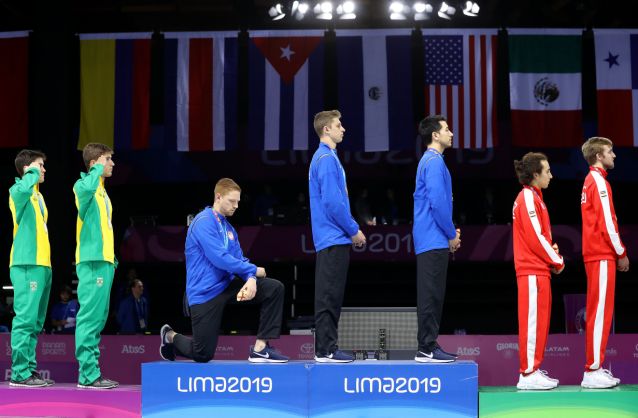
The International Olympic Committee’s rule on protests at the Olympics Games has been confined to one sentence in the Olympic Charter, and since that didn’t define what a “protests” were (the Committee appeared to be against them) that sentence had no practical effect. It reads, “No kind of demonstration or political, religious or racial propaganda is permitted in any Olympic sites, venues or other areas.”

.Recognizing, however, that the athletes of one of the teams likely to win a lot of medals also had a growing proclivity for protests against it own government and  President—guess which country that would be?—the IOC published a detailed list of prohibited actions that would not be welcomed at the 2020 Tokyo Olympics. Among them…

Kneeling during national anthems.

No fist-raising.

No use political signs or armbands.

None of the above  in stadiums, pools or at a finish line, not on podiums during medal ceremonies, norduring opening orclosing ceremonies.

No such protests in the Olympic Village, either.

This list was described as a “non-exhaustive list,” meaning that violations of the spirit of the prohibitions could also be judges a violation. The documents said that merely “expressing views” was not necessarily a protest.

Boy, I guess the Committee is counting on not many athletes being lawyers. Or Bill Clinton. Continue reading

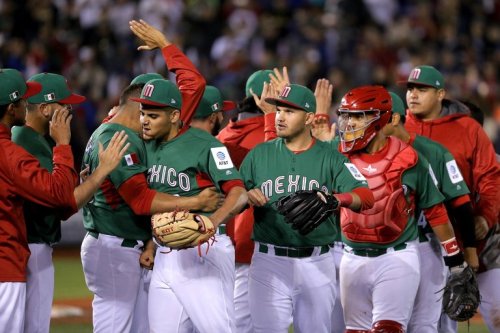
Screwing Over Mexico In The World Baseball Classic: Now THAT’S A Stupid Rule…

Rationalization #30. The Prospective Repeal: “It’s a bad law/stupid rule,” is a widely employed ethics dodge, used by everyone from drug dealers to tax cheats. It doesn’t mean that many rules are not bad and stupid however. The World Baseball Classic just demonstrated its management’s incompetence with one of them. As is often the case when bad rules and laws prevail, injustice is the result.

Sixteen national teams are competing in the World Baseball Classic, a relatively new baseball tournament played during MLB’s  Spring Training. There are five pools of teams in an elimination tournament. The competitors this year (the tournament is held every four years, sometimes three—never mind, they are still working it out) are Japan, Taiwan, China, SOUTH Korea (the first version of this post erroneously said “North”—wishful thinking on my part), Mexico, Cuba, Columbia, Puerto Rico, the Dominican Republic, Venezuela, Australia, Italy, the Netherlands, Canada, the U.S., of course, and…Israel. Pool competition just ended (the US is moving on to the next round) and Mexico, Venezuela and Italy all finished with records of 1-2 in their pool games. The tournament doesn’t have time for extended play-off games, so a tie-breaker was triggered.

Under Classic tiebreaker rules, the two teams with the fewest runs allowed per defensive inning in games played between the teams tied during the tournament play an elimination game, and the other is eliminated. The calculation of runs allowed per inning includes “partial innings.” (Hold that thought.) Major League Baseball announced that Venezuela (1.11 runs allowed per defensive inning) and Italy (1.05 runs allowed) will play an elimination game, with Mexico (1.12) out of the tournament. Here is how it stacked up: Continue reading

Major League Baseball’s Hypocritical Effort To “Speed Up The Game” Gets Sinister

extra-innings

When I was a kid, listening to Curt Gowdy describe the discouraging daily travails of the Boston Red Sox of Chuck Schilling, Frank Malzone, Gene Conley and Pumpsie Green over WHDH in Boston, sponsored by Atlantic Refineries (“Atlantic keeps you car on the go,go go,GO!”) and Narragansett Beer (“Hi, neighbor! Have a ‘Gansett! Straight from the barrel taste!”), most baseball games were done in two and a half hours. Now three hours is average, and for Red Sox games, four hours is not unusual. For those of us who enjoy baseball, this is hardly a tragedy, though it can be an inconvenience, and in my case, a major reason why my two languishing ethics books are still incomplete.

The honchos of the game, however, worry that the increasing time of games limits the game’s appeal to the younger generations, whose attention span resembles that of kittens, except for the relative few who can appreciate such features as drama, compelling narratives, suspense, character and probabilities. Thus MLB has been for years trying various measures to pare some of the time out of the modern baseball game. The baseball execs also act and talk as if they have no idea why the games have lengthened. They know. Anyone who follows the game knows. Continue reading

Ethics Hypothetical: Rules, Compassion, Integrity, Fairness, And A Looming Race Card

clock2

[The hypothetical is inspired by two recent events I witnessed in the past week.]

Preface: The state requires new bar admittees to take a one-day course covering the basics of practicing law in the jurisdiction—how the courts work, special procedural rules, unique aspects of local practice, horror stories, the works. They must complete the course or they can’t be certified, and the court-ordered series of lectures and presentations is held only once a month.

A company runs the mandatory curriculum under contract to the state, and is required to confirm in writing to the courts that its requirement have been fulfilled. One key requirement is that every attendee must be present for every minute of the presentations, except for brief emergencies, like using the rest rooms. The course administrators carefully monitor attendance. The published description of the course directs that once the course begins, theoretically at 9 am sharp, no late-comers will be admitted.

As you might imagine, missing the session can be quite a hardship, as participants often live and work in other jurisdictions.

The Event: It is 9:08 am on the day of the program, and the introductory video that begins the orientation is almost finished. It consists of interviews with members of the bar about the benefits of practicing in the state, the importance of ethical practice, etc: to say it is not substantive is an understatement. Literally nothing that is said and shown in the video is anything but boilerplate.

A young man, sweating profusely, bursts in the door, looking unhappy and desperate. “I’m sorry I’m sorry!” he babbles. He says that he had to drive up from a neighboring state and had an accident. “Can I still get in?” he pleads.

The male staffer responsible for the session chats briefly with an associate. The program was late starting, and this late arrival will miss nothing if he goes in now. “All right,” the honcho says as the young man heaves a sigh of relief. “I shouldn’t do this, but you haven’t missed anything.” As he goes into the auditorium, one can here the opening remarks of the first speaker, a judge. It is now 9:12 am, and another young man bursts through the door on a dead run. “My crazy cabbie’s been driving me all over the city for an hour!” he shouts. “I flew in last night from Arizona! Please, please, don’t make me do this again…I barely was able to afford this trip.” The administrator is wondering if he had seen the previous guy go into the auditorium. He’s heard this judge’s spiel many times: all that has been missed, to be honest, are a few (lame) jokes. “All right, all right, get in there quick!” he tells the new supplicant. “I’ll finish your paperwork during the break!” The kid looks like he’s going to cry, he’s so relieved.

I’m there, watching this (I’m on the program) and say to the administrator, “I bet this happens every time.” He says, “It does. I know that nobody misses anything that isn’t in the printed materials until 9:15, so it’s a hard stop after that.”

And another late arrival bursts through the door. It’s a bit after 9:14. The staffer has just told me that the final final deadline is 9:15, and it’s not that yet. This poor guy is bleeding through his pants,  has a big bruise on his face, and is saying something about a bicycle accident. By the time he gets himself settled—he is told that there is no time to clean up—it’s past 9:16. He starts toward the auditorium door as the other staffer says, “OK, that’s IT,” and starts to take the registration materials and lists away….just a very stressed young African-American woman enters, in plenty of time to see the bicycle rider, who is white, enter the auditorium. I can hear the judge through the open door. He’s still telling jokes, longer this time than usual.

Issues and Observations

1. The young woman was not admitted, and told that she had to come back another month. She too was from out of state. She also had a legitimate-sounding excuse.

  • Was that fair to her?
  • Should it have mattered that the program had not yet reached a serious stage?
  • She was told that 15 minutes was the absolute, unwaivable deadline. That was true, but it was not the deadline the company was contracted and pledged to enforce. That deadline was 9:00 am.

2. Should the explanations used by the latecomers play any part in the decision to allow them in? Why? Continue reading