Ethics Hero Emeritus: Sister Antonia Brenner, 1926-2013


Sister Antonia dies at 86

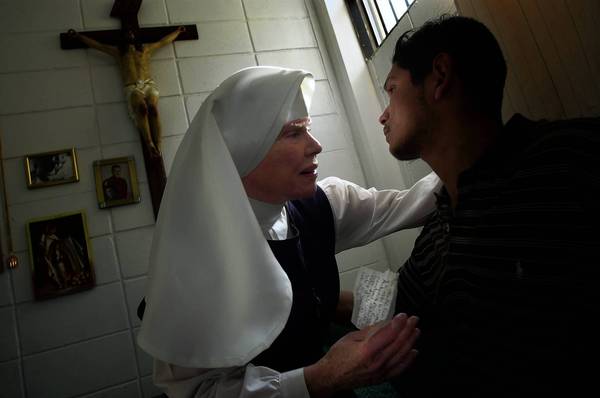
Sister Antonia caring for a prisoner in La Mesa in 2002

Once again, someone remarkable has died whose life was insufficiently celebrated while she was alive. I had never heard of Antonia Brenner until yesterday. I wish I had.

Mary Clarke was born on Dec. 1, 1926—we share a birthday!— the second of three children. Her father, Joseph, was a prosperous business executive; the family had a second home overlooking the Pacific. After her second marriage, to Carl Brenner, she was known as Mary Brenner, and was the mother of eight children, comfortably ensconced in Beverly Hills.  While struggling through her second divorce, she began doing charity work for the poor in Los Angeles.  A priest friend, Monsignor Anthony Brouwers, took  her to La Mesa state penitentiary in Tijuana, Mexico, which was filled with convicted murderers, thieves, gang members, rapists and other hardened criminals, all living in brutal and inhumane  conditions even by the horrible standards of U.S. prisons. Everything—her life, her name, and most of all, the existence of the prisoners, changed after that.

She became devoted to their plight as human beings, and brought the prisoners basics of comfort that were being withheld from them, at her own expense. She gave them aspirin, blankets, tooth paste, soap, even prescription eyeglasses. She carried spare toilet paper with her, and kep a lookout for other missing essentials. Brenner acquired a prison contract to sell soda pop to prisoners and then used the proceeds to post bail for minor offenders. She began spending more and more time with the prisoners, gaining their affection and trust, even singing in their church services. She treated them with dignity and kindness: when prisoners died, it was Mary Brenner who prepared him for burial. Continue reading

Congratulations To Hank Steuver For An Ethically Offensive Sitcom Review….No Small Feat!

"They won't consider aborting their child? That's ridiculous!"

“They won’t consider aborting their child? That’s ridiculous!”

It’s rare to find an ethically offensive TV review, and doubtlessly difficult to write one, but the Washington Post’s Hank Steuver is obviously equal to the task. Wow. My review of his review of the new NBC sitcom, “Welcome to the Family”:

“Yechhh. How Do people end up thinking like this?”

Here is the relevant section of his review:

“My nominee for quickest and most punitive cancellation goes to this facile dramedy about two 40-something couples who must learn to get along because their teenage children — a boy who is a Stanford-bound valedictorian and a girl who is an unfortunate iteration of the clueless blonde stereotype — are suddenly expecting a baby and have decided to keep it. Or perhaps they’re being forced to keep it, because they live in some parallel America in which Roe v. Wade has been fully reversed, thus reducing at least one obvious solution to the dilemma. (Which would, of course, cut the premise off right there; I understand that the point of the show is the pregnancy.) The truth is, these kids do live in a parallel America, the imaginary land of network television, which hasn’t found a way to talk frankly about abortion in the half-hour comedy format since, I don’t know, “Maude”? I’m not at all opposed to the personal choices made by the characters in “Welcome to the Family,” I just wish they’d had the choice to make. The foregone conclusion in the pilot is galling, especially in the scene where the teenagers’ combative fathers are seen chasing after the girl, believing she’s about to get on a rollercoaster.The metaphor is quite blunt: Save the fetus at all costs! (And forget Stanford!)” Continue reading

Disaster Ethics: The D.C. Naval Yard Shooting

Twelve dead? This is great---we can make another push for gun control!!!"

“Twelve dead? This is great—we can make another push for gun control!!!”

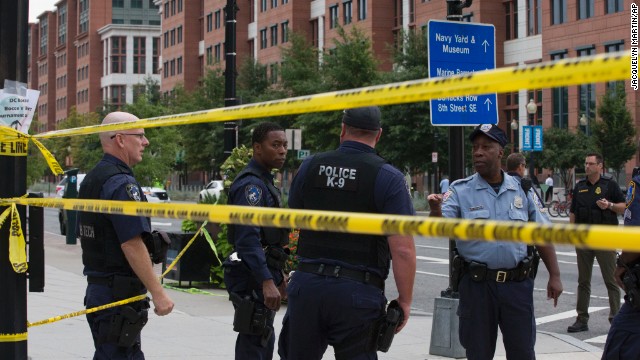
About 10 minutes from where I live, unidentified gunmen have killed 12 people (one of the gunmen is also dead) in an unexplained rampage. The facts are still being sorted out, and at least one shooter is still at large as I write this, but already two predictable examples of unethical disaster and crisis response have been on display:

1.  Reflex anti-gun tragedy exploitation

Apparently from now until the Second Amendment is but a distant memory, some Democratic politicians and anti-gun zealots will use every gun-related tragedy as a springboard to lobby for more regulations, and the facts be damned. At this point, we have not been told why the attack took place, who the shooters were, whether it was a terrorist act or not, whether the killers were Americans, whether or not the weapons were obtained illegally and what kind of guns they were. Never mind: interviewed on the radio, D.C. Delegate Eleanor Holmes Norton, Congress’s non-voting member, immediately pointed out that with all the guns that are available in this country, it should be no surprise to anyone that tragedies like this occur. I’m sure she would have liked to have been able to claim that global warming also played a part, except that it is a cool day in Washington. Continue reading

Don’t Blame The Lawyers: The Ethical, Unethical, NFL Settlement

Watch your heads!

Watch your heads!

When is a $765 million dollar law suit settlement “chump change”?  This is when, reading the reactions to the NFL’s announcement last week of its agreement with former players who sued the league over crippling  concussion injuries sustained while playing professional football:

  • It is inadequate when half of that will be ladled out over seventeen years, and all of it will be reduced by the lawyer’s fees, to be determined but unlikely to be less than a third.  That means that each former player (or his heirs and family) will get, at most, $114, 000 or so.
  • It is inadequate when the league paying the damages will split the payment among its 32 franchises, making each responsible for paying $24 million over 20 years, which comes to about $1.2 million a year. Remember that projected NFL revenues this season are $10 billion, and the NFL gets more than $40 billion on top of that through 2022, thanks to media rights.

In other words, chump change.

Or, if you prefer, “I gave my brain, mind and health to the NFL, and all I got was this lousy settlement.” Continue reading

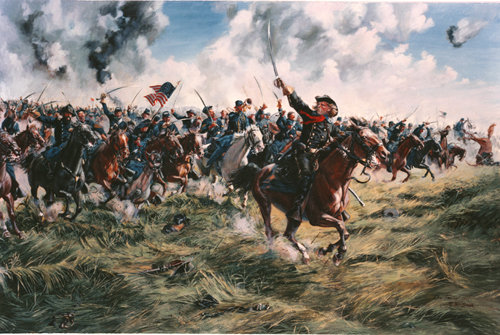
July 3: A Day To Honor Custer’s FIRST Stand, At Gettysburg… And Reflect On How Our Greatest Strengths Can Be Our Fatal Flaws

custercharge

I wrote this post two years ago, concerning my favorite neglected episode of the Civil War, when young George Armstrong Custer shocked Confederate J.E.B. Stuart with his unexpected and furious resistance to Stuart’s attempt at disrupting the Union flank while Gen. Meade’s army defended itself against Pickett’s Charge. As with the First Minnesota’s suicidal stand on the second day of the Battle of Gettysburg, Custer’s crucial moment of truth has been largely neglected in the assembly of the battle’s heroes; I don’t think it has ever been depicted in a Civil War film, for example, though there is at least one book about it.

The incident is especially fascinating to me because of the its multiple ironies. Custer succeeded when his nation needed him most because of the exact same qualities that led him to doom at the Little Big Horn years later. Moreover, this man who for decades was wrongly celebrated in popular culture as an American hero for a shameful botched command that was the culmination of a series of genocidal atrocities actually was an American hero in an earlier, pivotal moment in our history, and almost nobody knows about it.

Thus it is that among the brave soldiers of the Blue and Gray who should be remembered on this 150th anniversary of the greatest battle ever fought on this continent is a figure whose reputation has sunk to the depths, a figure of derision and ridicule, a symbol of America’s mistreatment of its native population. Had George Armstrong Custer perished on July 3, 1863, he might well have become an iconic figure in Gettysburg history. The ethics verdict on a lifetime, however, is never settled until the final heartbeat. His story also commands us to realize this disturbing truth: whether we engage in admirable conduct or wrongful deeds is often less a consequence of our character than of the context in which that character is tested.

Here is the post, slightly lengthened:

July 3, 1863 was the date of Pickett’s Charge, when Confederate General Robert E. Lee ordered a desperate Napoleonic advance against the Union line at Gettysburg in what has come to be a cautionary tale in human bravery and military hubris. The same day marked the zenith of the career of George Armstrong Custer, the head-strong, dashing cavalry officer who would later achieve both martyrdom and infamy as the unwitting architect of the massacre known as Custer’s Last Stand. Continue reading

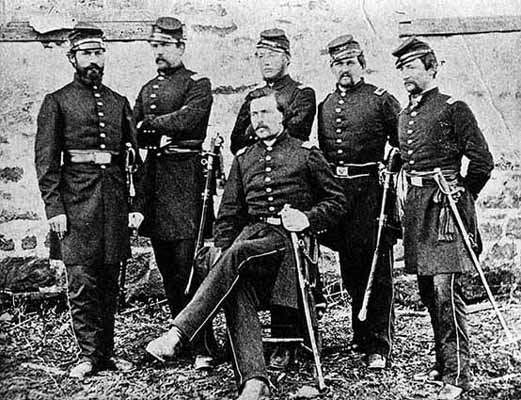
July 2, 1863: When 262 Minnesotans Saved The United States Of America

Officers of the First Minnesota Volunteer Regiment

Officers of the First Minnesota Volunteer Regiment

For the last two years, I have posted here about the courage and sacrifice of the men of the First Minnesota Volunteer Regiment at the Battle of Gettysburg. There was more than enough of those qualities, on both sides, to go around that day, and unless you are in the vicinity of that lovely and unbearably sad little Pennsylvania town, it isn’t just the brave Minnesotans who are neglected, but all of the participants. Yesterday was July 1, the anniversary of the beginning of the battle in 1863, and there was scant mention of it in the media. After all, there is the Zimmerman trial, and outrage over Jennifer Lopez accepting a million dollars to sing “Happy Birthday” for a brutal dictator, and whether movie viewers will flock to see Johnny Depp play Tonto. One of the few excellent acknowledgements of the date and its significance was by CBS, which also featured the famous feature on the battle published years ago by the Saturday Evening Post. 

In an ambitious mood, I once resolved to find a different group of battlefield heroes from that day to feature every July 2, the messiest, most important pivotal of the battle that itself has been overshadowed by the tragedy of suicidal Pickett’s Charge on July 3. But I have neither the historical research skills nor time to do justice to such a task, though the injustice of so many forgotten heroes is great. It is best to allow the First Minnesota Volunteer Regiment, who obeyed a desperate order to fill a breach in the Union line, knowing that it meant almost certain death,  “to gain a few minutes’ time and save the position and probably the battlefield,” to stand for all of them.

As for me, I’m going to watch, once again, Ted Turner’s excellent film Gettysburg, and play its soaring score in my home and my car. We have a duty to remember, and honor, every moment of those three days in July, 150 years ago. Continue reading

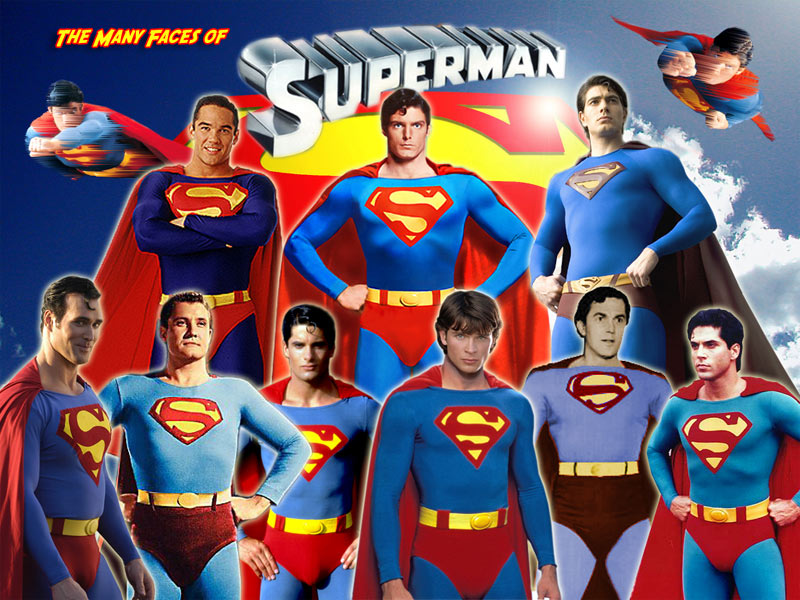
Superhero Ethics: The Duty To Rescue

Which is the cold, calculating, utilitarian face?

Which is the cold, calculating, utilitarian face?

In the new Superman film, Supie fails to rescue an important character in distress after the character requests that he allow him to perish.

Lawyer and superhero obsessive James Daily, co-author of “The Law and Superheroes” and the Law and the Multiverse blog, has taken to his keyboard to examine whether the transplanted Kryptonian had a legal duty to rescue the victim anyway.

His conclusion, and the law’s, is no. Daily writes,

“People are sometimes surprised to learn that, by default, there is no obligation under American law to help or rescue other people…Even “Good Samaritan” laws do not create an obligation to act as a Good Samaritan, but instead only encourage such acts of kindness by shielding some would-be rescuers from legal liability if they accidentally end up hurting rather than helping the victim. This “American rule” (not to be confused with the American rule for attorneys’ fees) applies even when a life could be saved with the most minimal of effort. As a result it has been called “morally repugnant” and “revolting to any moral sense,” but it is nonetheless the law in most states….” Continue reading

Ethics Hero Emeritus: Bob Fletcher (1911-2013)

Bob Fletcher

So many heroic citizens perform their exemplary ethical acts in near obscurity, never receiving widespread recognition or praise, never seeking it, and never missing it either. These are the best role models of all, but we learn about only a tiny percentage of them.

One such exemplar we learned about when he died this week is Bob Fletcher, a former government agriculture inspector who changed the course of his life to help his neighbors, who were in the midst of being abused and betrayed by their country. Continue reading

Ethics Hero Emeritus: Actress Jean Stapleton (1923-2013)

Edith Bunker, being stifled.

Edith Bunker, being stifled.

Jean Stapleton, the superb character actress best known as “Edith Bunker” from “All in the Family,” has died. She exemplified the actor who, given the chance to use her talents for cultural good beyond mere entertainment, not only did so but did so beyond all reasonable expectations.

Edith Bunker, the submissive, not-too-bright, loving, loyal and thoroughly confused character she played on the 70’s sitcom, always broke my heart. I found Stapleton’s portrayal difficult to watch, even when she was too funny to resist. Edith was an abused spouse who didn’t realize she was being abused. I think many women who were similarly abused resolved to change the course of their lives because watching Stapleton accept being “stifled” and insulted by the man she loved made them recognize the pattern they had accepted too. Yet Edith Bunker, in Stapleton’s hands, made “All in the Family” more than the portrait of a redneck bigot and his enabling wife, broadcast to be mocked by smugly liberal viewers reveling in their intellectual and moral superiority. We felt Archie was redeemable—as indeed the show slowly revealed that he was—-beyond his hard-wired prejudices, in part because such a sweet, good woman loved him. (The other parts included the superb writing of the characters and Carroll O’Connor’s nuanced Archie.) What an achievement Stapleton accomplished by playing a negative stereotype in a way that both promoted sympathy, understanding and rejection, while never becoming so ridiculous that the audience stopped caring about her. She deserved every one of her eight Emmy nominations and three awards: in fact, she smoked the competition every year. There wasn’t a better or more important  performance, male or female, on TV while “All in the Family” was on the air.

That’s not why Jean Stapleton is an Ethics Hero Emeritus, however. Continue reading

Ethics Hero: Angelina Jolie

Jolie

I am pretty certain that actress Angelina Jolie could have undergone a prophylactic double mastectomy and never revealed it, She could have had reconstructive surgery and continuing to appeal to the sexual fantasies of moviegoers, which has been a significant aspect of her movie career. She had no need to disclose the operation, which she underwent last month, and no obligation to. Nonetheless,Jolie revealed her choice to the world in an eloquent, powerful, and courageous op-ed in the New York Times this week, and undoubtedly saved lives by doing so. She also made a critical cultural statement about the worth of women and how they are devalued by being reduced to their body parts in popular culture, the media, and the minds of men.

I think it is one of the most courageous acts by an entertainment figure that we have ever witnessed.

Jolie writes in part… Continue reading