Unethical Quote Of The Month: Jon Gruden

youth-football

“There are a lot of geniuses that are trying to damage the game, and ruin the game. Do you feel it? There are a lot of geniuses that want to eliminate all sports, including recess. Not on my watch, and clap your hands if you’re with me on that!”

   —-Jon Gruden, ESPN analyst and former NFL coach, speaking at last week’s annual U.S.A. Football convention, the three-day  meeting of  the national governing body for amateur football.

This will be my annual Super Bowl week post,  one of the “watch the game if you have to and enjoy your nachos, just understand that by doing so you are supporting a billion-dollar industry that pays young men to cripple themselves and that is covering up the real risks of brain damage as long as it can” essay that I have written here the last few years.

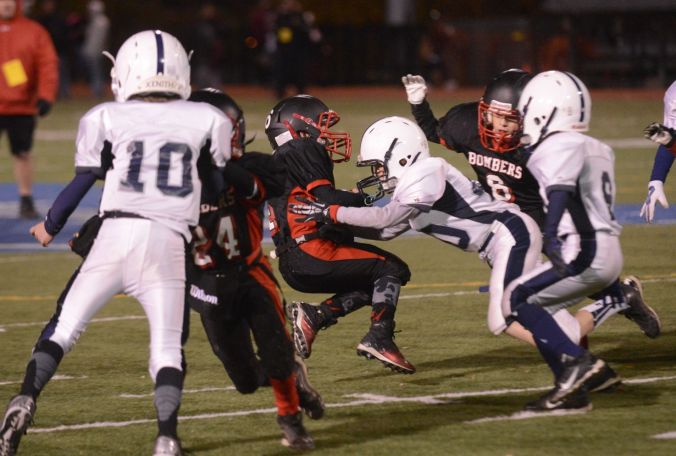
The New York Times reports that U.S.A. Football is experimenting with a radically altered  version of the game for kids that is designed to reduce head trauma:

Each team will have six to nine players on the field, instead of 11; the field will be far smaller; kickoffs and punts will be eliminated; and players will start each play in a crouching position instead of in a three-point stance…

“The issue is participation has dropped, and there’s concern among parents about when is the right age to start playing tackle, if at all…There are, legitimately, concerns among parents about allowing their kids to play tackle football at a young age,” [Mark Murphy, the president of the Green Bay Packers and a board member at U.S.A.] continued, “so they can look at this and say they’ll be more comfortable that it is a safer alternative.”

Later we are told that the new, supposedly safer version will only be tested in a few locales, and that it may be years before the new rules are widely instituted. And how many kids will sustain brain damage in the meantime, I wonder? From the Times piece…

Continue reading

Did Apple Kill The Little Girl?

driving_-selfie-car

A Christmas Eve tragedy from 2014 has sparked another ethically provocative lawsuit.

James and Bethany Modisette were driving through Denton County, Texas, on the evening of December 24, 2014, when they had to stop their car due to a traffic incident ahead of them on the Interstate. Their children, Isabella, 8, and Moriah, 5, were in the back seat, Everyone in the vehicle had a seat belt fastened.

Meanwhile, Garrett Wilhelm, idiot, was chatting away on his phone using the FaceTime app, and didn’t notice that the traffic ahead of him was stopped. His car rear-ended the Modisettes’ vehicle at 65 mph. Little Moriah was killed.

Now the Modisettes have filed a lawsuit against Apple, the maker of the app and the iPhone it was used with, citing a “failure to install and implement the safer, alternative design … to ‘lock out’ the ability of drivers to utilize the FaceTime application.” In the suit, the parents claim the company didn’t warn FaceTime users like Wilhelm that “the product was likely to be dangerous when used or misused in a reasonably foreseeable manner.” Continue reading

Ethics And Sports: Maybe It’s Confirmation Bias, But The TV Ratings Give Me Hope

And these days, when the goal is a more ethical society, I’ll take hope anywhere I can find it.

The big story in the NFL right now is that for the first time ever, its TV ratings are dropping. Through the first seven weeks of the season, ratings were down for every prime-time NFL show: “Sunday Night Football” by 19 percent, “Monday Night Football” by 24 percent and the Thursday night game by 18 percent. For the season as whole, ratings are off in regional games too. The NFL is doing what it always does with bad news: obfuscating and lying. It has blamed the drop on the Presidential race, as if anyone wouldn’t do anything to escape that, and the generational abandonment of network TV and even cable for the internet. Various polling results, however, show that a big factor is the league’s increasingly obvious lack of values.

The concussion issue-–finally—is hurting interest in football, especially as parents try to steer their children toward less risky sports. A recent study that researchers took pains to insist was only troubling, not conclusive, found brain chemistry changes in children who had played one season of junior football. I don’t know about anyone else, but if there is any evidence that a sport might reduce my kid to a brain-damaged invalid by the time he’s 60, that’s plenty for me to limit his recreation choices. The public is also finally reacting to the NFL’s evident cover-up of its responsibility for ex-players who have perished as a consequence of CTE, a brain disease caused by repeated head trauma. I wish this was the main reason that fans are turning off pro-football games, but at least it’s a factor. Continue reading

The Warped Values Of NFL Fans

nfl-poll

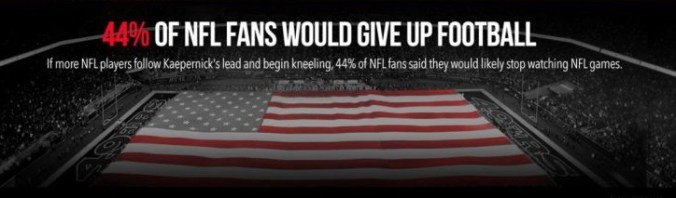
Yahoo Sports posted an infographic on polling results regardingthe ongoing national anthem protests following the example of  San Francisco 49ers quarterback Colin Kaepernick. Part of it shows that 44 percent of NFL fans would likely stop watching NFL games if more players protest the movement.

This suggests that 44% of NFL fans have more  ethical objections to a sport that panders to hypocritical, Black Lives Matter-supporting dim bulbs like Kaepernick than to the fact that the same sport pays young men to cripple themselves while raking in billions and denying that there is a “causal link” between the concussions it routinely inflicts on players and the debilitating brain disease that is being found in autopsies of more former NFL players than not.

This month a class-action lawsuit was filed against Pop Warner, the nation’s largest youth football league. It alleges that the organization knowingly put its young players in danger by ignoring the risks of head trauma. The complaint also accuses USA Football, the youth football arm of the N.F.L. that  creates football helmet safety standards, of failing to protect football-playing kids from the long-term consequences of repeated head hits, while ignoring medical research (as described in the documentary “League of Denial” and the film “Concussion”) that has raised serious concern about whether football is a safe sport, especially for children.

The suit was filed in federal court in California by Kimberly Archie and Jo Cornell, whose sons played football as youngsters and were found to have chronic traumatic encephalopathy or CTE, a neurological condition linked to repeated blows to the heads. In March, Pop Warner settled a lawsuit with a family whose son played Pop Warner football and later committed suicide. He was found to have CTE. Continue reading

Comment of the Day: “The Amazing Mouthwash Deception: Helping Alcoholics Relapse For Profit”

There is an Ethics Alarms post “going viral” right now, at least as viral as any post on an ethics blog is likely to go. For two weeks now, my post at the end of July about how the “urban legends” site Snopes had descended into  dishonest, spinning, fact-distorting partisan/ left “factchecking” hackery has lapped all others here, and been shared to record levels on Facebook (nearing 11,000 shares) and Reddit.

This is nice, of course. It has brought a few (though not many) new commenters to the blog, and presumably more readers who stayed to peruse other topics. It has made August 2016, usually a fairly dead month, the most heavily trafficked month in Ethics Alarms annals. The post alerted some people to why Snopes is untrustworthy, though not, apparently, the Washington Post, which cited it as authority just a few days ago. It also prompted, on Reddit and Facebook, several thousand smug “this is not news, I’ve known this for years” comments. Where were your blog post, jerks?

The post’s wide circulation through the web also made me aware that a conspiracy theory holding that Democrats and the Hillary Corrupted maintain a team of attack commenters who go to blogs and attempt to muddy the waters when the truth about Clinton threatens to break through the denial dam might be accurate. I have received four or five almost identical comments on that post attempting to deny my dissection of Snopes’ pathetic attempt to prove that Hillary didn’t defend a child rapist, didn’t discredit his young victim in the process, didn’t know he was guilty when she did it, and didn’t laugh about the case in a recorded interview. None of the four commenters  read all of my post, which echoed a previous one in pointing out, as I always do, that a lawyer defending a criminal is not unethical, that the attacks on Hillary for doing so were ignorant and unfair, and that Hillary Clinton has nothing to apologize for in this case. Never mind: all four of these commenters ( and some others which never made it onto the blog) shifted into similar boilerplate language claiming I was attacking her too,  and preceded to repeat Snopes’ dishonest “factchecking” as if the documentation of its falsity I presented in the post didn’t exist.

Nonetheless, the Snopes revelation was not the Ethics Alarms post I would have chosen to “go viral.” There have been many essay in the last six year that I was, and am, especially proud of and believe were original, perceptive and important, and that have been barely read by anyone, never linked to or shared, and that have had all the impact of a shell thrown into the surf. How I wish my warning to the Republican Party , for example, urging it not to permit Donald Trump to participate in the primaries, had received similar attention. Not a single editorial board or pundit saw the peril looming, or at least  they didn’t write or talk about it if they did, because having The Donald spouting his inanities would be good copy and “fun.”

One such post dates back to the first full year of Ethics Alarms: The Amazing Mouthwash Deception: Helping Alcoholics Relapse For Profit, from August 2010. In six years, it has amassed about the same number of views that the Snopes piece amassed in half a month. Yet the topic, how mouthwash manufacturers profit significantly by hiding the widespread use of their product by alcoholics who use mouthwash to conceal their destructive disease from family members and co-workers, is barely mentioned  on the web—a few places, and almost all of them since the post. Still, Congress hasn’t held hearings, regulatory agencies haven’t noticed, and the products still carry warnings that fool non-alcoholics into believing that the stuff is poison, so nobody drinks it. Lives could be saved, marriages rescued, and endangered businesses might survive, if what I wrote was generally known

I’ve done the original research and put the problem out there. At least I’ve tried, and I will continue to write about the problem, which I have learned about first hand.

My efforts  haven’t been completely futile. I have received some gratifying comments and off-site e-mails from family members who read the article, discovered that a loved one was secret drinker, and got them help. I have also received a few responses that confirmed my work, though none quite like this one from new reader Dave, an alcoholic himself.

Here is his remarkable and  cryptic  Comment of the Day on the post, The Amazing Mouthwash Deception: Helping Alcoholics Relapse For Profit. Is it intentional irony? Is it sarcasm? Is it support, in the form of criticism? You decide:

Halfway through your article I decided it would be a good idea to go to shoppers and grab myself a bottle. I’d been so triggered today, only being a week sober prior. It’s great, you know, the mouthwash deception as you call it. I spend roughly $3.50 on a bottle of Life brand yellow mouthwash and it gets me radically twisted, with zero hangover. So not only does it make it easier for me to be a functioning alcoholic based on its inexpensiveness and zero hangover qualities, it is also amazingly convenient in that within 10 minutes I have three different 24 hour grocery stores I can go to in order to get a bottle.

Alcoholism is a shitty disease, believe me, I have lost much at the expense of it.

Continue reading

Four Supreme Court Decisions: Abortion, Guns, Affirmative Action, Corruption…And Ethics. Part 3: Whole Woman’s Health v. Hellerstedt

shrinking-number-of-abortion-clinics-in-texas

[The Supreme Court came down with four controversial and ideologically contentious decisions in June, and I apologize for taking almost a month to cover them all. One of the reasons Ethics Alarms occasionally launches a series like this one is to ensure that developing ethics stories of importance do not push important issues to the sidelines. The fact that this four part series had only finished parts 1 and 2 was an irritant to me, as well as some readers.]

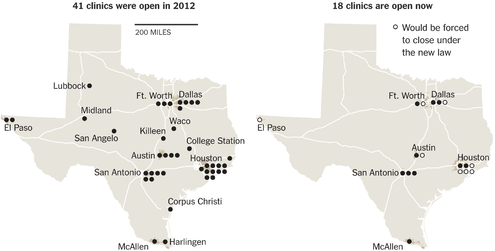
In Whole Woman’s Health v. Hellerstedt, decided on June 27, the Supreme Court held in a 5-3 majority that two provisions of a Texas law, one requiring physicians who perform abortions to have admitting privileges at a nearby hospital and another requiring abortion clinics in the state to have facilities comparable to an ambulatory surgical center,  places a substantial and unconstitutional obstacle in the path of women seeking an abortion, because they constituted an undue burden on abortion access.

Life would be so much simpler if our elected officials and activists employed an adaptation of the Golden Rule, and looked objectively at issues from the other side’s point of view. This is especially true in the realm of rights.  Second Amendment absolutists insist that virtually any laws regulating who can purchase guns, when and where they can purchase them, and how and how quickly they can be purchased are efforts to whittle away the right to bear arms. They also argue that such regulations have the ultimate goal of  eliminating that right entirely, which, in many instances is the case, especially if you listen carefully to the rhetoric of the legislators proposing such measures. There is little difference from this and what anti-abortion advocates are attempting to do with laws like House Bill 2 (H. B. 2).

The bill ostensibly is designed to make abortions safer, thus protecting women’s health, just as many gun laws are promoted as safety measures. Oddly, virtually all of the supporters of the Texas bill would make abortion illegal if they could. I’m sure it’s just a coincidence, just as it’s a coincidence that the authors of bills requiring potential gun owners to jump through increasingly burdensome hoops and deal with mandatory trigger locks and “safe gun” technology would gladly repeal the Second Amendment if they could. The ethical principle is the same in both matters: a right isn’t a right if legal obstacles make it difficult to exercise that right.

The question is, what’s a reasonable obstacle? Any regulation imposed on a constitutional right must not create “a substantial obstacle” and must be reasonably related to “a legitimate state interest.” The Supreme Court uses the language and logic of case precedents, which are its previous examinations of these issues and the balancing they require. One such case, though I did not find it mentioned in the majority opinion or dissents in Hellerstedt, would be the voter ID decision of many years ago, in which a strong majority ruled that the state interest in preventing fraudulent voters and maintaining the integrity of the election process justified inconveniencing those who were subjected to the extra burden of obtaining appropriate identification. In recent years, this decision has been questioned because many believe the motive behind voter ID laws is not really to protect the franchise, but to keep likely Democratic voting blocs from the polls.

Is there a difference legally between a bill that is authored with the intent to restrict the right to vote of older, poorer, and darker citizens while claiming that its sole purpose is to make sure non-citizens don’t affect the results of elections, and an identical  bill that is genuinely intended to safeguard the voting rolls, without any political motive at all? No, or at least there shouldn’t be. The Court’s job is to evaluate what the law does, not try to read the minds and hearts of those who wrote it. Justices only should try to do the latter when there is a debate over what the law says.

Ethically, however, there is a significant difference between a law using a public purpose as a sham to accomplish unethical ends, and a law with a legitimate purpose that has some negative side effects. Trying to restrict a citizen’s rights because one doesn’t respect those rights (or perhaps the citizen) is unethical.

The SCOTUS majority, in its typical examination of a balancing case like this, looked at whether there was a sufficient public safety benefit to a law that had resulted in a precipitous reduction in abortion services: Continue reading

Ethics Quiz: The World’s Cutest Water-skier

waterskiing baby

Keith St. Onge and his wife are professional barefoot water skiers and co-owners of the World Barefoot Center in Winter Haven, Florida. Last week, they had their six-month old daughter Zyla strap on little tiny skis and finally attempt what her parents had spent weeks training her for–water-skiing. She did it, too, for 686 feet across Lake Silver.  The proud parents filmed her feat and posted the video on YouTube (of course).

The Washington Post notes that many are criticizing the St. Onges for the stunt, claiming child endangerment.  Papa St. Onge defended the unusual pre-toddler (the girl can’t walk yet) activity, saying, “People don’t realize that it was done properly. It was planned and she was ready for it.”

Hmmmm…

Your strange Ethics Alarms Ethics Quiz of the Day is…

Is this ethical parenting?

Continue reading

Emory Update: University President James Wagner Vows To Punish Perpetrators Of “Trump 2016” Grafitti, And Reason Whiffs On Why That’s Wrong

Nice equivocating, Reason.

Nice equivocating, Reason.

To avoid burying the lede, let us understand right off that this is known as “chilling free speech,” and is un-American and wrong.

Following the revelation that Emory chief James Wagner ratified the complaints of ideology-disabled students that the expression of support for a major party political candidate was an unacceptable assault on student “safety,” Reason now informs us that Wagner is reviewing security tapes so the students can be subjected to the “conduct violation process.” Although the University has not demonstrated similar verve when chalk-scrawled messages contained more popular content, it is making the disingenuous argument that the manhunt is only about policies requiring prior approval of such chalk campaigns, and that prohibit chalk graffiti that won’t be washed away by rain like the itsy-bitsy spider.

The problem with swallowing that malarkey is that mere chalking has never prompted security camera footage examinations or presidential concern before. This is about condemning and squelching mainstream political speech that the prevailing majority of the campus doesn’t like.  This wasn’t swastikas or “hate speech.” “Trump 2016” at Emory is no different from “LBJ 1968” at Berkeley.

Being gentle and oh so careful to avoid sounding too much like he doesn’t sympathize with Trump-despisers,  Reason reporter Robby Soave writes, Continue reading

The Incompetent James Wagner, President Of Emory College

Trump 2016

The incident was simple and easily handled for any college president with a modicum of common sense, respect for free speech, and a comprehension of the needs of basic higher education. Unfortunately for Emory college, its students and stake-holders, James Wagner is not such a college president. He is, instead, a craven incompetent. Harsh? You decide.

At Emory, someone wrote the frightening words “Trump 2016” with chalk on a stair railing. Given that this is an election year and Donald Trump is running for President, such a scribble should be regarded as unremarkable. Oh, if it happened on a campus where I was enrolled, I might think, “Gee, apparently they accept idiots into this institution, and my degree may not be worth spit,” but that would be the extent of my dismay.

Ah, but it’s 2016, and thanks to the pusillanimous campus leadership at the University of Missouri, Duke, Occidental, Princeton, Yale and so many other places, college students nationwide have gotten it into their delicate heads that there is a basic human right to be shielded from any writing, words, slogans, pictures, historical references or sidelong glances that might upset their preconceived views of life in any way. Thus a group of Emory students who gasped with horror at “Trump 2016,” which is not only political speech but, unfortunately, mainstream political speech, went to Wagner and demanded action.

What Wagner should have said, following in the footsteps of the few college presidents who have shown themselves worthy of their jobs, is some version of what Oklahoma Wesleyan University, Dr. Everett Piper, wrote on his school’s website in response to similar student complaints on his campus: Continue reading

Watching the Super Bowl Last Year Was Unethical. This Year It Is Indefensible.

superbowl-50

Next year, it will be close to criminal.

The American public can no longer plead ignorance when it comes to supporting, financing and enabling the cynical exercise in human carnage for cash that is known as professional football. Since the last Super Bowl was played, “Concussion” visited the movie theaters, putting in dramatic form the undeniable facts exposed in the documentary “League of Denial.” Both “Concussion’s” director and its star, Will Smith, have stated in interviews that they don’t think they can enjoy watching football any more.Reaching this conclusion should not require the experience of making a movie  about the facts of the deadly concussion epidemic that the NFL blithely promotes, nor months of bringing to life a script describing how players have been misled and lied to in order to keep them sacrificing their bodies, minds and future to the greedy maw of a billion dollar. It should only require logic, humanity, decency, and bit of sacrifice.

In just the last several days, the casualty list of NFL stars found to have damaged their brains has lengthened significantly.

Former Oakland Raiders star quarterback Ken Stabler’s brain was found to have chronic traumatic encephalopathy or CTE, the concussion-triggered brain disease. A day after that announcement, the late Colts star quarterback Earl Morrall’s brain was found to be similarly damaged.  Stories were published around the same time about former Minnesota Viking linebacker Fred McNeil, who died in November and was also suffering from CTE. He had become a lawyer after his playing days, but began losing his memory and ability to concentrate. He had violent mood swings, and by his mid 40s, had lost his career, his job, his family, and his home. Former NY Giants star and famous broadcaster Frank Gifford died last year: he had chronic traumatic encephalopathy too.

On September 8, former Giants safety Tyler Sash was found dead at age 27 of an accidental overdose of pain medications at his Iowa home.  The results of an autopsy announced at the end of January showed that Sash already had advanced CTE. So did the brain of a 25-year-old former college football player whose brain was discussed in a February article in “Neurology Today.” From the case study:

The case, reported in the January 4 online issue of JAMA Neurology, involved a young man whose cognitive, mood, and behavioral symptoms progressively worsened following a history of 10 concussions incurred while playing football from age 6 till his junior year in college.

The patient completed a neurocognitive battery of tests prior to his death (due to an unrelated cardiac infection) at age 25. Although those tests revealed multiple deficits, and his symptoms steadily worsened for three years after he stopped playing, a consensus panel of clinicians blinded to his pathology report was unable to reach a primary diagnosis of CTE.

“Although CTE was considered,” the report stated, “the lack of delay in symptom onset, his young age, and his family history of depression reasoned against CTE as the primary diagnosis. Consensus members thought that neuropsychological performance, while impaired, did not discriminate postconcussive syndrome or major depression from CTE.”

That pathology report, however, was conclusive for a diagnosis of CTE, based on mild ventricular dilation, hippocampal atrophy, and pathological lesions of hyperphosphorylated tau consisting of neurofibrillary tangles, neurites, and astrocytes around small blood vessels found at the sulcal depths of the frontal and temporal lobes.

It’s not just the NFL that is crippling young men. It’s college football too. Continue reading