So Soon? The Bill Maher Ethical Condundrum Strikes Again…In Ferguson!

It's baaaack!

It’s baaaack!

No sooner did I announce the Bill Maher Ethical Conundrum than a perfect example of it—not involving Bill Maher—hit the news…and joined the Ferguson Ethics Train Wreck.

In August, the Federal Aviation Administration agreed to a request by the St. Louis County police to restrict about 37 square miles of airspace over Ferguson, Missouri, then engulfed in the most violent of the protests and rioting sparked by the shooting of Michael Brown. The restriction lasted for 12 days, and the reason given for it was safety concerns. Shots had been fired at a helicopter at one point during the violence in the city.

Safety is surely a valid concern, and since there were legitimate reasons to believe that the no-flight restrictions were prudent in the interests of safety, the measure was ethical. Or was it? The Bill Maher Ethical Conundrum, for those who missed the recent post:

Is the ethical nature of an act defined by its intent, or by an objective assessment of the act alone without reference to motive?

The Associated Press obtained tapes of the FAA’s air traffic managers discussing how to redefine the flight ban to allow commercial flights to operate at nearby Lambert-St. Louis International Airport and to permit police helicopters to fly through the area while meeting the goals of the ban. On the ban, they heard an administration manager say, about the St. Louis County Police Department, “They finally admitted it really was to keep the media out. But they were a little concerned of, obviously, anything else that could be going on.” A manager at the administration’s center in Kansas City said the police “did not care if you ran commercial traffic through this T.F.R. all day long. They didn’t want media in there.” Acknowledging that a ban that said “…you know, ‘OK, everybody but the media is OK,’ ”  the FAA managers then developed wording that they felt would keep news helicopters out of the controlled zone but not impede other air traffic.

Bingo! A flight ban in the interest of safety, serving the interests of safety, but motivated primarily by the illegal, unconstitutional, unstated motive of interfering with the public’s right to know through exercise of the Freedom of the Press.

Ethical or unethical?

The Bill Maher Ethical Conundrum strikes again!

___________________

Facts: New York Times

The Free Range Mom, Bias, and the Perils Of Blind Loyalty

About  the blind leading the blind---not only is it dangerous, it looks ridiculous to those who can see.

About the blind leading the blind—not only is it dangerous, it looks ridiculous to those who can see.

One of my favorite bloggers just fell into the blind loyalty trap. I’m sympathetic, but this is something that those who accept the responsibility of  teaching us important lessons and clarifying difficult issues must avoid at all costs. Bias makes us stupid, and blind loyalty breeds bias like carrion breeds maggots. It pains me to see Lenore Skenazy, author of the Free Range Kids blog, undermine her credibility like this.

She titled her post Horrible Editorial Chides Mom for Not Predicting Unpredictable Crime. In it, she takes the side of a mother who left her four-year-old son in an unlocked, running van while she picked up her daughter at a northeast school. Someone was drove her van off with her son in it, and subsequently crashed. The boy was unhurt. Under the circumstances, there is nothing horrible about the editorial, which uses the incident—even Skenazy agrees that the mother’s conduct was “dumb”—to caution parents about leaving children in cars. This is the editorial that aroused Skenazy to defend the indefensible:

“A Calgary mom has no doubt learned her lesson. The woman recently left her four-year-old son in her unlocked, running van while she picked up her daughter at a northeast school. The mother said she was gone about six minutes, and when she came out, someone was stealing her van with her son in it.

Fortunately, the incident ended well, with the child unhurt after the thief crashed the van, and the suspect was taken into custody.…charges of child endangerment need to be pressed to set an example, because no matter how often these types of things occur, other parents continue to leave their kids in similar situations. It takes just a few minutes to get your child out of a vehicle and bring him or her along with you on whatever errand needs running. Sure, it’s more convenient just to leave a child in the car and do the errand, unencumbered. However, child safety should trump inconvenience every time. Better a few extra minutes lost bundling a little one in and out of a vehicle than a lifetime of regret and what-ifs.”

The rationalizations in Skenazy’s defense begin with the title of her post, which is dishonest and in her own words, “dumb.” She is using moral luck as a defense, arguing that the sequence of events as they unfolded were merely unfortunate, and the mother just as easily could have returned to her van and car with nothing amiss. The odds favor nothing bad happening in six minutes; on the other hand, the odds of nothing bad happening are much better if a child isn’t in an unlocked vehicle with the engine running at all. Continue reading

Of Black Lungs and Concussions: How Can An Ethical Person Be A Football Fan?

So now you know. And,,,?

So now you know. And…?

The worst thing about pro football is not its wife-beating, gun-toting, child-beating players, or that the league happily has been willing to ignore these little flaws while promoting such flawed men as heroes to America’s young. Nor is the worst thing about pro football the fact that one of its teams has a politically incorrect nickname. No, the worst thing about pro football is that it makes billions from inducing young men to cripple their cognition long before nature would even consider doing it to them, and corrupts its huge national audience by inducing it to not only cheer this process, but pay for it.

Sally Jenkins, in a frank, stark column for the Washington Post, compared the NFL to the coal industry of yore, when minors were dying of black lung and terrible working conditions, and the government had to step in:

Since the NFL insists on behaving like the coal industry circa 1969, the only solution to its problems is for Congress to step in and regulate the business of these 32 billionaire plunderers. This week, the Department of Veterans Affairs brain bank announced that 76 out of 79 deceased NFL players had chronic traumatic encephalopathy, a degenerative brain disease. The price for owning a team just went up. Jerry Jones, Bob Kraft, Dan Snyder, Steve Bisciotti and all the rest, if you want to enrich yourselves at the expense of the ravaged health of others, be prepared to pay for it. Your future is endless litigation and government interference.

The CTE thunderbolt follows closely on the league’s callous handling of domestic violence cases. A new raft of medical investigations and lawsuits say that CTE caused some of these devastating domestic explosions, such as Jovan Belcher’s 2013 murder-suicide. CTE leads to aggression, paranoia, impaired judgment and depression….Here’s the deal: Concussions are the black lung of the NFL. And the league knows it.

Sure it does, but my problem is, so do its fans. The nation needed coal, still needs it in fact, so regulating that industry was reasonable, imperative, and practical. The country doesn’t need to have a deadly sport to watch every Sunday (Thursday, Monday…). Once it could claim that it was innocent, that helmeted players were protected, and that the tragically crippled were aberrations. Not any more. Continue reading

This Time, The Kid “Living His (Parent’s) Dream” Is Dead. Still Inspired?

teen-pilot-crash

Pointing out the breach of ethics when parents endanger children by allowing, encouraging, pushing, or forcing them to risk their lives before they are old enough to comprehend what risking their life means has been a periodic theme on Ethics Alarms. There was 16-year old Abby Sunderland, who had to be rescued from an attempt to become the youngest person to sail around the world solo. Paul Romero sent his son Jordan, 13, out to be the youngest to climb Mount Everest. In April of this year, the Coast Guard had to rescue the sick one-year-old of Eric and Charlotte Kaufman, who brought the baby and their three-year old along as they tried to circumnavigate the globe in their yacht. (Never mind, they all had life jackets.). Less likely to be fatal but epic in its length was the ordeal “the Biking Vogels” put their twin sons through, as they were forced to live on bicycles for years while their parents lived out their low-tech “Easy Rider” fantasies, peddling across America.

As was bound to happen, another set of parents in this unethical club  have met with tragedy of their own engineering. Haris Suleman and his father, Babar Suleman, from Plainfield, Indiana, were attempting to fly around the world with the newly licensed  teen piloting their single-engine aircraft. The journey, to be completed in 30 days, would have set a record. Gotta set those records!  The Biking Vogels were determined to set a record too.

As the plane piloted by a 17-year-old novice pilot took off from an airport in Pago Pago in American Samoa, it suddenly lost power and crashed into the water. The boy is dead; the father’s body has yet to be found. Continue reading

Ethics Quiz: Sexy Safety In The Air

This one’s simple. Watch this New Zealand Air safety video. It was recently pulled, possibly in part because of objections that it sexually objectified women. The video, shown to passengers before take-off, was even the target of a Change.org petition, which one again shows that many U.S. citizens don’t comprehend freedom of speech, and think that the U.S. is a monarchy, perhaps because the President often seems to be under that delusion himself. Now the video:

Your Ethics Alarms Ethics Quiz for a slow week in ethics (so far):

Is this video disrespectful to women, in bad taste, vulgar or inappropriate?

In the succinct words of Julia Roberts as Erin Brockovich: “They’re called boobs, Ed.”

And they are everywhere, and a lot more gratuitously displayed than here. Airlines have a problem getting passengers to pay attention to the safety instructions ( here’s Jerry Seinfeld making some trenchant observations on the dilemma), and having beautiful women in bikinis do the chore is as good a solution as any. Even the critics, prudes and boob-o-phobes must have been paying attention. Harm: minimal to none. Benefits: enough. The video passes utilitarian muster.

It’s also funny. I particularly like the Hawaiians in the dugout demonstrating the crash position.

________________________
Pointer: Fred

Facts: ABC


Laser Pointer Abuse: Why Ethics Gets Complicated

laser pointerThis month, the FBI announced that it was expanding a program rewarding anyone who reports an incident of an individual aiming a laser pointer at an airplane with $10,000. ( This use of the cheap lasers is a federal crime.) The bounty was previously offered in a handful of cities, but because it seems to have reduced the number of laser strikes on planes, it is being expanded nationwide.

Wait…is this really a problem? It’s several problems, in fact. The main problem is that laser pointers can, if the wielder of one gets “lucky,’ bring down an airplane. The related problem is that this country is littered with so many unbelievable assholes that we even have to discuss this….and imagine what other stupid, dangerous, irresponsible things they do when they aren’t trying blind pilots thousands of feet in the air.

Incidents where laser pointers interfered with the operation of commercial airliners have increased a ridiculous 1000% rate since 2005, when federal agencies started compiling statistics. Last year, there were 3,960 laser strikes against aircraft reported, an average of almost 11 incidents per day.

Some ethics-related thoughts:

1. There is no way around it: sociopaths, who are essentially ethics-free, are a constant threat and blight on society. Aside from the children involved, whose conduct can be chalked up to immaturity and flawed reasoning, the people who would aim a laser pointer at an airplane just for the hell of it are kin to those who set fires, vandalize buildings, create computer viruses and generally make life ugly and dangerous for the rest of us because they can. You can’t educate them or give them a sense of right and wrong. All you can do is make laws with harsh punishment for the stupid, destructive conduct these individuals engage in to give themselves a sense of power and importance. Ethics is irrelevant; their ethics alarms can’t be repaired, because they don’t exist. The laser-abusers  illustrate the maxim often quoted here that “When ethics fails, the law steps in.”

2. Anyone who uses a laser pointer this way and who is aware of the potential results is capable of much worse. This is signature significance, don’t you think? It is tempting to use such a crime as a justification for pre-crime: anyone who would do this is too stupid or too inherently anti-social to be trusted in a free society. Pre-crime, however, is a concept too prone to abuse, a slippery slope that the Constitution wisely precludes. I would, however, see no reason not to require a conviction of this crime to be disclosed to every potential employer, for all time. Nobody should trust someone who even once would risk causing an airplane to fall out of the sky because it would be cool, and I don’t care if the reason for the act was the lack of brain cells, IQ points, the sense God gave a mollusk or a missing conscience. I don’t want you in my neighborhood, near my family, or in my workplace. I don’t trust you. and I never will. Does this place a burden on you, if others feel as I do? Good, and too bad for you. Don’t try to shoot 757s out of the sky for laughs, and you won’t have the problem. Continue reading

Birding Ethics vs. Education Ethics: One Applies Common Sense, The Other Doesn’t Apply It, Or Sunscreen Either

"Don't worry, Mr. Sapsucker---the birders are looking out for you. Just be grateful you don't go to public school in San Antonio."

“Don’t worry, Mr. Sapsucker—the birders are looking out for you. Just be grateful you don’t go to public school in San Antonio.”

In the intense avocation of bird-watching, a code of ethics reminds practitioners of common sense. In public school education, there is no accepted code of ethics. And there is precious little common sense.

Cornell University’s Macaulay Library contains more than 200,000 bird call recordings, and 150,000 of them can be downloaded onto smartphones and other electronic devices. This allows canny bird-watchers to play the calls in the wild, attracting rarely-seen species.

Unfortunately, these realistic calls, experts say, can stress birds, including endangered species. Thus there is a code of ethics for the recreation of birding, The American Birding Association’s Principles of Birding Ethics, and it states,

 “Limit the use of recordings and other methods of attracting birds, and never use such methods in heavily birded areas, or for attracting any species that is threatened, endangered or of Special Concern, or is rare in your local area.”

It’s a well-conceived code that gives behavioral guidance where guidance is needed.

Now let’s look at a profession where most of us would say common sense is essential, and where the lack of it leads to  unethical and unacceptable conduct born of institutionalized incompetence. No, this time I’m not talking about our government. I’m talking about the educational profession, and the public schools. Continue reading

Kids On Leashes: Final Hypotheticals

kids on leashes2

Not to beat a dead dog, but while conversing about this surprisingly contentious issue (here, and here) on Facebook with the ever-thoughtful and provocative Lianne Best (Ethics Alarms congratulations go to Lianne for being honored by NARAL as an Outstanding Advocate For Choice), I realized that I should have posed one more hypothetical for the enthusiastic child-leashers to chew on, to wit:

“Have you ever seen anyone in public with both a kid and a dog on leashes simultaneously?”

Would you do that? And if you wouldn’t, why would having a child on a leash without the dog be any better?

To which Lianne countered with an even better hypothetical:

“How about a parent walking in public with the child on a leash but the dog walking along without one?”

____________________

Spark: Lianne Best

Graphic: Baby Cottage Gifts


On Liberals, Dignity, Dogs, Signature Significance and Toddlers On Leashes

But they LIKE it!

But they LIKE it!

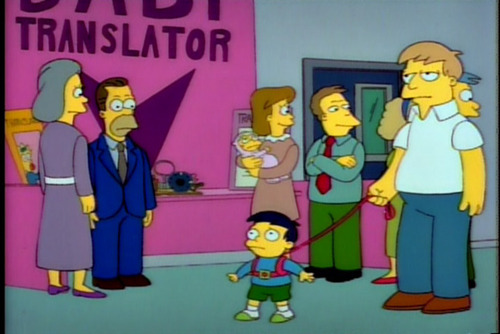
The damndest essays ignite furious debates here. I raised CNN’s mid-day quiz about parents walking children on a leash-–did I mention it featured a video of one mother dragging her prone harnessed child through a store like the kid was a sack of potatoes? I should have—-primarily because 1) it reminded me of “The Simpsons,” 2) because I was struck by the fact that ethics was never brought into a conversation that I would deem as concerning an ethics issue, and 3) because it was notable that CNN wasn’t talking about sunken Malaysian airplanes.

Still, I have been enlightened by the unexpectedly lively discussion, if not encouraged. In particular, this never struck me as an ideological issue, but it certainly seems to be one. Upon reflection, I should have predicted it, though this is not flattering to liberals.

I’ll return to this in a bit.

The defenses of the demeaning practice have been mostly pragmatic, which involves a utilitarian argument: “It works, and the ethical violations either don’t exist, or are too small to care about.” The most annoying defense so far has required  intentionally taking a statement in my post literally that also has an important figurative message, as well as misstating even the literal meaning, all to make it easier to dismiss the intended point. That’s some kind of record for straw men. Or would that be straw dogs? No, I think that’s something else.

The phrase in question was “whether it was fair, kind, respectful or right to treat your child like a cocker spaniel…” To make it easier to attack, my critic has changed that to “…to treat your child in a manner associated with the treatment of dogs.” Sneaky. It is true that dogs are typically kept on a leash, but that is only half the message, as fair readers will acknowledge. The term “treated him-her-them like a dogs/dogs” means, and has meant for a very long time, treating a human being in an inhuman, demeaning, humiliating, unkind, unfair fashion showing a lack of respect and making the human being in question miserable. The description has been used to describe both treatment that is seen in the treatment of actual dogs—such as substandard living conditions, lack of autonomy, domineering oversight, feeding of food not fit for human consumption, and in this case, use of a leash in public, as well as used to describe treatment that would never be literally possible with real dogs, such as too many typing assignments, refusal to give credit or bonuses for effective research, not allowing a family member a sufficient allowance, forcing a child to dress in old, outdated or unattractive clothes, etc. In the current case, both meanings apply, and focusing on just one is intentionally misrepresenting the issue.

As to whether the use of leashes on human children is demeaning, try this thought experiment: Would any white nanny dare to walk in public with two black children on a leash? How about the mother in a mixed marriage, in which the mother is blonde and the children are black? Would not the imagery of whites leashing blacks be inherently distasteful, regardless of the age of the African-Americans involved? Continue reading

Child Care Ethics And Leashes For Toddlers: CNN and Its Viewers Flunk An Ethics Alarm Test

Kids on leashes

It is constantly amazing to me that journalists so seldom identify obvious and critical ethics issues in the topics and events they cover. The rest is mixed emotions: this absence of ethics awareness is a serious culture-wide problem; then again, were this not so, I’d probably be in a different, and less stimulating profession.

Today I sat down to lunch as CNN engaged in a breathless discussion of whether using leashes on toddlers and even older children was a good idea, as it is either a growing trend among parents, or CNN was having a slow news day. The phone lines were open, and many viewers weighed in, with the primary camps expressing the following positions:

1. “If it makes children safer, then there is no reason not to do it. Safety is everything. Kids have been killed running into the street.  A leash will prevent that.”

2. “This shows the decline of child-rearing skills in the United States. If you can’t control your kid better than this, you are the problem.”

If the question of whether it was fair, kind, respectful or right to treat  your child like a cocker spaniel occurred to anybody in this discussion (I know the CNN staff never considered it), I saw and heard no evidence of this. Yet that is the central question, and it is an interesting one to consider. The fact that matters of human dignity, responsibility, respect, fairness, autonomy, kindness, proportion and prudence need to be balanced to answer the question at hand never came into the discussion, and those debating the issue demonstrated neither awareness of the competing ethical values, nor the ability to know how to employ them. Continue reading