And The Winner Of The “It Would Be A Better World If Everyone Read Ethics Alarms” Contest Is…Aalst, Belgium!

From the BBC:

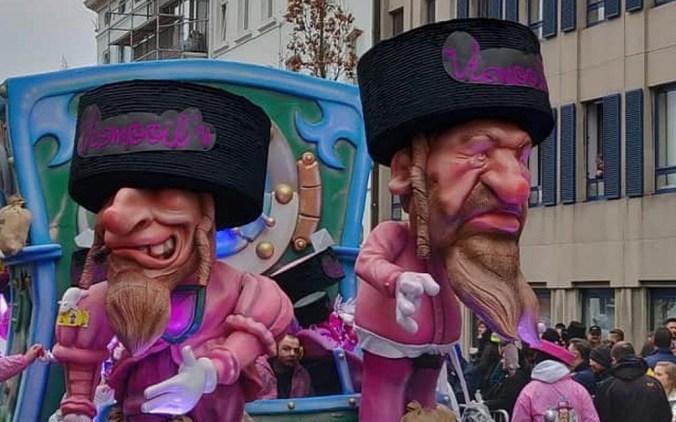
Israel, Jewish groups and Belgian Prime Minister Sophie Wilmès were among many who strongly condemned the costumes in Sunday’s parade in Aalst.  Some critics said likening Jews to ants was similar to Nazi anti-Semitism, which persecuted Jews as “vermin”.

The Aalst mayor’s spokesman told the BBC “it’s our humour… just fun”. Peter Van den Bossche said “there isn’t a movement behind it” and “we don’t wish harm to anyone. It’s our parade, our humour, people can do whatever they want,” he said. “It’s a weekend of freedom of speech.”

Aalst lies 31km (19 miles) northwest of Brussels – the heart of the EU…The city drew much criticism for parading caricature Jews last year – so much so that it was dropped from Unesco’s cultural heritage list in December. After the outcry, Aalst itself had asked to be taken off the list….

There were also people parading in Nazi SS uniform-
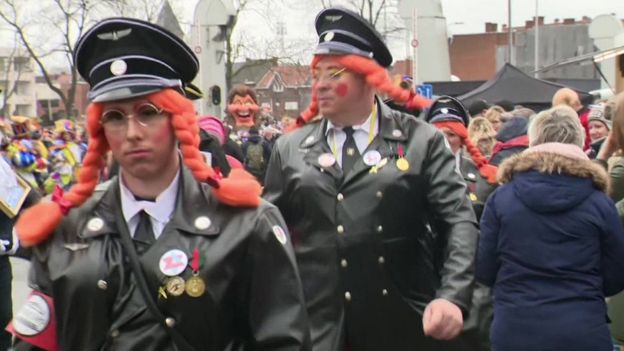
– despite the fact that, in World War Two, the Nazis deported about 25,000 Jews from occupied Belgium to the Auschwitz death camp, where most were murdered…In Sunday’s parade some caricature Jews posed with a mock-up of the Western Wall – often called Jerusalem’s Wailing Wall, a holy site for Jews. It was labelled “the wailing ant”, in Dutch “de klaugmier”. The Dutch for “wailing wall” is “klaagmuur”.
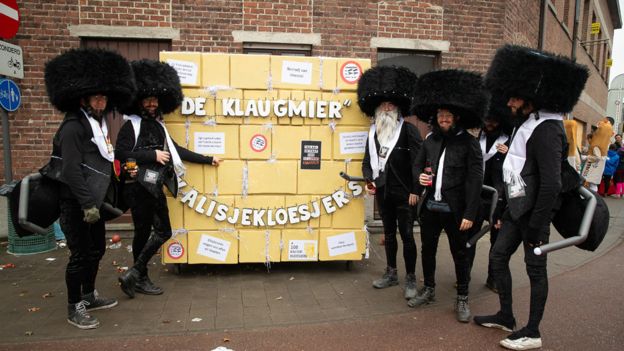
“This doesn’t encourage anti-Semitism; the reaction last year was over the top,” Mr Van den Bossche said. “Two hundred percent it’s not anti-Semitic.”
Continue reading

The Novelist Is Scared By Red Caps. What’s The Ethical Response To That?

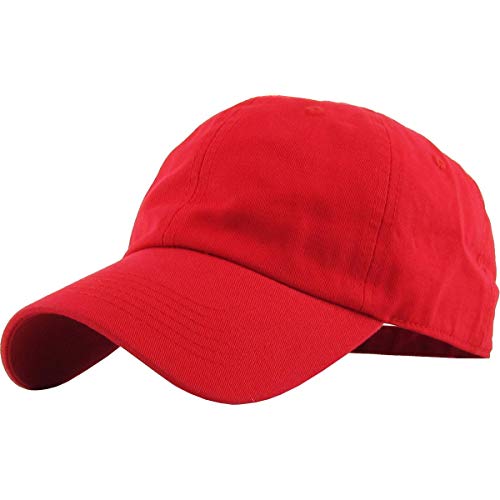
“AAAAAAAIIIIIII!!!! Take it away! TAKE IT AWAY!!!”

Rebecca Makkai, an American novelist of moderate success, tweeted,

Fascinating!  And her tweet raises some trenchant ethics questions:

1. How should good Americans regard someone who suggests that it isn’t normal to support the elected President of the United States?

Answer: As a bad American, as well as stunningly arrogant. The impulse is fascist: those who don’t agree with the political positions of Makkai and her ilk are not merely wrong, mistaken or misguided, but abnormal. It is particularly subversive to pronounce those who are behaving exactly as U.S. citizens have behaved and have been expected to behave since 1789 as not being normal, while Makkai, one of the divisive and destructive members of the “resistance” attempting to undermine the nation’s unity and institutions, pose as respectable.

2. Does an individual’s aversion to red caps because one variety carries a slogan deemed objectionable to the Trump Deranged qualify as a sensitivity anyone is obligated to observe in their choice of headgear? Continue reading

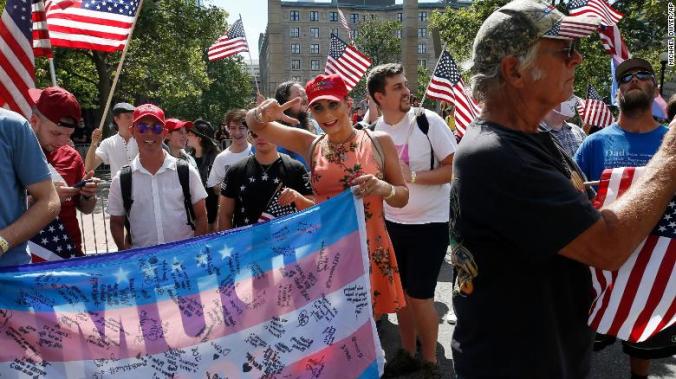
99% Of Protests Are Unethical, And Yesterday’s “Straight Pride Parade” In Boston Was A Perfect Example Of Why


As Buffalo Springfield noted in its 1966 hit “For What It’s Worth”…

What a field-day for the heat
A thousand people in the street
Singing songs and carrying signs
Mostly say, hooray for our side.

That pretty much sums up most demonstrations and protests, making them a destructive waste of time, emotion, and city budgets. In the Ethics Alarms Rule Book to your right (there is a lot of good stuff on your right, and I would estimate that almost no one bothers to check it out) is the 12 Question Protest Ethics Checklist. Studies say most people don’t click on links, either, so here is what you would find if you did:

Protesters, no matter what they are protesting, have an ethical duty to ask themselves these ten questions before they stop traffic, jam networks, take over buildings or otherwise make life miserable for people who have little or nothing to do with what is being protested:

1. Is this protest just and necessary?

2.Is the primary motive for the protest unclear, personal, selfish, too broad, or narrow?

3. Is the means of protest appropriate to the objective?

4. Is there a significant chance that it will achieve an ethical objective or contribute to doing so?

5. What will this protest cost, and who will have to pay the bill?

6. Will the individuals or organizations that are the targets of the protest also be the ones who will most powerfully feel its effects?

7. Will innocent people be adversely affected by this action? (If so, how many?)

8. Is there a significant possibility that anyone will be hurt or harmed? (if so, how seriously? How many people?)

9. Are you and your group prepared to take full responsibility for the consequences of the protest?

10. Would an objective person feel that the protest is fair, reasonable, and proportional to its goal?

11. What is the likelihood that the protest will be remembered as important, coherent, useful, effective and influential?

12. Could the same resources, energy and time be more productively used toward achieving the same goals, or better ones?

Protesters  or demonstrating groups seldom consider these questions, but if they did, they would have to answer the majority of them, and probably all in most cases, with a response that suggests that they should be doing something else. There have been a few exceptions in my lifetime—very few—but yesterday’s fiasco in Boston, my old stomping grounds, is sadly typical.

This dork…

…organized a “Straight Pride” parade in downtown Boston, the equivalent of trolling-by-demonstration. I get it: if Gay Pride parades are not considered anti-straight, then there is no reason why a Straight Pride parade should be considered as anti-LGBTQ.  If, however, one already knows that such a demonstration will be received as such (double standards being the order of the day)  then the Second Niggardly Principle applies… Continue reading

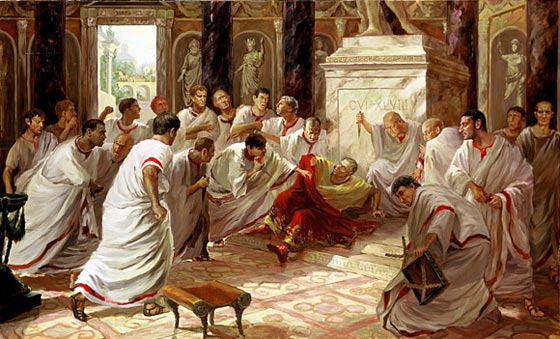
Comment Of The Day: “Ethics Observations On The ‘Shakespeare in the Park’ Trump As Julius Caesar Production”

It was a pleasure to see eloquent and thoughtful teacher/blogger Curmie back commenting after a hiatus, and his timing could not have been better, as the controversy over the nightly assassination of a Julius Caesar who appears to be President Trump’s twin has become even more relevant since an anti-Trump zealots started picking off Republican Congressmen with his rifle.

Curmie is a theater professional with keen perspective on artistic freedom and a proven facility with ethical analysis. Here is his Comment of the Day on the post, Ethics Observations On The “Shakespeare in the Park” Trump As “Julius Caesar” Production:

Not surprisingly, I suppose, I’ve been thinking a lot about this story lately—enough to post about it twice on my own blog. Not having seen the production, I can’t say for certain that it does or doesn’t do X or Y. But I wonder if what we’re dealing with here is a variation on the theme of the Second Niggardly Principle.

[Ethics Alarms note: “When an individual or group can accomplish its legitimate objectives without engaging in speech or conduct that will offend individuals whose basis for the supposed offense is emotional, mistaken or ignorant, but is not malicious and is based on well-established impulses of human nature, it is unethical to intentionally engage in such speech or conduct.”]

A couple of points first. Drama, especially in the West, has always been political. I would argue (although I suspect the majority of my fellow theatre historians would disagree) that the Dionysian Festival, generally regarded as the birthplace of formal theatre (although there was almost certainly theatrical activity of some kind before that) was created less to honor Dionysus—a rather obscure demi-god worshipped primarily in Asia Minor—than to consolidate the political power of the tyrant Peisistratus.

Whether or not this is the case, it is unquestionably true that the Dionysia was used as a site for political speeches (e.g., Pericles’ funeral oration), and that the plays themselves commented on contemporary events (e.g., the Oresteia on the reforms of Ephialtes three years earlier, or Oedipus Tyrannos on the plague). Old Comedy—the plays that would have been contemporaneous with the work of the great Athenian tragedians—was explicitly political, often vulgar, and uniformly iconoclastic. These comic critiques of the powerful were seen by the state as an important part of the cultural life, much as the Feast of Fools became a staple of the medieval calendar. Similarly, Americans knew we were going to be all right after 9/11 when David Letterman started telling Bush jokes again. Continue reading