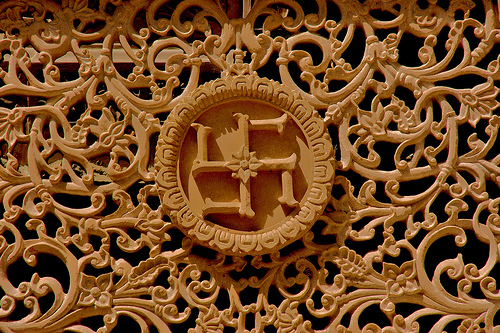
I was recently reminded about the origins of the Nazi swastika, ironically enough, during the Cincinnati funeral service of my dear friend, Georgetown classmate, lawyer and patriot Mitchell Dale, who died last summer. Looking down during a prayer, I was startled to see the Hindu version of the symbol in a mosaic imbedded in the church floor.
Oddly, the pastor and mourners weren’t arrested.
Yet last month, an unnamed Jewish student placed a small, bronze, Indian swastika on the bulletin board of his Jewish fraternity, Zeta Beta Tau, in the university’s International House. The building had recently been the target of an unidentified vandal who drew three swastikas on the walls. After posting the swastika, the student stayed close to the bulletin board, intending to discuss it and the previous vandalism with observers. He briefly stepped away, unfortunately for him, and during that period a member of the student’s fraternity saw the swastika and called GWU’s campus police. They filed a report and took the swastika as evidence. When the student found out the police had been called, he immediately came forward to authorities and said that he had posted the image to spark a conversation about the ancient symbol, cultural appropriation, messages, perception…as in what used to be called “education.” He said he did not intend to offend anyone, noting in doing so that this was an Indian swastika, not a Nazi one. He had just returned from studying religion in India, and said he became fascinated by the idea that a symbol that was not one of hate could become so defined by hate.
GWU suspended the student and evicted him from university housing pending the outcome of five disciplinary charges. The university also kicked him off campus, and referred the incident to the District of Columbia police for investigation as a potential “hate crime.” He could face expulsion.
Ethics observations:
1. FIRE, Freedom for Individual Rights in Education, is on the case. Thank you, FIRE. FIRE Program Officer and attorney Ari Cohn wrote,
“GWU may not ignore thousands of years of history and effectively forbid all uses of the swastika because it was used by Nazi Germany. It’s ironic that the charges against the student illustrate the very point he was trying to make in the first place—that context is important and there’s much to be learned about the history of the swastika.”
2. Now the Hindu American Foundation is protesting as well. This is the wonderful aspect of diversity, and a warning to institutions and diversity hounds that diversity must cut in all directions, or is a sham. It is discriminatory for a university to demonize and censor an aspect of a world religion’s symbology and culture. Do you think the administrators at GW sufficiently understood this, or just didn’t care, going with what they perceived as the most powerful interest group?
3. The George Washington fiasco comes in the wake of other colleges responding to anti-Semitic swastika vandalism, but that shouldn’t have mattered. Continue reading

 Ethics Alarms