Greedo Ethics

Who shot first?

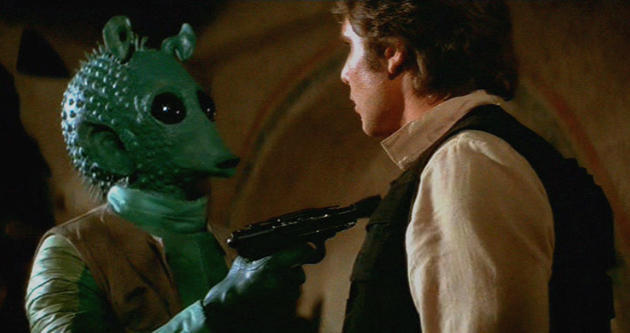
Jedi Emeritus George Lucas betrayed a warped concept of cowboy ethics, self-defense and ethics generally in a recent Hollywood Reporter interview in which he was quizzed about his technological fixes on the original Star Wars trilogy. The topic was the shooting of Greedo in the bar, when Han Solo blasts away at the green, fishy porcupine-like villain, who has a gun pointed at him:

Lucas: Well, it’s not a religious event. I hate to tell people that. It’s a movie, just a movie. The controversy over who shot first, Greedo or Han Solo, in Episode IV, what I did was try to clean up the confusion, but obviously it upset people because they wanted Solo [who seemed to be the one who shot first in the original] to be a cold-blooded killer, but he actually isn’t. It had been done in all close-ups and it was confusing about who did what to whom. I put a little wider shot in there that made it clear that Greedo is the one who shot first, but everyone wanted to think that Han shot first, because they wanted to think that he actually just gunned him down.

Lucas’s idea of what constitutes a “cold-blooded killer” runs counter to law, common sense, and ethics. Continue reading
Was Butch Cassidy a Sexual Harasser?

The story out of South Boston about a young student who fought off a bully’s school bus attack by kicking him in the groin and is now being investigated by the school for sexual harassment (inappropriate touching, don’t you know!) made me think of many things.

It made me think of the Chinese proverb that “When the only tool one has is a hammer, every problem looks like a nail.” And its longer version, which adds “especially if you are a school administrator….”. And the even longer version, which concludes with “who has the IQ of a gerbil and the judgment of Lindsay Lohan”.

It made me think about how the education profession might end the long reign of journalism as the Ethics Alarms “Most Unethical Profession” winner this year. That would be remarkable, since journalists have been especially vigorous in disgracing themselves in 2011, but education is certainly making a spirited year-end rally.

Mostly, however, it made me think of Butch Cassidy. Continue reading

“Walking Dead” Ethics

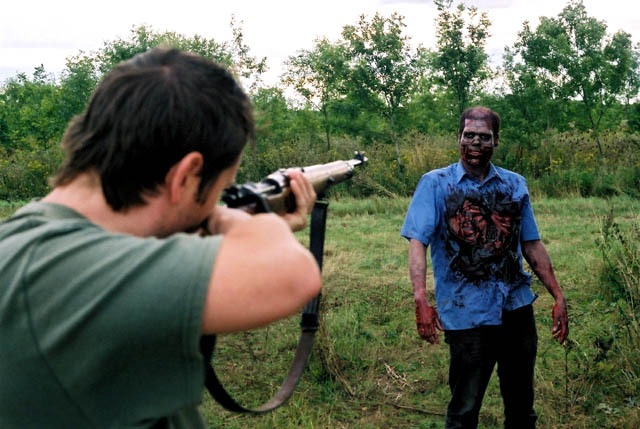
American Movie Classics’ excellent, if harrowing, zombie apocalypse drama “the Walking Dead” finally raised the ethical issue looming like a zombie Woolly Mammoth over all zombie films: Is it ethical to kill zombies? Are they still human beings?

Nobody seriously disputes that killing a zombie who is about to eat you or your compatriots is self-defense, justifying deadly force. But what about the common practice in every George Romero-inspired zombie epic: shooting the shambling things (or the sprinting variety, as featured in the re-make of “Dawn of the Dead”) on sight—in the head, naturally? Is it murder? Euthanasia?

The issue was raised in this Sunday’s episode of “The Walking Dead,” as it was revealed that the prickly doctor who presides over the remote farm where our zombie-fleeing heroes are currently taking refuge keeps a batch of captive “walkers,” including his rotting wife, locked in a barn. He feeds them chickens, which are presumably finger-lickin’ good. The doctor regards zombie killing as an atrocity, the equivalent of killing a sick person. “They are humans,” he says. Continue reading

A Cautionary Ethics Tale From Texas

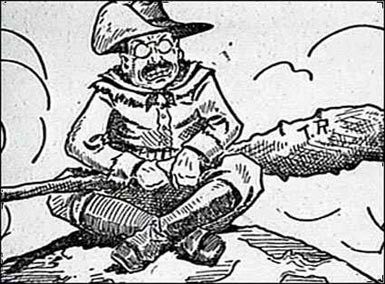
A Good Samaritan Teddy could relate to

In Texas, a 62-year-old man pulled over on the highway to help a couple whose truck had run out of gas. While he was assisting, the Good Samaritan apparently objected to the demeaning way the 31-year-old husband was addressing his wife, and said so. The husband then attacked the older man…who drew his concealed gun and shot him in the shoulder.

<sigh> Continue reading

American Lessons from the English Riots

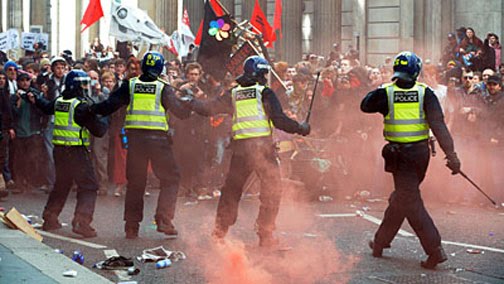
I am going to refrain from joining the ranks of amateur psychologists trying to identify the “root cause” of the English riots. People of any age or economic status who riot are, it is fair to say, assholes, like lesser social miscreants such as vandals, computer virus inventors, Leroy Fick and Pastor Terry Jones. If I were convinced that these riots were in response to necessary government cutbacks in social programs, I would have something arguably useful to say, but that doesn’t seem to be the case.

There is no question, however, that in allowing the riots to go on so long and harm so many citizens, businesses and homes, the British government has failed one of its most basic duties. Great Britain has been the anti-gun zealot’s Nirvana for a long time: not only can’t citizens own guns for their personal protection, neither can the police. That can work, if the culture is reliably non-violent, and if social and community institutions do a good job making sure that the culture of non-violence is strong, self-reenforced, and deep.

Well, it isn’t, is it?

Continue reading

“Seattle Cop Punches Girl In Face!” Ethical?

YouTube is a wonderful resource that enriches our entertainment, makes us laugh, holds people in the public eye accountable for their actions, and give us better access to current events than ever before. In the area of police conduct, it has exposed abuses that might have otherwise escaped scrutiny. It is also eventually going to get a police officer killed.

The viral video of a Seattle cop punching a teenaged girl in the face has been getting the Rodney King treatment from the broadcast media and the web, with the immediate assumption that his actions are per se proof of police brutality and excessive force. All the societal hot buttons are stacked against the cop: he punches a woman (“You don’t hit a girl!“); she’s a teen (It’s an adult beating a child!); she’s black, and he’s white (Racism!); the underlying offense that triggered the incident was as minor as you can get. (“Jaywalking?”) Predictable, the sensation-hunting news outlets and the usual knee-jerk critics of the police (the N.A.A.C.P. and the A.C.L.U.) have pounced. This is neither a fair nor a competent way to examine a complex incident. Continue reading