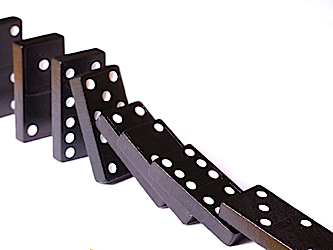
Blame the first domino, not the last one..
I generally revile Senate Majority Leader Harry Reid for his hyper-partisan leadership of the Senate, his unethical statements and his manner of conducting himself. Still, I am bound to take this rare opportunity to defend Sen. Reid, who is taking the brunt of criticism from both Democrats and Republicans for weakening the filibuster last week. True: he didn’t have to take this course, and I think it will probably, as the talking head shows Sunday seemed to agree, make the toxic and dysfunctional politics in Washington worse, not better. Reid, however, is not the primary one at fault. He was doing his job as he saw it, dealing with circumstances that are now beyond his control.
What led to the so-called “nuclear option” becoming reality was an unplanned convergence of Machiavellian politics, breaches of professional duty, dishonesty, irresponsible legislating, lack of statesmanship, unfairness, disrespect, bad luck, incompetent leadership, and most of all, a cycle of revenge that is now only likely to continue. Most of this was out of Harry Reid’s hands.
History shows that U.S. Presidents were once virtually always given the benefit of the doubt regarding judicial appointments to the federal courts, except in the rare cases of serious ethical questions or dubious qualifications. It was a good system, and the right system, and both parties followed it, realizing that the ideological mix in the courts was fluid and cyclical, and that today’s new conservative judge would eventually be offset by the appointee of the next liberal President, and vice versa. Democrats destroyed that tradition and accord on judicial appointments when in 1987, the Senate Democrats blocked President Reagan’s nomination of Robert Bork, who had been selected by President Reagan to fill a vacancy on the U.S. Supreme Court. Continue reading

 Ethics Alarms