
The Easy Ethics Verdict On Trump’s Middle East Immigration Suspension

immigration-protests

There are three steps to evaluating the ethical nature of any law or government action. The first is what was done. The second is how it was done. The third, and usually most difficult to assess, is why it was done, and whether the measure’s objectives are ethical, including whether the measure can reasonable be expected to accomplish them. . What President Trump’s controversial Executive Order temporarily halting immigration from seven Muslim nations is was covered in the previous post on the subject. Thanks to the fact that our mainstream journalists are incapable of reporting some news events without allowing their biases to distort or confuse the facts, the what was misrepresented to the public, and that misrepresentation is reflected in most discussions of the relevant issues on the web.

How the measure was implemented is an ethics  issue, as this involves competence, responsibility, accountability, diligence and leadership.

The Executive Order was incompetent and irresponsible.

There, that was easy.

It’s nice to be able to post an analysis here that nobody will disagree with. Usually I don’t even bother posting such verdicts.

The sudden order (you can read it here) caused world-wide confusion. Passengers were barred from flights to the United States. Customs and border control officials received notice and instructions in the wee hours of the morning, and many began work without knowing what they were supposed to do.  The order  blindsided Trump’s cabinet—what there is of it so far—including Homeland Security chief John Kelly and, incredibly, “Mad Dog”  Mattis, the new Secretary of Defense, who was not consulted by the White House during the preparation of the order and was not given an opportunity to provide input while the order was being drafted. Mattis did not see a final version of the order until a few hours before President Trump arrived to sign it at the Pentagon. Now he really has reason to be be mad. Continue reading

The New! Improved! Bipartisan! Gun Bill Is ALSO Unconstitutional…And The Statements Of The Senators About It Are Nauseating

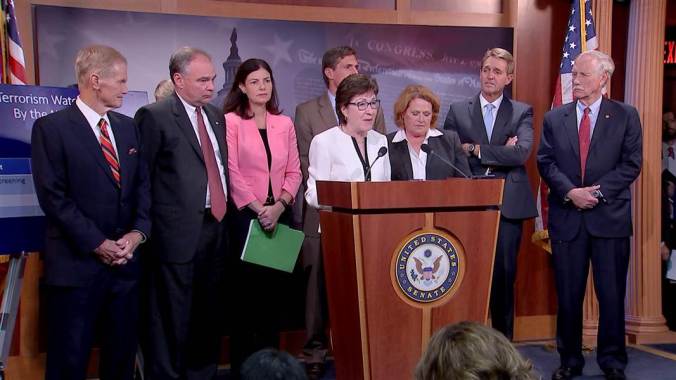
Collins et al

The New York Times, which apparently only respects that part of the Constitution that protects biased and dishonest newspapers, cheers a newly  proposed anti-gun measure as one that “puts new muscle and momentum behind what would be one of the few restrictions placed on gun ownership in the past 20 years.”

It also takes away the rights of citizens without due process of law.

The compromise bill, proposed by Senator Susan Collins (R-Maine) and backed by Senator Heidi Heitkamp (D-ND), was cooked up a day after the Senate, in the words of the Times, “refused to advance any of four measures intended to make it harder for suspected terrorists to buy guns.”

No, that’s U.S. citizens who have not been convicted of any crime, not “suspected terrorists.” It is not a crime to be suspected of anything. The government cannot take away your rights because it suspects something, or fears you might do something in the future.

Is that really such a difficult concept from elected officials and journalists? Why is that?

“Surely the terrorist attacks in San Bernardino and Orlando that took so many lives are a call for compromise, a plea for bipartisan action…Essentially, we believe if you are too dangerous to fly on an airplane, you are too dangerous to buy a gun,” Collins said in a news conference.

I call on my fellow citizens in Maine to remove this incompetent woman from her high office, for she is unfit to serve: Continue reading

The Washington Post—Finally—Admits The Truth About President Obama

fingers-pointing

I will reprint The Washington Post’s lead editorial here nearly in full. I will have comments after, though I will make this one now: every character trait and leadership deficit the Post points to  was evident to objective observers—like me—from the beginning of Obama’s administration. That one of the most consistent and prominent Democratic Party and liberal policy boosters in the national news media finally mounts the integrity, honesty and integrity to admit it now is not all that satisfying.

Here is, with a few omissions so you will link to the site and read the whole thing (it’s only fair), is the damning and undeniable editorial:

Charles E. Schumer (D-N.Y.) decided he would vote against President Obama’s nuclear deal with Iran, he explained his reasoning in a 1,700-word essay. On balance, he concluded, “the very real risk that Iran will not moderate and will, instead, use the agreement to pursue its nefarious goals is too great.” We disagree with that conclusion, but not with serene confidence; we share the senator’s concern that Iran will use the lifting of sanctions to intensify its toxic behavior in the region. We understand and respect Mr. Schumer’s decision; also, it’s generally better to treat policy disagreements in good faith.

That has not been the spirit in which Mr. Obama and his team have met his Iran-deal critics. The president has countered them with certitude and ad hominem attacks, the combined import of which is that there are no alternatives to his policy, that support for the deal is an obvious call and that nearly anyone who suggests otherwise is motivated by politics or ideology. Mr. Obama’s rhetoric reached its low point when he observed that the deal’s opponents value war over diplomacy and that Iranian extremists were “making common cause with the Republican caucus.”

Continue reading