This Question to the Ethicist Sends Me to the Wood-chipper

[That would be my foot sticking out. I’m sure my good neighbor Ted would be willing to get me through…or any one of the thousands of people I’ve infuriated over the years.]

You can read Kwame Anthony Appiah’s answer to the most discouraging question he’s ever been asked (my description, not his) if you like. Essentially “The Ethicist” says (I’m counting here), “No, no, no, no, no, no, no, no, no, and no!” As usual the New York Times “Ethicist ” is thorough, but he could have written his response in his sleep, as I could have, and if you’re reading an ethics blog, so could you.

Here’s the question, and hold on to your heads…

A close friend of many years whom I’ve always thought of as an extremely honest, ethical person recently confided in me that she shoplifts on a regular basis. She explained that she never steals from small or independently owned businesses, only from large companies, and only when no small business nearby carries the items she needs. She targets companies that are known to treat their employees badly, or that knowingly source their products from places where human rights are violated, or whose owners/C.E.O.s donate to ultraconservative, authoritarian-leaning candidates, etc.

My friend volunteers in her community and has worked her entire life for nonprofit antipoverty and human rights organizations. While she isn’t wealthy, she is able to afford the items she steals and believes that she is redistributing wealth; she says she keeps track of the value of what she’s stolen and donates an equal amount to charity. She thinks of her actions as civil disobedience and says she will accept the consequences if she’s caught.

When she told me, I thought, Stealing is wrong. But as we discussed it, I realized I was oversimplifying a complex moral issue. Is it wrong to steal food to feed your starving children? What if I stole a legally purchased gun from a person I knew was about to commit a mass shooting? Are those who bring office supplies home from their workplace also thieves? I find myself struggling with the question of whether an individual’s actions are morally defensible if they do more good than harm. — Name Withheld
Continue reading

Musings on Jesse Otero, the Human Broken Window

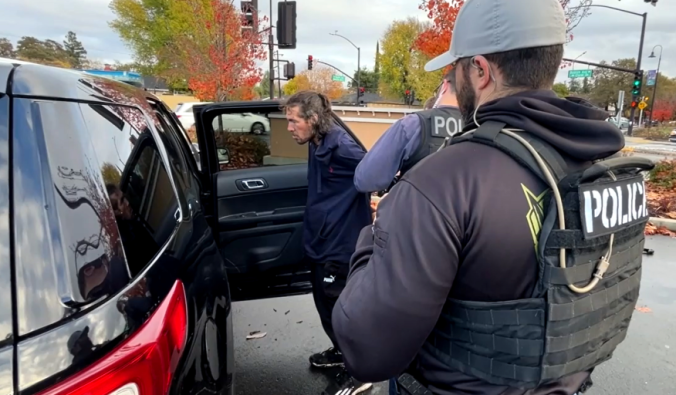
Jesse Leonardo Otero, 44, has been arrested 90 times for shoplifting in the Bay area of California, most recently this month. He is a drug addict, homeless, and supports himself by shoplifting and selling stolen property, often stealing from the same stores over and over again. He doesn’t discriminate, though, targeting small businesses, big-box stores, or whatever seems convenient at the time. He isn’t just lifting candy bars: when Jesse steals, it’s usually hundreds of dollars of merchandise at a time. Local police and store managers know him by name. The manager of Five Little Monkeys toy store in Albany, California, for example, says she has reported Otero to police more than 20 times. Jesse ranged far and wide in his shopping trips, and is an expert on the BART transit system, which he uses to hit stores at every stop.

Nobody has kept count of the number of days Jesse has spend in jail for his exploits, but it isn’t very many. The usual routine is that police give Otero a citation and release him. Sometimes, as with this month’s arrest, he is arrested and jailed for a short time, then let out of jail free, just like in Monopoly. All of this ridiculous pattern is due to California voters, in their wisdom, passing a law in 2014 that weakened penalties for everything Jesse does, like illicit drug use, vagrancy, petty theft, and shoplifting. Prosecutors now can’t file a felony shoplifting charge unless the items taken top $950 in value.

Multiply Jesse by several hundred (or thousands?) and you can understand why so many stores in California are experiencing ruinous shoplifting. Social justice warriors, advocates of “restorative justice” and those who regard the fact that a disproportionate number of those in prison are black as proof of systemic racism dispute the validity of the “Broken Windows” theory, but California’s experience is one more bit of significant evidence that the theory is sound.

Continue reading

Guest Column: Shoplifting Ethics

by Sarah B.

[Introduction: This excellent post by Sarah B, who has a history of them, posed a dilemma. It was originally posted in this week’s Open Forum, but the comment easily could have been a Comment of the Day on two recent posts, “Irony: The Washington Post Telling CVS How To Handle Rampant Shoplifting,” and “Technology Ethics Fail: Self-Checkout.”

In the end, I decided to publish it as a guest post, as Sarah herself told us up front what she was commenting on, writing, “This article, about a woman who wrote a piece for the newspaper anonymously about how and why she shoplifts, is worth discussing,” referring to “I’m a middle-class shoplifter – and here’s why I’m happy to confess it” in the UK’s Independent. Proving once again that valuable insights can be obtained from idiotic essays, Sarah’s post is far, far, FAR superior to the article that apparently spawned it. The explanation of “anonymous” about why she’s apparently “happy” about being a shoplifter was so devoid of either logic or ethics comprehension that it made my phantom hair hurt. Among her fatuous excuses and rationalizations were “It’s easy, so it’s the stores’ fault,” “I don’t even see it as shoplifting” (#64 on the rationalizations list, “It isn’t what it is”), “I’m owed it,” and #22, the worst rationalization of all, “It’s not the worst thing,” because she “would only do this in a supermarket chain, rather than any family-run small business.” People like the author make me want to chuck my business and profession and become a pimp or something. Why do I spend so much time on ethics when so many people think like this? Fortunately, Sarah had a different and more constructive reaction.JM.]

***

First, there is no doubt that her actions are unethical, and while we could just analyze this as a “name the rationalizations”, I also think that a deep dive into the article can show many things about our society and make for a good discussion. There are options for discussing how she doesn’t shoplift because she has to, but does it to decrease the prices of expensive alternatives instead of paying for what she wants. However, I want to look at how I think we could combat her “how-to guide”.

This seems to me to be a great case study in “locks keep an honest man honest.” The author admits that much of her stealing is predicated on the app-shopping and self-checkout philosophy of big stores. My main proposal, after looking at this, is to somehow return to the “good old days” of customer service.

Continue reading

Irony: The Washington Post Telling CVS How To Handle Rampant Shoplifting

…when it is the extreme anti-police, anti-law enforcement ideologues the Washington Post supports and slants the news to assist that are the reason shoplifting is out of control in D.C. and other cities.

The photo above that accompanies the laughable Post editorial shows the infamous CVS Pharmacy at 14th and Irving streets NW. There, in recent months, roving mobs of thieves have staged “smash and grab” mass raids resulting in the store having empty shelves and the local neighborhood having little access to needed supplies. “Shoplifters ransacked this CVS over two days early last month, and it hasn’t been restocked since,” the concerned editorial board wrote. “Weeks later, there’s still hardly anything to buy — or steal. The CVS at 14th and Irving symbolizes extreme retail theft and the harms it can engender. Distressing and inconvenient to ordinary people, threatening to businesses and livelihoods, and repellent to tourists, unchecked shoplifting can corrode a community’s spirit.”

The Post, which has never uttered a metaphorical “boo” regarding its woke, black Democratic mayor directing a huge, block letter “Black Lives Matter” message to be painted on a downtown street two years ago, is engaging in outrageous hypocrisy. “Black Lives Matter,” of course, means “Police Beware” and “Enforce the Law At Your Own Risk.” In related news, the Supreme Court today turned down Derek Chauvin’s last ditch appeal to get his unfair trial declared what it was; I’m assuming they don’t need the grief. They have to work in D.C. after all.

Continue reading

A Canary Dies In An Ethics Culture Mine, And It’s No Surprise That The Mine IS In The State Of Washington

In the city of Federal Way, Washington, Denise Yun is running for the City Council on a platform of protecting businesses from crime. Meanwhile, Nick Rose, a Federal Way Trinity Ace Hardware store owner, apparently caught her attempting to steal multiple hammers from his store by stuffing them into her purse.

Seeing her act suspiciously and spying the glint of something metallic in the woman’s jumbo purse, Rose asked if he could see what she had in there, to which Yun replied, “Absolutely not!” So he reached into her bag anyway, and pulled out one of his hammers. “It was one of my hammers that had a little ACE tag hanging on it. It was a ball peen hammer, so I just grabbed it. And as soon as that happened, she just stormed out of the store,” he said. Taking the rest of the hammers.

Continue reading

The Weenie Mandate

Elsewhere on Ethics Alarms are a few posts defending the decision by employers to fire employees who have physically intervened in attempted robberies, sometimes to the extent of capturing the thieves. Such individuals are usually hailed as heroes by the media and the public, and the stores that discipline them are assailed as heartless ingrates. The companies are on solid ground, ethically, legally and practically. Typically, there are policies in the employees handbook specifically laying out how robberies are to be handled. Physical intervention not only risks the would-be hero’s well-being, but the welfare of other employees as well. When a staffer’s amateur law-enforcement act goes well, it is still just moral luck.

Unfortunately, this sensible policy has had illicit relations with the “shoplifting should be a crime” mutants, and the result is one frightening deformed offspring. Thanks to woke brain rot seeping through San Francisco and other urban areas, viral videos show staff just standing by politely as people forage through store shelves, sometimes returning several times.

The woman above, Mary Ann Moreno, had worked at Circle K for 18 years. Moreno was behind the counter when Tyler Wimmer walked into the convenience store with a knife, and asked Mary if she would give him a pack of cigarettes for free. Moreno declined. When he grabbed a pack anyway, she instinctively reached out and touched him, then pulled away. Based on the surveillance tapes, the company fired her for violating the company’s “Don’t Chase or Confront Policy” regarding shoplifters and robbers. Moreno is now suing Circle K Stores Inc. Her attorney, Iris Halpern, said the footage clearly shows that Moreno acted in self-defense and made no real effort to stop or chase Wimmer. “Companies have not sufficiently thought through the nuance in these situations,” she says.

Continue reading

Comment Of The Day: “Dispatch From ‘The Great Stupid'”

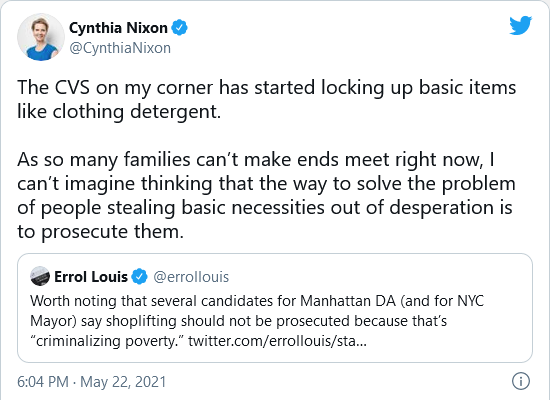
nixon-tweet

I had a long list of topics I wanted to write about today, but I have been rendered mostly unproductive due to some malady or another. Luckily, and not for the first time, readers have come through with content at least as valuable as anything I could have generated. I already have backlog from the last two Open Forums, and some delayed Comment of the Day as well. I am very grateful.

This Comment of the Day is another from the frequently history-minded (and often pessimistic) Steve-O-in-NJ, and his subject is the bad ideas, an evergreen topic, focusing on the tweet above, which is more representative of the current drift of progressive thought (it one is generous enough to call it that). Only one previous post had the “bad ideas” tag: this one, on “fertility equality.” I bet there are a hundred more that should have it, like anything about making Kamala Harris Vice-President.

Here’s Steve:

The U.S. and the world have hosted some pretty bad ideas over time.

The tulip bulb bubble, the ancient astronauts theory (remember “Chariots of the Gods?”), phrenology, New Coke, the XFL, and Boston selling Babe Ruth to the Yankees were some of the more benign ones. John Maxwell’s execution of the leaders of the Easter Rising, Mao’s Great Leap Forward, and the National Guard opening fire at Kent State were some of the ones that were not so harmless. The Reign of Terror, where the Committee on Public Safety sent who knows how many to the guillotine for any reason or no reason, Pol Pot’s Year Zero, in which towns, money, religion, and private property were abolished and execution by clubbing to death by a pick or a hoe, also for any reason or no reason,, Petrograd Order No. 1 (mostly now forgotten) which de facto stripped military officers of disciplinary authority, causing the Russian military to collapse like a deflated balloon in the face of renewed German offensives, and Hitler’s crackpot racial theories were examples of instant disasters.

Continue reading

Dispatch From “The Great Stupid”

Few revolting developments on the political scene justify the last words in “Bridge Over The River Kwai” more than this:

Nixon tweet

However, if such crack-brained reasoning ever progressed to widespread public policy, the iconic end of another film classic would be a better diagnosis. Take it, Marlon:

Criticism of Nixon’s insane tweet will be brushed off by progressives and Democrats (who, if honest, would own it) on the grounds that Nixon, who ran for mayor of New York not too long ago (though it seems like eons) is an uber-woke socialist, and therefore not representative of “real” progressives. There are two problems with that dodge, however. Several Democrat-run cities are barely enforcing laws against shoplifting as it is, notably Great Stupid Central, San Francisco (or is GSC Portland? Or Seattle?), where, reports the New York Times, shoplifting is out of control because law enforcement isn’t controlling it:

“The mundane crime of shoplifting has spun out of control in San Francisco, forcing some chain stores to close. Walgreens said that thefts at its stores in San Francisco were four times the chain’s national average, and that it had closed 17 stores, largely because the scale of thefts had made business untenable.”

Continue reading

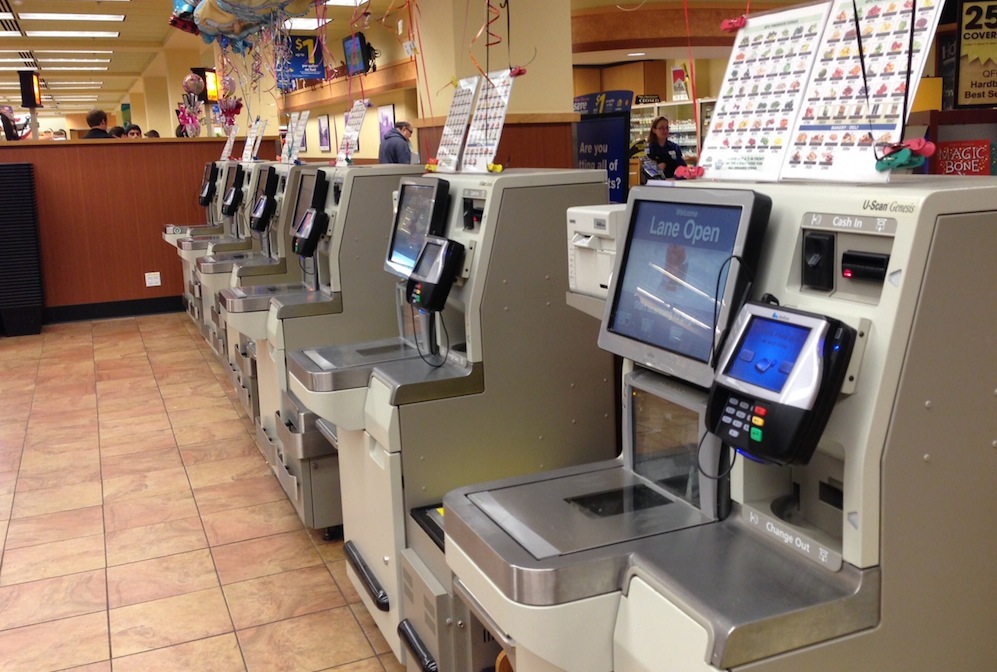
Self-Checkout Ethics

Self-Checkout-Loss

I am embarrassed to admit that this issue never occurred to me begore a friend sent me an article about it. Or maybe I should be proud.

Voucher Codes Pro is a company that offers coupons to internet shoppers. It surveyed 2,634 people, and almost 20% said they had cheated while using a grocery store self-checkout. Over half of the cheaters said they took advantage of the system because they realized being apprehended was unlikely. A 2015 study of self-checkouts with handheld scanners conducted at the University of Leicester audited a million self-checkout transactions over a year’s time.Out of $21 million in sales, goods worth nearly $850,000 left stores without being scanned and paid for.

How does this happen? There are several techniques:

  • Ringing up a T-bone ($13.99/lb) with a code for a cheap ($0.49/lb) variety of produce is known as “the banana trick.”
  • When a pricey item leaves the conveyor belt without being scanned, it’s “the pass around.”
  • Then there is “the switcheroo,” where you peel the sticker off something inexpensive and place it over the bar code of something pricey. You do have to make certain that the two items are about the same weight to avoid triggering the “unexpected item” alert on some machines.

“Anyone who pays for more than half of their stuff in self checkout is a total moron,” reads a comment in a Reddit discussion on the subject. Another one says, “There is NO MORAL ISSUE with stealing from a store that forces you to use self checkout, period. THEY ARE CHARGING YOU TO WORK AT THEIR STORE.”

I guess this would apply to gas stations too.

Continue reading

The War On Dollar Stores

The problem–well, one of them—with trying to control how other people choose to live their lives is that nobody’s smart enough to do it without making things worse. Still,a lot of sociologists and politicians think they are smart enough.

Oklahoma City, Tulsa, Fort Worth, Birmingham, and Georgia’s DeKalb County have passed restrictions on dollar stores, and other communities are debating whether to follow their example, where laws and zoning regulations limit how many of these small stores can open within a particular area. Other laws dictate what they can and can’t sell, most notably fresh food. You see, the antipathy to dollar stores is based on the narrative pushed by activists that they saturate poor neighborhoods with cheap, over-processed food, squeezing out other retailers and lowering the quality of nutrition in poor communities. An analyst for the Center for Science in the Public Interest makes the argument, “When you have so many dollar stores in one neighborhood, there’s no incentive for a full-service grocery store to come in.” Dollar stores, like Dollar Tree and Dollar General, the researchers say, make neighborhoods seem poor, and scare away better stores,  “locking in poverty rather than reducing it,” as one told the Washington Post.

Ah! Poor nutrition  is the fault of dollar stores!

Oops! Continue reading